
As you prepare to teach Doctrine and Covenants 77–80 in Sunday School this week, you’ll find a unique blend of prophecy, preparation, and personal responsibility. These sections touch on interpreting the book of Revelation, trusting the Lord in unfamiliar assignments, and the importance of serving wherever we’re called. To help you guide a meaningful and engaging class discussion, we’ve gathered a collection of thought-provoking questions, simple object lesson ideas, and personal sharing prompts. These teaching helps are designed to invite participation, deepen understanding, and help your class see how these scriptures apply to their lives today.
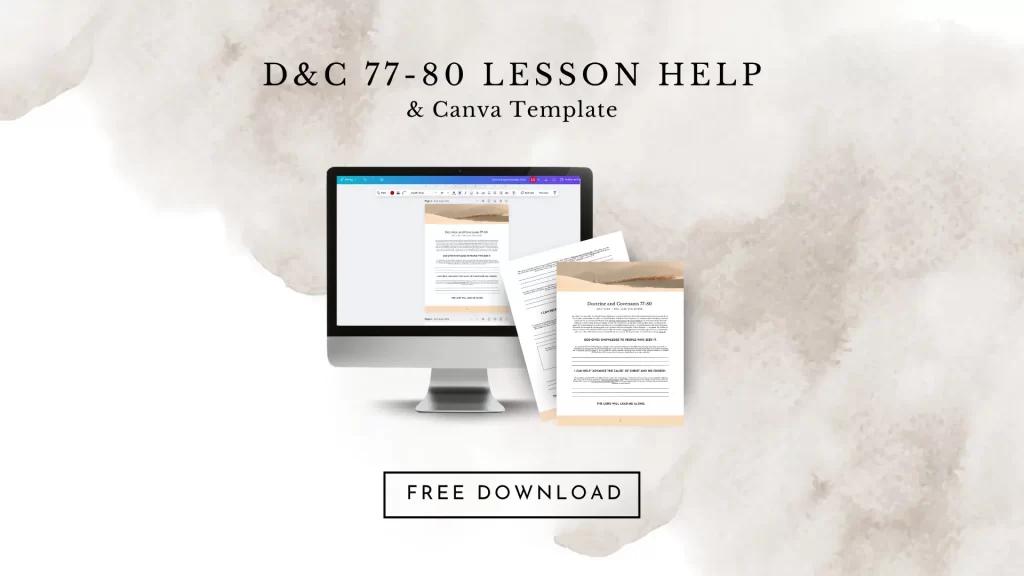
To download our free lesson help + customizable Canva Template, click here: https://otherthanamom.myflodesk.com/dc77-80
God gives knowledge to people who seek it.
Engaging Questions:
- What’s a time when you sincerely sought answers from God and received them?
- How do you usually seek spiritual knowledge—through scripture, prayer, conversations, or something else?
- Why do you think God doesn’t always give answers right away? What can we learn from waiting?
- What role does faith play in the process of seeking knowledge from God?
- How can you tell the difference between knowledge from the Spirit and your own thoughts?
- What’s one gospel question you’ve had that led you to study, ponder, and receive revelation?
- Why is it important to ask questions in our spiritual journey rather than avoid them?
- How can you create space in your life to better hear the answers God is trying to give you?
- What have you learned recently that you think came from God’s guidance?
- What advice would you give to someone who feels like they’re not getting answers to their prayers?
Object Lessons:
1. The Covered Object – Seek and Find
Materials:
- An object covered by a cloth (scriptures, flashlight, small treasure box)
Lesson Overview:
Show the covered item and ask if anyone knows what it is. Invite them to lift the cloth and discover it. Point out that God’s truths are often right in front of us—but we have to actively seek to uncover them.
Discussion Points:
- What helps us “lift the cloth” spiritually?
- Why is knowledge from God more valuable when we seek it?
2. The Locked Box
Materials:
- A small box with a lock and a key (or combination)
- A slip of paper inside that says, “Ask, and ye shall receive” (D&C 77:1 style)
Lesson Overview:
Explain that some truths are like treasures—they’re not handed out without effort. But God gives us the key (the Spirit, scriptures, prayer) to unlock them. When we seek with real intent, He opens truth to us.
Discussion Points:
- How do you “unlock” spiritual knowledge in your own life?
- What does it mean to “seek with real intent”?
3. The Dark Room & Flashlight
Materials:
- A flashlight and a darkened room or box
Lesson Overview:
In a dark room or covered box, place a message or symbol. Turn on the flashlight to reveal it. The darkness represents the world’s confusion; the flashlight represents God’s light and truth, which is given when we choose to seek Him.
Discussion Points:
- What sources of light help you find answers from God?
- How is spiritual light different from worldly knowledge?
4. The Empty Cup
Materials:
- A cup and a pitcher of water
Lesson Overview:
An upside-down cup cannot be filled. Turn it upright and pour water in. Teach that God cannot fill us with knowledge unless we are open and ready to receive it—humble, curious, and teachable.
Discussion Points:
- What can keep our “cup” turned upside down?
- How can we make ourselves more receptive to revelation?
5. The Puzzle Without the Picture
Materials:
- A puzzle, but hide the box lid showing the final image
Lesson Overview:
Have people try to put together the puzzle without knowing what it is. Then reveal the full picture. Explain that revelation gives us the bigger picture. We might not understand all pieces right away, but seeking God’s knowledge puts it into perspective.
Discussion Points:
- When has God helped you make sense of spiritual “puzzle pieces”?
- Why is patience often part of seeking knowledge?
6. The Scriptures as a Treasure Map
Materials:
- A scripture marked with a “treasure map” sticker or tag
- A small object labeled “truth” or “personal revelation”
Lesson Overview:
Explain that the scriptures are like a treasure map—when we search them sincerely, we find precious truth. Doctrine and Covenants 77 is a great example: Joseph asked questions while reading Revelation, and the Lord gave insight.
Discussion Points:
- What does your scripture study look like when you’re truly seeking?
- How can you better use the scriptures to find answers?
Personal Sharing Prompts:
- Think of a time when you sincerely asked God a question and received an answer. How did that answer come, and what did it teach you?
- Think of a time when a truth in the scriptures became clearer because you were searching for understanding. What helped you recognize the Lord’s guidance?
- Think of a time when you received insight during prayer or pondering. What did you learn about how God teaches us personally?
- Think of a time when your questions led you to deeper faith instead of doubt. How did seeking knowledge draw you closer to God?
- Think of a time when the Lord helped you understand something that once felt confusing. What changed in your heart or mind?
- Think of a time when you studied a topic or doctrine and received spiritual confirmation of its truth. How did that influence your testimony?
- Think of a time when a Church leader or teacher helped answer one of your spiritual questions. How did that experience build your trust in how God uses others to teach?
- Think of a time when you were inspired to ask a question you hadn’t considered before. What did the Spirit help you discover?
- Think of a time when you felt God was preparing your mind to receive revelation. What was the result?
- Think of a time when you realized that God truly wants to share His knowledge with you. What did that understanding do for your relationship with Him?
I can help “advance the cause” of Christ and His Church.
Engaging Questions:
- What does the phrase “advance the cause of Christ” mean to you personally?
- What talents or spiritual gifts do you feel you can use to help build up the Church?
- Have you ever felt the Spirit prompt you to do something small that had a big impact on someone else’s faith?
- What are some ways people your age can help move the Lord’s work forward?
- How can supporting your leaders or ministering to others help advance Christ’s cause?
- Why do you think the Lord calls ordinary people—like in D&C 80—to do extraordinary work?
- What gives you courage to stand up for your beliefs in your home, school, work, or community?
- How do your daily choices reflect your commitment to Jesus Christ’s mission?
- What are some “behind-the-scenes” or less visible ways you’ve seen others quietly serve and strengthen the Church?
- What’s one small thing you could do this week to help advance the cause of Christ?
Object Lessons:
1. The Domino Chain
Materials:
- A line of dominoes (or other stackable objects)
Lesson Overview:
Set up a line of dominoes. Let participants see how removing just one domino stops the whole chain. Then show how putting it back allows the chain to complete. Explain that each person matters in advancing the Lord’s work—your influence helps the movement go forward.
Discussion Points:
- What’s your role in the “chain” of the Church?
- How does your effort strengthen others?
2. The Body and Its Parts
Materials:
- Labels or cards with different body parts (hand, eye, foot, etc.)
Lesson Overview:
Hold up or assign body parts (based on 1 Corinthians 12). Each part serves a function—no one is unnecessary. Similarly, everyone in the Church has a unique and vital role in advancing Christ’s work.
Discussion Points:
- What talents or gifts do you have that help the Church move forward?
- How can we better support others in their roles?
3. The Candle Sharing the Flame
Materials:
- A candle (real or battery-operated)
- Several unlit candles
Lesson Overview:
Light one candle, then use it to light others. Emphasize that sharing your light doesn’t diminish yours—it multiplies it. As we share testimonies and serve, we expand the Lord’s light and help advance His cause.
Discussion Points:
- How can you “share your light” in simple ways?
- What does it look like when a ward or family is fully “lit”?
4. The Puzzle Piece
Materials:
- A jigsaw puzzle with one piece missing
Lesson Overview:
Show a mostly completed puzzle with a missing piece. Then fit in the final piece and explain: the work isn’t complete without every piece. Christ’s Church is built as each person steps into their place with faith and effort.
Discussion Points:
- What is your “piece” in building the kingdom of God?
- What happens when someone decides their part doesn’t matter?
5. The Relay Race
Materials:
- A baton (rolled-up paper works fine)
- Optional: volunteers to “run”
Lesson Overview:
Explain a relay race and how each person carries the baton for a time before passing it on. In the Church, we’ve been handed the baton by early Saints—and we’re now running our leg of the race to advance the cause of Christ.
Discussion Points:
- Who handed the gospel “baton” to you?
- What can you do this week to move it forward?
6. The Brick-by-Brick Build
Materials:
- LEGO bricks or wooden blocks
Lesson Overview:
Have individuals add bricks one by one to build a wall or tower. Each contribution may seem small, but together it becomes something strong and meaningful. Building Christ’s Church is a collective work, and every effort matters.
Discussion Points:
- What does “advancing the cause” look like in daily life?
- How can we support each other in building the kingdom?
Personal Sharing Prompts:
- Think of a time when you felt called or prompted to do something small that helped build the Lord’s Church. What did you learn from acting on that prompting?
- Think of a time when you shared your testimony and felt it strengthened someone else. How did that experience help you feel part of the Lord’s work?
- Think of a time when you served in a calling that felt like a sacred responsibility. How did you see the Lord’s hand in that service?
- Think of a time when you encouraged or supported someone else in their faith journey. How did that feel like advancing the Lord’s cause?
- Think of a time when you made a sacrifice to serve in the Church or help others come unto Christ. What blessings followed?
- Think of a time when you felt inspired to open your mouth and share something about the Savior. What helped you act in faith?
- Think of a time when you helped someone feel more welcome, included, or loved in a Church setting. What impact did that have?
- Think of a time when you felt joy in helping someone receive an ordinance or keep a covenant. How did that deepen your desire to serve?
- Think of a time when you felt the Holy Ghost confirm that your efforts were making a difference in the Lord’s work. What were the circumstances?
- Think of a time when you realized that your talents or life experiences could be used to bless others in the Church. How did you act on that realization?
The Lord will lead me along.
Engaging Questions:
- When have you felt that the Lord was leading you, even if you didn’t know where you were going?
- What does it mean to you to be “led along” instead of receiving every answer at once?
- How do you recognize the Lord’s guidance in your life? What signs or feelings help you know?
- Why do you think the Lord sometimes leads us step by step instead of showing the whole plan?
- What helps you trust the Lord’s timing when things feel uncertain?
- Can you think of a time when the Lord’s path for you looked different than what you expected—but turned out better?
- What scriptures, hymns, or people help you feel more confident in following the Lord’s direction?
- How can you help someone else feel that the Lord is leading them?
- What do you think it means when the Lord says, “I will lead you along” (D&C 78:18)?
- What’s one decision or goal you’re currently working on where you need the Lord’s guidance? How are you seeking it?
Object Lessons:
1. Blindfold & Guide
Materials:
- A blindfold
- A small obstacle course (or a path across the room)
Lesson Overview:
Have one person wear the blindfold while another gently guides them with verbal instructions or by the hand. The blindfolded person must trust the guide to avoid obstacles.
Discussion Points:
- What does it feel like to walk without seeing?
- How is this like trusting the Lord when you don’t know what’s ahead?
2. Flashlight in the Dark
Materials:
- A flashlight
- A darkened room or box
Lesson Overview:
Turn off the lights and turn on a flashlight. Point out that the flashlight only lights up a few steps ahead—not the whole room. Similarly, God often leads us step by step, not all at once.
Discussion Points:
- Why do you think God only shows us “a little at a time”?
- How have you seen the Lord’s guidance in your life?
3. GPS vs. Map Analogy
Materials:
- A GPS device or phone with a map app
- A paper map
Lesson Overview:
Show how a GPS gives real-time direction—even recalculating when we make a wrong turn. The Lord, through the Holy Ghost, adjusts our route and guides us lovingly, just like GPS.
Discussion Points:
- What happens when you ignore spiritual promptings?
- How does the Lord “recalculate” when we stray?
4. The Shepherd and the Sheep
Materials:
- Picture or toy of a shepherd and sheep
Lesson Overview:
Sheep don’t always know the way, but they follow the voice of the shepherd. Christ is our Good Shepherd, and He leads us to safety even when we don’t fully understand the path (John 10:27).
Discussion Points:
- How do you recognize the Lord’s voice in your life?
- What helps you follow when it’s hard?
5. The Compass
Materials:
- A compass
- Optional: a picture of a wilderness trail
Lesson Overview:
A compass always points north—a constant guide even when we’re unsure of the terrain. The Lord, through His Spirit and His word, is our spiritual compass, leading us when life feels uncertain.
Discussion Points:
- What are your “spiritual compass tools” (scripture, prayer, leaders)?
- How do you stay aligned with the Lord’s direction?
6. The Puzzle with Missing Pieces
Materials:
- A puzzle with several key pieces missing at first
Lesson Overview:
Start assembling the puzzle with missing pieces. Even though it’s incomplete, the picture begins to emerge. Add the pieces gradually, showing how the Lord reveals His plan piece by piece as we go forward in faith.
Discussion Points:
- How do you stay patient when you can’t see the full picture?
- What keeps you going in moments of uncertainty?
Personal Sharing Prompts:
- Think of a time when you didn’t know what to do next, but the Lord guided you step by step. How did you recognize His hand in your journey?
- Think of a time when a decision felt uncertain, but you moved forward with faith. How did the Lord confirm you were on the right path?
- Think of a time when a detour or delay ended up being part of the Lord’s direction. What did you learn about His timing?
- Think of a time when the Lord led you to help someone—maybe without even realizing it at first. How did that experience increase your trust in Him?
- Think of a time when personal revelation came slowly over time. How did you see the Lord leading you, even when answers weren’t immediate?
- Think of a time when the Lord helped you grow through a challenge you didn’t expect. What did you learn about His guidance and purposes?
- Think of a time when looking back helped you see that the Lord had been guiding you all along. How did that realization strengthen your testimony?
- Think of a time when the Lord used someone else to help lead or encourage you. How did He show you that you weren’t alone?
- Think of a time when the Lord led you to change direction, even when it was hard. What blessings followed?
- Think of a time when the Lord’s words—through scripture, a talk, or a prompting—felt like a direct invitation to keep going. What did you feel, and what did you do?
I can receive all things with thankfulness.
Engaging Questions:
- What’s something small in your life that you’re especially thankful for right now?
- Why do you think the Lord asks us to receive all things—including hard things—with thankfulness?
- How does gratitude change your attitude when you’re going through a tough time?
- Can you think of a trial or challenge that you’re now grateful for? What did it teach you?
- How can expressing gratitude invite the Spirit into your day?
- What’s the difference between being thankful for everything and being thankful in everything?
- How does showing gratitude help strengthen your faith in Jesus Christ?
- What are some creative ways you’ve seen people express their gratitude to God or others?
- Who in your life has taught you the most about being thankful, and how?
- How can keeping a gratitude journal or habit help you recognize the Lord’s hand more often?
Object Lessons:
1. The Thankful Jar
Materials:
- A jar and slips of paper
- Pens for writing
Lesson Overview:
Pass around slips of paper and invite everyone to write one thing they’re thankful for—even something hard or unexpected. Place them in the jar labeled “Gratitude = Glory.” Explain that when we receive all things with thankfulness, even our trials become part of our growth.
Discussion Points:
- How can we be thankful even in hard times?
- What blessings have come from difficult experiences?
2. The Wrapped “Ugly” Gift
Materials:
- A gift box wrapped in ugly or torn wrapping paper
- Inside: something meaningful or symbolic (a mirror, a small treat, or note with a scripture)
Lesson Overview:
Present the gift and ask if anyone wants to open it. People may hesitate due to its appearance. Then open it and show the valuable content. Teach that some blessings come in unexpected packaging, but gratitude helps us discover the hidden value.
Discussion Points:
- What “ugly packages” has God blessed you through?
- Why does thankfulness change how we see things?
3. Lemon and Sugar
Materials:
- A lemon, sugar, and water
- Optional: make a small batch of lemonade
Lesson Overview:
Taste the lemon (sour), then add sugar and water to make lemonade. Point out that life sometimes gives us “lemons,” but when we add faith and gratitude, we gain sweet perspective.
Discussion Points:
- What are some of your “lemons” in life?
- How can gratitude change the outcome?
4. The Gratitude Glasses
Materials:
- A pair of fun or symbolic glasses labeled “Gratitude”
- A few objects or pictures to view with and without the glasses
Lesson Overview:
Have someone wear the “gratitude glasses” while observing the same objects others see without them. Talk about how gratitude gives us a new perspective—we see blessings we otherwise might overlook.
Discussion Points:
- What’s something ordinary in your life that’s actually a blessing?
- How can we “put on” gratitude each day?
5. The Two Bags – Focus on What’s Inside
Materials:
- Two small bags: one decorated nicely with junk inside, one plain with a treasure (like a treat or kind note)
Lesson Overview:
Open both and ask: which one brought more value? The outward appearance didn’t matter—the contents did. Life’s situations might look undesirable, but thankfulness helps us recognize the true blessings they hold.
Discussion Points:
- What hidden blessings have you discovered with hindsight?
- How does being thankful change how we experience trials?
6. Gratitude Chain
Materials:
- Strips of paper in different colors
- Pens and tape or stapler
Lesson Overview:
Each person writes something they’re thankful for on a strip of paper and links them into a chain. As it grows, it shows how shared gratitude strengthens unity and joy.
Discussion Points:
- How can we help others see their blessings?
- What role does thankfulness play in our relationships and in the Church?
Personal Sharing Prompts:
- Think of a time when being thankful changed how you experienced a trial. What did gratitude help you see more clearly?
- Think of a time when you paused to recognize the Lord’s hand in small, everyday things. How did that deepen your gratitude?
- Think of a time when someone else’s example of thankfulness inspired you. How did their attitude affect your own?
- Think of a time when you felt grateful in a moment that didn’t seem like a blessing at first. What changed your perspective?
- Think of a time when expressing gratitude in prayer brought you peace. What did you feel, and how did it affect your faith?
- Think of a time when the Lord blessed you in an unexpected way. How did you recognize and receive that blessing with thankfulness?
- Think of a time when being thankful helped you see the Lord’s purpose in something difficult. How did that influence your actions?
- Think of a time when gratitude helped you overcome comparison, discouragement, or frustration. What did you choose to focus on instead?
- Think of a time when you wrote down or shared something you were thankful for and it changed your mood or mindset. What difference did it make?
- Think of a time when thankfulness helped you draw closer to the Savior. How did it shape your relationship with Him?
The call to serve God matters more than where I serve.
Engaging Questions:
- Have you ever wanted to serve in a specific place or role but ended up somewhere unexpected? What did you learn?
- Why do you think God cares more about our willingness to serve than the location or assignment?
- How can you find purpose in your current calling, job, or situation—even if it’s not what you hoped for?
- What does it mean to you to be “called of God”? How can that apply to everyday life, not just missions or church callings?
- When have you felt joy in serving, no matter the task or audience?
- How can focusing on who you serve, rather than where you serve, change your attitude?
- What advice would you give to someone who feels their service is small or unnoticed?
- What examples from scripture or people you know show the power of faithful service in unexpected places?
- How can we better support others in their unique assignments—even if they’re different from our own?
- What’s one way you can serve God more fully right where you are today?
Object Lessons:
1. Different Tools, Same Work
Materials:
- A variety of tools (e.g., spoon, ladle, measuring cup, spatula)
Lesson Overview:
Hold up different tools and ask: “Which one is more important?” Point out that each has a purpose in a kitchen, just as each person has a unique place in God’s work. What matters is that we’re all involved—not which “tool” we are.
Discussion Points:
- How can we honor our current assignment, even if it seems small?
- Why does God care more about our heart than our location?
2. Flashlights Facing Different Directions
Materials:
- Multiple flashlights
Lesson Overview:
Turn on the flashlights and have them shine in different directions. Emphasize: it doesn’t matter which way they’re pointed—what matters is that each one shines. Our service spreads light, no matter where it happens.
Discussion Points:
- What are ways you can “shine” where you’re currently planted?
- How does God use us in unexpected places?
3. The Orchestra Analogy
Materials:
- Picture of an orchestra, or objects that mimic instruments (e.g., spoon as baton, etc.)
Lesson Overview:
Explain that in an orchestra, not everyone plays the melody—but every part matters. In the Lord’s service, no calling or location is “small” when we give it our all.
Discussion Points:
- What happens if one part of the orchestra doesn’t show up?
- What can we learn from those who serve joyfully in quieter roles?
4. The Seed and the Soil
Materials:
- Small seeds, cups of dirt or pictures of various terrains
Lesson Overview:
Plant the same seed in different cups. Point out that the seed represents our willingness to serve, and the soil represents where we’re planted. The Lord can make us grow and bless others anywhere, as long as we are willing.
Discussion Points:
- How does attitude impact our ability to grow and bless others?
- Where has God planted you—and how are you growing?
5. Envelope with Blank Address
Materials:
- A sealed envelope with a message inside but no address
Lesson Overview:
Ask what’s missing. Then add: the envelope represents us—the letter is the message of the gospel, and the address doesn’t matter as long as we’re willing to be sent. The Lord can use us wherever we go.
Discussion Points:
- How can we be more open to serving wherever we’re needed?
- What helps us trust in the Lord’s assignments?
6. Puzzle Pieces in Different Corners
Materials:
- A jigsaw puzzle
Lesson Overview:
Have people place pieces in different corners of a puzzle. Point out that no matter where each piece is placed, it contributes to the bigger picture. Likewise, every place of service matters in God’s plan.
Discussion Points:
- How does this principle apply to callings at church or school?
- What does it mean to “go and do” even when you don’t know where?
Personal Sharing Prompts:
- Think of a time when you were asked to serve in a way that surprised you. How did you come to see the value in that assignment?
- Think of a time when you served in a small or unseen way and felt the Lord’s approval. What did that teach you about the nature of service?
- Think of a time when you hoped for a specific opportunity but were led to something different. How did you grow through that unexpected path?
- Think of a time when you saw that your willingness to serve was more important than the title or location. What did the Lord teach you through that experience?
- Think of a time when you saw someone serve with great faith in a humble role. How did that example influence how you viewed your own service?
- Think of a time when your assignment or role changed, but your desire to serve stayed strong. How did that consistency bless you and others?
- Think of a time when you didn’t feel qualified to serve, but the Lord helped you anyway. How did you feel His support?
- Think of a time when you realized that you were placed in the right place at the right time to bless someone. How did that strengthen your testimony?
- Think of a time when you focused more on who you were serving (the Lord and His children) than what you were doing. How did that shift change your experience?
- Think of a time when you felt joy in serving, no matter how ordinary the task seemed. What did you learn about God’s work?


Hi! I am wondering if you would create a file of each post. The questions and activities are great ideas! However, between the pop up ads and the length, it is difficult to read them all. I would love the same content in a printable form that I could take with me to my class. Thanks!
You should definitely check out our Lesson Help Vaults, all our posts are there ad-free and there are canva templates too!