Introduction: Teaching Sisters to “Look and Live”
This lesson help is designed to make your Relief Society preparation both deep and do-able. It:
- Separates Elder Christofferson’s message into clear discussion points (following his shifts in emphasis).
- Surfaces powerful direct quotes that anchor doctrine and spark meaningful conversation.
- Adds 10 engaging questions, 5 simple object lessons, and 10 personal sharing prompts for each section—so you can scale up or down depending on your time and class needs.
Use this outline to help sisters move from hearing to doing: lifting their eyes to God in sorrow and in safety, aligning daily choices with revealed standards, and experiencing the promised prosperity—defined as living in the Lord’s presence.

Grab our free bundle of 50+ Presentation Backgrounds by clicking here: https://otherthanamom.myflodesk.com/freebackgrounds
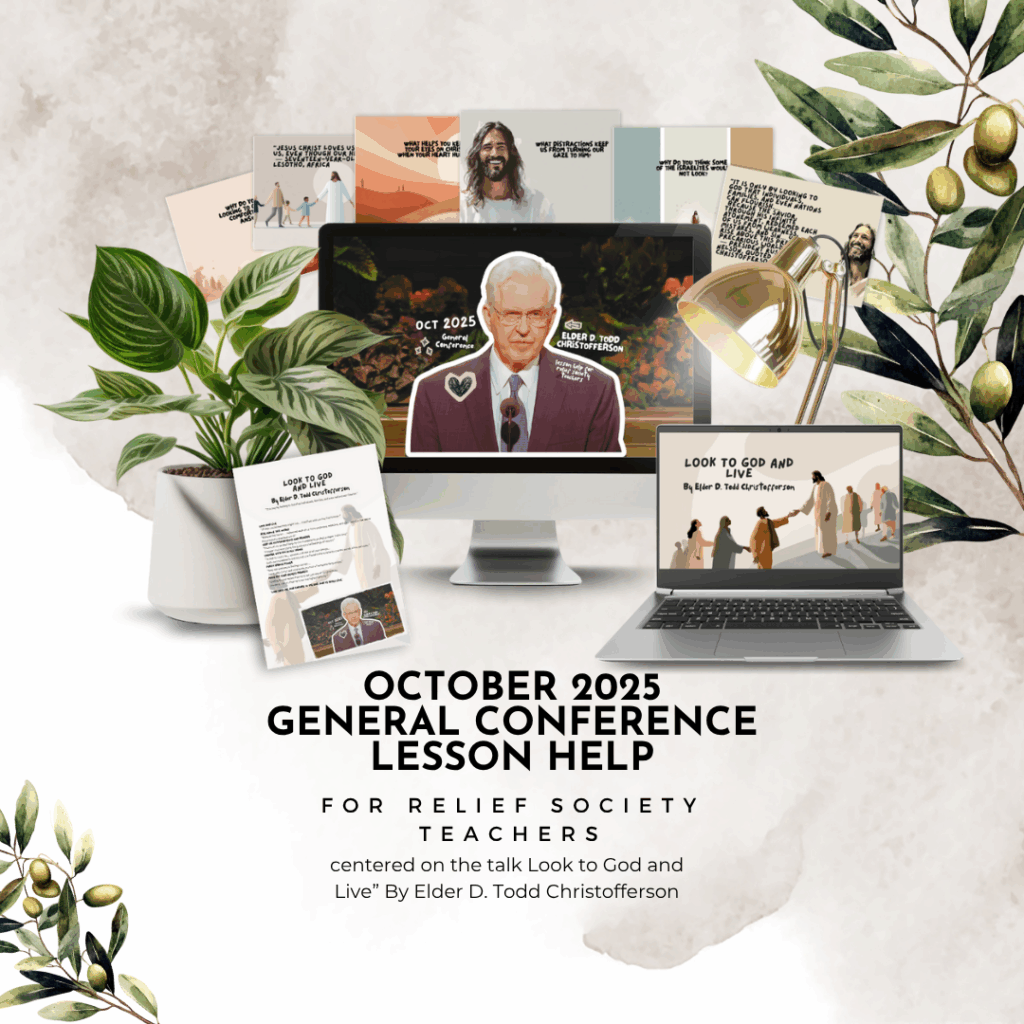
Interested in a done-for-you lesson plan with a teacher’s outline Google Doc, Canva Presentation Template, Lesson Handout Template, and themed presentation backgrounds? Click here: https://www.etsy.com/listing/4392269226/october-2025-general-conference-lesson?sr_prefetch=0&pf_from=shop_home&ref=shop_home_active_1&dd=1&logging_key=781a5fa7888ef1b6123393091cbd0732a885215e%3A4392269226
Section 1 — Lesotho: “Look to Him” in Tragedy
Key quotes to anchor your discussion
- “Seventeen-year-old survivor Setso’ana Selebeli testified, ‘Jesus Christ loves us and is with us, even though our hearts hurt.’”
- “Turn to the Lord, and find the strength to accept His will. Jesus Christ is ‘the author and finisher of our faith.’ Don’t look away, but look to Him.”
- “Look to Him. … ‘See that ye look to God and live.’”
Doctrinal emphasis: Looking to God is not theoretical; it sustains covenant people amid shock, grief, unanswered questions, and holy lament. The Spirit brings solace in song, scripture, and prayer while faith seeks understanding.
10 Engaging Discussion Questions
- What does “look to Him” sound like and feel like when hearts hurt?
- How do sacred music, scripture, and prayer each function differently as comfort?
- Why is it significant that those suffering in Lesotho were the ones bearing testimony?
- Where is the boundary between honest grief and losing our gaze on Christ?
- How can Relief Society create space for lament without losing hope?
- What truths do you hold on days when explanations don’t come?
- How does looking to God together (community) differ from doing it alone?
- What keeps us from looking to God in crisis (anger, guilt, numbness)?
- When has “accept His will” felt possible—what preceded it?
- What does “don’t look away” mean in your discipleship right now?
5 Object Lessons
- Flashlight in a Dark Box: Open the box and shine a single light—Christ’s light pierces grief’s enclosure.
- Compass vs. Whirlwind Jar: A jar of water spun to storm; a steady compass needle still points true—Christ orients even in chaos.
- Two Chairs (Alone/Together): Sit sisters in pairs to pray—comfort multiplies in covenant community.
- Weighted Blanket + Hymnbook: The blanket represents sorrow’s weight; hymns placed on top represent solace received while still carrying weight.
- Knot and Ribbon: A tight knot (questions) with a ribbon (faith) tied through—faith threads through, even before knots are undone.
10 Personal Sharing Prompts
- A time you felt seen by God while grieving.
- How a hymn carried you through a night season.
- A prayer that didn’t change circumstances but changed you.
- The scripture that became “daily bread” in loss.
- A moment you chose not to look away from Him.
- How the ward ministered in a way that felt like Christ Himself.
- What “accept His will” looked like in your family’s story.
- An unanswered question you can rest beside because of Jesus.
- How gratitude coexisted with grief for you.
- Who around you might need help to look up today?
Section 2 — Scriptural Types: Liahona and Brass Serpent
Key quotes to anchor your discussion
- “It is as easy to give heed to the word of Christ … as it was … to give heed to this compass.”
- “If they would look they might live. … And if we look we may live forever.”
- “Many did look and live, but others were ‘so hardened’ that they simply would not look and perished.”
- “Cast about your eyes and begin to believe in the Son of God … that He shall suffer and die … and rise again.”
Doctrinal emphasis: The Lord uses symbols to teach spiritual reflexes—heed the word (Liahona), look to the Healer (serpent on the pole). The saving act is simple but not shallow; hardness prevents simple obedience.
10 Engaging Discussion Questions
- What does “as easy to give heed” mean in a complex world?
- Why is “looking” to Christ both simple and resisted?
- What hardens hearts against simple remedies?
- How do we “cast about our eyes” today—practically?
- In what ways is the Book of Mormon your modern Liahona?
- How do ordinances teach us to look and live repeatedly?
- Where do you see counterfeit “poles” people are asked to look to?
- How can we help loved ones soften a hardened heart?
- What’s the relationship between belief in the Atonement and daily choices?
- How do you teach children/teens to “look quickly”?
5 Object Lessons
- Small Compass and Printed Scripture: Tape a verse to the compass—word + direction.
- Copper/Brass Rod on a Stand: A visual “pole”—invite silent reflection on where eyes go first in trouble.
- Sticky Notes on a Wall: “Where I look in stress”—replace with scriptures about Christ.
- Eye Chart: Lines of text getting smaller—train spiritual eyesight by focused daily looking.
- Timer for 10 Seconds: Hold up a cross/Christ image and invite 10 silent seconds of looking—notice heart shift.
10 Personal Sharing Prompts
- When a single verse reoriented your day.
- A moment of quick obedience that averted spiritual harm.
- How “looking” during sacrament changed your week.
- A time you chose the simple, saving step over the complicated one.
- What hardened your heart—and what softened it.
- How a child taught you to “look and live.”
- When the Book of Mormon pointed a straight course for you.
- A symbol (art, temple, ring) that helps you look.
- How you helped someone “cast about” their eyes to Christ.
- A small ritual you use to re-look during the day.
Section 3 — What “Prosper” Really Means
Key quotes to anchor your discussion
- “It is only by looking to God that individuals, families, and even nations can flourish.”
- “No promise is repeated more often … ‘If ye keep my commandments ye shall prosper … and if not … ye shall be cut off from my presence.**’”
- “‘Prosper’ meant … guidance and blessings … economic well-being … capacity to rise above hardship and trial.”
- “Through the grace of Christ, ‘all things work together for [their] good.’”
Doctrinal emphasis: Prosperity = presence. The promise is spiritual first, temporal second; flourishing is living under heaven’s guidance, not merely gaining wealth.
10 Engaging Discussion Questions
- How does redefining “prosper” change our goals?
- What evidences of the Lord’s presence count as prosperity in your life?
- How do we teach youth this definition amid consumer culture?
- What family practices invite “guidance and blessings”?
- How have you seen “work together for good” unfold over time?
- What happens to a community that measures prosperity as presence?
- How do commandments function as conduits of presence?
- Where do you see nations flourish or fail by this definition?
- What threats subtly cut us off from His presence?
- If prosperity is presence, what will you seek differently this month?
5 Object Lessons
- Two Ledgers: One ledger lists money; the other lists “presence moments” (prayer answered, prompting received). Which ledger are we keeping?
- Wi-Fi Router: Commandments are like staying in range—presence flows when connected.
- Plant with Light: A plant thriving under light vs. wilting in shade—flourish by presence.
- GPS Online/Offline: Online = guidance; offline = guessing—keep the covenant signal strong.
- Scale with Coins vs. Scriptures: Which side “weighs” prosperity rightly?
10 Personal Sharing Prompts
- When you felt unmistakably “in His presence.”
- A commandment that most clearly mediates His presence for you.
- A family habit that brings heaven’s guidance.
- How a financial setback still counted as prosperity.
- The “good” you only recognized years later.
- A national/community moment that showed heaven’s favor (or absence).
- How fasting or temple worship intersects with prosperity.
- A time you repented and felt presence return.
- A story where “prospering” enabled you to minister to others.
- What you’ll change to flourish by His presence, not appearances.
Section 4 — How to Look to God: Commandments, Counsel, and Standards
Key quotes to anchor your discussion
- “To look to God is to keep His commandments, cry unto Him continually … counsel with Him in all your doings, and let your heart be full of thanks day and night.”
- “‘The Family: A Proclamation to the World’ … and For the Strength of Youth … teach how to look to the Lord in making good decisions.”
- “Look unto me in every thought; doubt not, fear not.”
Doctrinal emphasis: The Lord defines looking: covenant keeping, prayerful dependence, counsel with heaven, and gratitude. Prophetic guides translate doctrine to daily decisions.
10 Engaging Discussion Questions
- Which of the four verbs (keep, cry, counsel, thank) stretches you most?
- How does counsel with God differ from informing Him of plans?
- What does gratitude “day and night” look like when life is heavy?
- How do FSY and the Family Proclamation help with gray areas?
- What practices help you “look … in every thought”?
- How do we stay out of extremes—rule-obsession vs. rule-avoidance?
- How can we teach standards as invitations to presence?
- What does “doubt not, fear not” mean in your current decision?
- How do you discern when a personal standard needs raising?
- How does counseling with God change timing, not just content?
5 Object Lessons
- 4-Corner Poster: Keep / Cry / Counsel / Thank—invite sisters to place sticky notes of lived examples in each corner.
- Decision Tree: Write a pending decision; trace two branches: “counsel with God” vs. “go it alone.”
- Gratitude Jar: Drop slips all week; notice presence awareness grow.
- Headlamp: “Every thought” illumination—truth lights next steps, not miles.
- User Manual: FSY booklet as a “manual” for body, media, choices—manufacturer’s guidance.
10 Personal Sharing Prompts
- A time counsel with God changed your plan.
- What “cry unto Him continually” looked like in one season.
- How night-and-day gratitude changed your atmosphere.
- A decision clarified by FSY principles or the Family Proclamation.
- How “doubt not, fear not” re-framed anxiety.
- The commandment that taught you to love the Commander.
- When a prophetic standard protected you before you saw danger.
- A tiny act of thanks that opened a big door.
- Your current question you’re taking to God.
- How you help youth see standards as covenant scaffolding.
Section 5 — Your Body Is Sacred: Chastity and Divine Power
Key quotes to anchor your discussion
- “Treat your body … with respect. … ‘Am I honoring my body as a sacred gift from God?’”
- “Keep sex and sexual feelings sacred. … Outside of marriage between a man and a woman, it is wrong to touch the private, sacred parts … even if clothed.”
- President Nelson: “Few things will complicate your life more quickly than violating this divine law. … Physical intimacy is only for a man and a woman who are married to each other.”
- “Public opinion is not the arbiter of truth. … ‘If you have been unchaste, I plead with you to repent.’”
Doctrinal emphasis: Chastity protects divine power and preserves testimony. Bodies and sexual feelings are sacred stewardship; repentance is real and promised.
10 Engaging Discussion Questions
- How does viewing the body as sacred change daily choices?
- What language helps us teach chastity without shame yet with clarity?
- Where does public opinion pressure show up most for you or youth?
- How can Relief Society be a refuge for those repenting?
- What does “keep sexual feelings sacred” look like in media choices?
- How does temple worship fortify sexual integrity?
- What practical boundaries honor bodies in dating/courtship?
- How do we hold standards and show mercy simultaneously?
- How has repentance healed what seemed unhealable?
- What does “public opinion is not the arbiter of truth” require of you?
5 Object Lessons
- Fine China vs. Paper Plate: Sacred use vs. casual use—value determines handling.
- Locked Safe: Power entrusted, protected by covenants.
- Water Purity Test: A drop of dye spreads—media contamination matters.
- Temple Picture and Doorkey: Worthiness opens access to greater light and power.
- Contract with Signature: Covenants are binding agreements with promised help.
10 Personal Sharing Prompts
- A boundary you’ve set that honors your body.
- How the temple helps you see yourself as God sees you.
- Teaching chastity with both love and truth in your home.
- A repentance story (your own or general) that brought hope.
- A media decision that protected your spirit.
- When public opinion clashed with revealed truth—and your choice.
- How a leader ministered well to someone struggling with chastity.
- What you say to a teen who feels “everyone does it.”
- How the sacrament renews sexual integrity commitments.
- A favorite scripture you’d give someone beginning to repent.
Section 6 — Presence vs. Cut Off: The Gift of the Holy Ghost
Key quotes to anchor your discussion
- “The opposite of prosperity was not poverty—it was being cut off from the presence of the Lord.”
- “He [the Holy Ghost] brings inspiration and guidance … and helps to avoid evil influences, poor decisions, and dead ends.”
- Story: a brother whose membership was withdrawn, who later repented—“he began to feel ever more keenly the absence of the Holy Spirit … and he missed it.”
Doctrinal emphasis: The decisive blessing of discipleship is companionship of the Spirit. Losing that presence is the true loss; repentance restores access to light.
10 Engaging Discussion Questions
- How do you recognize the Spirit’s everyday presence?
- What early warning signs signal loss of His influence?
- How do we help others hunger again for the Spirit?
- Where might we rationalize sin by pointing to others’ failings?
- What practices quickly restore spiritual sensitivity?
- How do ordinances (sacrament, temple) re-tune us to the Spirit?
- How can leaders counsel with love in discipline moments?
- What does “cut off” look like in a modern life?
- How do you testify of the Spirit without pressuring?
- What system in your ward invites returning members warmly?
5 Object Lessons
- Dimming Light Switch: Gradual loss of light through small choices.
- Phone on Airplane Mode: Messages stop coming—turn “airplane mode” off through repentance.
- Noise-Canceling Button: The Spirit’s voice is still—quiet the noise to hear.
- Battery Icon: Daily charge (scripture/prayer) vs. running on 1%.
- Map with Dead End: The Spirit helps avoid “dead ends.”
10 Personal Sharing Prompts
- A day you noticed the Spirit clearly guiding you.
- What cuts your signal fastest—and how you respond.
- A time you missed the Spirit and yearned to feel Him again.
- How sacrament specifically restores you.
- A leader who balanced truth and tenderness in correction.
- An impression you followed that averted a “dead end.”
- A season of returning—and what helped most.
- A hymn, temple moment, or scripture that re-tuned your heart.
- How you teach children to notice the Spirit.
- Your testimony of the difference between with/without His presence.
Section 7 — Don’t Look Beyond the Mark: God as Highest Priority
Key quotes to anchor your discussion
- “There seems to be no end to the different sources people look to … Most are ‘looking beyond the mark.’”
- “We need not be ‘children, tossed to and fro.’”
- “Looking to God means … He is our one highest priority.”
- Survivor’s witness: “Now He is the number-one priority in my life.”
Doctrinal emphasis: Covenant steadiness rejects trend-driven doctrine. Looking to God first orders all other priorities and identities beneath Him.
10 Engaging Discussion Questions
- What are today’s most convincing “beyond the mark” distractions?
- How do you discern helpful tools from false anchors?
- What practices keep you from being “tossed to and fro”?
- What changes when God is the single highest priority?
- How do you reorder good things (family, work, service) under God?
- What helps you maintain priority when costs rise?
- How can Relief Society culture reflect God-first living?
- How do you help a friend settle after spiritual whiplash?
- What one priority shift would bless your discipleship today?
- Which of Elder Christofferson’s warnings/assurances do you need most?
5 Object Lessons
- Target with Bullseye: Place “God” at center; other circles labeled family, work, hobbies—keep the bullseye.
- Rock/Sand Jar: Put big rock (God) first; everything else fits. Reverse order fails.
- Anchor and Sail: Trends (wind) vs. anchor (covenants).
- Filter Funnel: Scripture/prophetic filter before anything enters your mind/heart.
- Plumb Line: God’s truth stays vertical even when the room tilts.
10 Personal Sharing Prompts
- A priority realignment that restored peace.
- A time you discerned a teaching as “beyond the mark.”
- Your best God-first morning or evening ritual.
- What it cost—and blessed—to keep God first in one decision.
- How prophetic counsel steadied you recently.
- The scripture that is your current plumb line.
- A time you helped someone find center without controlling.
- How you keep “good things” from becoming “God things.”
- What “number-one priority” looks like in your calendar.
- Your testimony of the promise: “Look unto me … and ye shall live.”
Conclusion: Building a Relief Society That Looks and Lives
Elder Christofferson’s message is a clear covenant pattern for our day:
- Look to God in sorrow—He meets us with mercy, not explanations.
- Look to Christ’s types—heed His word; behold His healing.
- Prosper by presence—seek His Spirit more than success.
- Use revealed guides—commandments, counsel, FSY, and the Family Proclamation.
- Honor bodies and chastity—protect divine power; repent with hope.
- Prize the Holy Ghost—notice, nurture, and restore His companionship.
- Make God the highest priority—refuse to be tossed; stop looking beyond the mark.
This lesson help gives you sectioned quotes, substantive questions, tactile object lessons, and personal prompts to foster doctrinal clarity, spiritual safety, and courageous application. As sisters practice looking to God in every thought—especially when hearts hurt—they will live in His presence. And in His presence, they and their families will truly flourish.