Introduction: How to Use This Guide
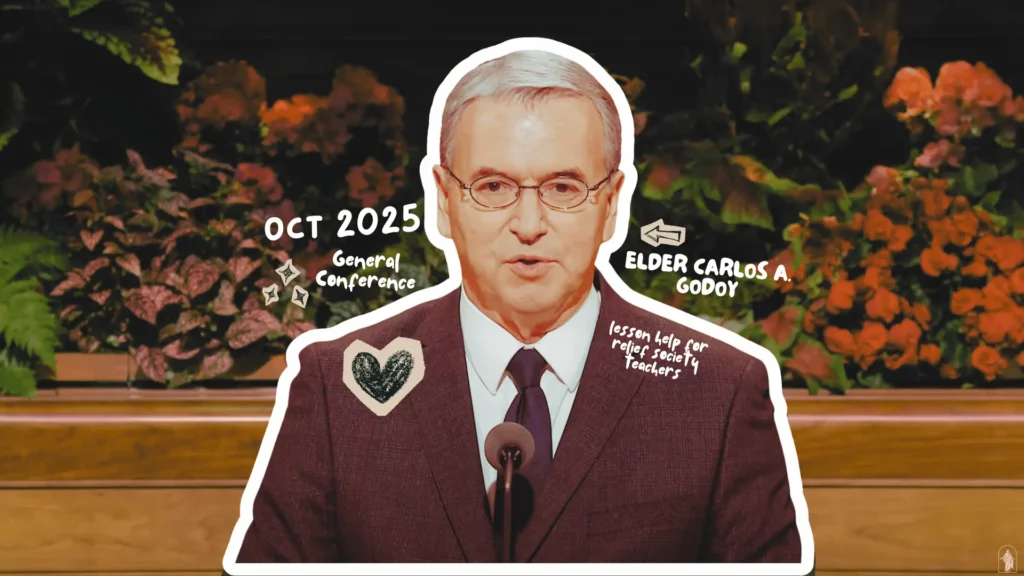
This lesson help follows Elder Godoy’s message in chronological order and separates the talk at each natural change of emphasis. Each section includes:
- Anchoring long quotes from the talk to ground doctrine and spark discussion (not a scatter of short snippets).
- 10 engaging questions to promote meaningful Relief Society dialogue.
- 5 quick object lessons (2–5 minutes each) to make principles tangible.
- 10 personal sharing prompts to invite lived experience and testimony.
Use one section for a single class—or spread sections across several weeks. Pair questions with object lessons and prompts as needed for your group.

Grab our free bundle of 50+ Presentation Backgrounds by clicking here: https://otherthanamom.myflodesk.com/freebackgrounds
Section 1 — Reassignment to Africa and First Impressions: A Flourishing Church Amid Modest Means
Anchoring Quote
“My new assignment took Monica and me to beautiful Africa, where the Church is flourishing. It has been a blessing to serve among the faithful Saints in the Africa South Area and witness the Lord’s love for them. It’s inspiring to see generational families of all backgrounds… dedicating their time and talents to serve others.
At the same time, given the region’s demographics, many people of modest means are joining the Church and transforming their lives through the blessings of tithing faithfulness and the educational opportunities offered by the Church. Programs such as Succeed in School, EnglishConnect, BYU–Pathway Worldwide, and the Perpetual Education Fund bless many lives, especially those of the rising generation.”
10 Engaging Questions
- What does it mean for a church to be “flourishing” where many members have modest means?
- How do tithing and education create spiritual and temporal transformation together?
- Which “time and talents” offerings do you see quietly strengthening your ward?
- Where have you seen the Lord’s love for a people or place through local leaders?
- What do these African examples teach about consecration vs. comfort?
- How might we better notice and support rising-generation learners in our ward?
- What blessings have you personally traced to tithing faithfulness?
- How do Church education programs act as ministering tools?
- Why does the Lord often plant flourishing faith in soil of scarcity?
- What could our Relief Society do this quarter that tangibly “flourishes” someone else?
5 Object Lessons
- Two Cups, One Source: One large pitcher (the Lord’s love) fills two cups labeled “Spiritual” and “Temporal.”
- Seeds and Sunlight: Seeds labeled “tithing,” “study,” “service” under a lamp—growth requires multiple inputs.
- Bridge Sketch: Draw a simple bridge labeled “Programs” spanning “Need” to “Opportunity.”
- Talent Tags: Hand out paper “talent tags” (time, skill, language) and invite sisters to place them in a shared basket of consecration.
- Flourishing Plant in Small Pot: Healthy plant thriving in a small container—growth in modest means.
10 Personal Sharing Prompts
- A time tithing unlocked unexpected help.
- A Church education resource that blessed you or someone you love.
- A leader who showed you the Lord’s love for your “place.”
- Offering time/talent rather than money and seeing miracles.
- Being “of modest means” and flourishing spiritually.
- A skill you consecrated to bless the ward.
- Helping a youth or new member pursue education.
- A family story of faith growing in scarcity.
- A way Relief Society “bridged” your need to opportunity.
- Where you feel prompted to plant consecrated effort next.
Section 2 — The Doctrine of Joy: “Smiling Faces and Grateful Hearts” Regardless of Circumstances
Anchoring Quote
“The greatness of our Saints in Africa becomes even more evident as they face life’s challenges and the demands of a growing Church. They always approach it with a positive attitude. They embody well the teaching from President Russell M. Nelson:
‘The joy we feel has little to do with the circumstances of our lives and everything to do with the focus of our lives.
When the focus of our lives is on God’s plan of salvation … and Jesus Christ and His gospel, we can feel joy regardless of what is happening—or not happening—in our lives.’They find joy despite their challenges. They have learned that our relationship with the Savior enables us to approach difficulties with smiling faces and grateful hearts.”
10 Engaging Questions
- What practices help you shift focus (not circumstances) to find joy?
- How do “smiling faces and grateful hearts” differ from denial or toxic positivity?
- What does it look like to keep the plan of salvation front and center weekly?
- Which gospel habits most quickly restore your focus on Christ?
- How does gratitude change the emotional climate of a home or quorum/class?
- What competing “focuses” most often steal your joy?
- How do we validate pain and still choose Christ-centered joy?
- When has “the demands of a growing Church” stretched you into deeper joy?
- What are your personal “joy anchors” (scriptures, ordinances, people)?
- How might Relief Society culture model grateful realism?
5 Object Lessons
- Camera Focus: Show a blurred photo, then refocus—same scene, different clarity.
- Joy Thermostat: Cardboard “thermostat” labeled “Focus on Christ” that sisters “turn up.”
- Two Lenses: One lens labeled “Circumstances,” one “Covenants”—look through both.
- Gratitude Stones: Pass small stones—each sister names one covenant-based gratitude.
- Plan of Salvation Ribbon: Unroll a ribbon path—place a small heart at “Christ.”
10 Personal Sharing Prompts
- A time joy returned without circumstances changing.
- Your go-to scripture that re-centers joy.
- A gratitude practice that felt authentic in grief.
- The ordinance that most resets your focus.
- One “joy thief” you’ve learned to disarm.
- A calling that stretched you into joy.
- Teaching children to choose joy without dismissing feelings.
- A hymn that turns your heart toward Christ.
- A recent “grateful heart” moment in a hard week.
- How Relief Society lifted your focus to Jesus.
Section 3 — Field Vignettes: Mozambique, Zambia, Malawi, Zimbabwe, Lesotho (Overflowing Faith, Sparse Resources)
Anchoring Quote (compiled narrative)
Mozambique: “More than 2,000 people filled the small chapel and three tents… The stake president is 31… leads this growing and challenging stake with no complaints—only a smiling face and a grateful heart. … The patriarch… gives ‘eight to ten’ blessings per week. … Along the road… people buying food late at night… ‘working during the day to eat tonight.’ The next morning… I was even more moved by their smiling faces and grateful hearts.”
Zambia: “A couple… with a baby and two small children… ‘45 minutes to an hour’ walk… every Sunday… with no complaints—only smiling faces and grateful hearts.”
Malawi: “Two branches using public schools… humble and modest conditions… They were happy to have a nearby place to gather… no complaints—only smiling faces and grateful hearts.”
Zimbabwe: “Sunday services held in a rented house… 240 people… 10 new members baptized that week… Some sitting outside, watching through windows and doors… no complaints—only smiling faces and grateful hearts.”
Lesotho: “A rented house… sacramental room overflowing… This was only half the membership… the other half would attend a second sacrament meeting… no complaints—only smiling faces and grateful hearts.”
10 Engaging Questions
- What do these scenes teach about worship as desire, not convenience?
- How does scarcity sharpen our sense of sacred?
- What does “no complaints” look like in our ward’s context?
- Where might our abundance dull devotion—and how can we counter that?
- How can we better honor young leaders stretched by growth?
- What do you notice about hunger (physical and spiritual) in these stories?
- How might we prepare to worship if our chapel were tents, classrooms, or homes?
- What policies or practices help overflow situations feel reverent and welcoming?
- Which vignette most moves you—and why?
- How do we teach our children that gathering is worth a long walk?
5 Object Lessons
- Empty Chair by the Door: Place a chair in a doorway to symbolize worship from “outside the windows.”
- Backpack Walk: Wear a light backpack and walk the perimeter of the room—feel a “one-hour walk” before sacrament.
- Paper Chapel/Tent: Fold paper into a small “chapel” and attach paper “tents” to show overflow.
- One Loaf, Many Slices: Slice a loaf thin to feed many—small resources, large love.
- Two Clocks: One set for “drive 5 minutes”; one for “walk 60 minutes”—ask how preparation changes.
10 Personal Sharing Prompts
- A time you worshiped in humble or makeshift spaces.
- What you’re willing to “walk” to keep sacred.
- Overflow moments that still felt holy.
- A leader who quietly carried a heavy load joyfully.
- A Sabbath sacrifice that deepened your reverence.
- Finding gratitude when logistics were hard.
- Teaching kids to love sacrament meeting.
- How you felt when your ward was “bursting at the seams.”
- The simplest chapel you’ve ever loved.
- One comfort you could surrender to gain more focus.
Section 4 — Resilience in Tragedy: The Lesotho Accident and a Young Disciple’s Witness
Anchoring Quote
“I returned to Lesotho later due to a fatal traffic accident involving several of our youth… I expected a somber atmosphere. Instead, I encountered strong and resilient Saints…
Mpho Aniciah Nku, 14, a surviving accident victim, said: ‘Trust in Jesus and always look unto Him, because through Him you’ll find peace, and He will help you in the healing process.’”
10 Engaging Questions
- What does resilient faith look like in the middle of grief?
- How do we avoid rushing one another’s healing while still choosing hope?
- Which practices help you “always look unto Him” in trauma’s aftermath?
- What can adults learn from youthful witnesses like Mpho?
- How do we help a ward mourn with those that mourn and worship with hope?
- What words/acts best communicate “we are with you” after loss?
- Where have you seen peace arrive before answers did?
- What role does sacrament worship play in communal healing?
- How might we prepare Relief Society to respond to sudden tragedy?
- What phrases from your covenants speak directly to grief?
5 Object Lessons
- Broken Pot, Mended with Gold (Kintsugi image or story): Beauty in repaired places.
- Weighted Blanket: Tangible comfort—“He will help you in the healing process.”
- Two Candles: One lit from the other—borrowed light in dark hours.
- Heartbeat Metronome: Set a metronome slowly—healing has a pace; let it be.
- Prayer Chain: Paper links; each link = a name/family to be prayed for.
10 Personal Sharing Prompts
- A moment when peace came without explanation.
- What helped you feel held by your ward after loss.
- Words you wish people would/ wouldn’t say in grief.
- A youth’s testimony that lifted you.
- How music or sacrament steadied you in sorrow.
- A scripture you clung to in the hospital/funeral/home.
- Choosing to look to Jesus when you had no strength.
- A small act of ministering that meant everything.
- How you honor those you’ve lost while living forward.
- What “healing process” looks like for you right now.
Section 5 — Why Christ Can Succor Us: Alma 7 and a Living Apostle’s Witness
Anchoring Quote
“Why can the Savior succor them and us in any circumstances of our lives? …
‘And he shall go forth, suffering pains and afflictions and temptations of every kind. …
And he will take upon him their infirmities, that his bowels may be filled with mercy… that he may know how to succor his people according to their infirmities.’As Elder David A. Bednar taught… ‘No human being, perhaps, knows. But the Son of God perfectly knows and understands… because He felt and bore our burdens before we ever did.’”
10 Engaging Questions
- What aspect of Alma 7 most expands your trust in Christ’s succor?
- How does “before we ever did” change your prayers?
- What does it mean for Jesus to know how to succor you uniquely?
- Where have you experienced tailored, not generic, comfort?
- How do ordinances deliver that succor into real time?
- What keeps you from asking boldly for the help He already knows you need?
- How do we teach children about a Savior who feels with them?
- Where do you most need to trade self-sufficiency for Christ-sufficiency?
- How can Relief Society be a conduit (not a substitute) for His succor?
- Which words—pains, infirmities, temptations—feel most relevant to you now?
5 Object Lessons
- Fitted Key: A key labeled “Succor” opening a lock—tailored help.
- Custom-Fit Bandage: Cut a bandage to fit a knuckle—specific, not generic care.
- Name Card in Savior’s Hands (image): He knows you by name and need.
- Weighted and Shared: Hold a weight; a partner helps—“yoke” the burden.
- Before/After Timeline: Mark “His Atonement” before your trial on a line.
10 Personal Sharing Prompts
- A time Jesus’ help felt custom-fit.
- The prayer you finally dared to pray.
- How an ordinance delivered strength.
- A burden lifted through yoking with Christ.
- Teaching a child to seek the Savior’s succor.
- A moment Elder Bednar’s teaching rang true in your life.
- Temptation He helped you bear or escape.
- An infirmity He met with mercy.
- Trading pride for petition.
- A scripture you now read as your invitation to be succored.
Section 6 — The Lord’s Yoke: Rest, Meekness, and Light Burdens
Anchoring Quote
“I conclude with my testimony of Christ’s words found in Matthew 11:
‘Come unto me, all ye that labour and are heavy laden, and I will give you rest.
Take my yoke upon you, and learn of me; for I am meek and lowly in heart: and ye shall find rest unto your souls.
For my yoke is easy, and my burden is light.’Just like those Saints in Africa, I know this promise is true. It is true there, and it’s true everywhere.”
10 Engaging Questions
- Where do you most need rest right now—and what does “coming” look like?
- What changes when we picture a double yoke with Christ at our side?
- How does meekness make burdens lighter?
- What does it mean to “learn of” Jesus in the middle of heavy labor?
- Which burdens does He lift by removing, and which by strengthening you?
- How do you discern when to drop a burden vs. yoke it with Him?
- What practices turn Sabbath into soul-rest?
- Where has His yoke felt surprisingly “easy” after you submitted?
- How do we help each other accept help from the Lord and from people?
- What single step of “coming unto Him” will you take this week?
5 Object Lessons
- Two-Person Yoke (rope between two people): Feel the difference of shared weight.
- Backpack Transfer: Move items from your bag into a second bag (Christ’s side).
- Rest Chair: A simple chair placed near the pulpit—visual invitation to “sit and find rest.”
- Load Balance Scale: Add weights to both sides; re-balance by shifting to Christ’s side.
- Meek Soil: Show soft tilled soil vs. hard ground—meekness lets seeds (help) sink in.
10 Personal Sharing Prompts
- The moment you felt soul-rest for the first time in a long time.
- A burden that became lighter when you let the Savior in.
- Learning meekness from Jesus in a hard relationship.
- Submitting to His way and finding it easier than yours.
- A Sabbath that truly restored you—and why.
- Asking for help without shame.
- A hymn or verse from Matthew 11 that became yours.
- Dropping a burden you weren’t asked to carry.
- Seeing His hand in tiny easings, not just big rescues.
- Your weekly “one step closer” plan to come unto Him.
Conclusion: Why This Lesson Format Strengthens Relief Society
- Chronological sections keep the conversation anchored in the prophet’s flow—from flourishing faith, to doctrine of joy, to lived vignettes, to Christ’s succor and yoke.
- Long anchoring quotes let the Spirit teach through the living Apostle’s words.
- Engaging questions move sisters beyond summary into discipleship decisions.
- Object lessons make truth visible and memorable in minutes.
- Personal prompts open space for testimony, covenant commitment, and communal healing.
As you teach, expect the Spirit to knit hearts across circumstances. The African Saints’ witness—smiling faces and grateful hearts—is not cultural optimism; it is covenant focus on Jesus Christ. That same focus can flourish here, in our ward, this week, as we consecrate our time and talents, look to the Savior for succor, and accept His gentle yoke that makes every faithful burden light.