Introduction: Why “the One” Matters Right Now
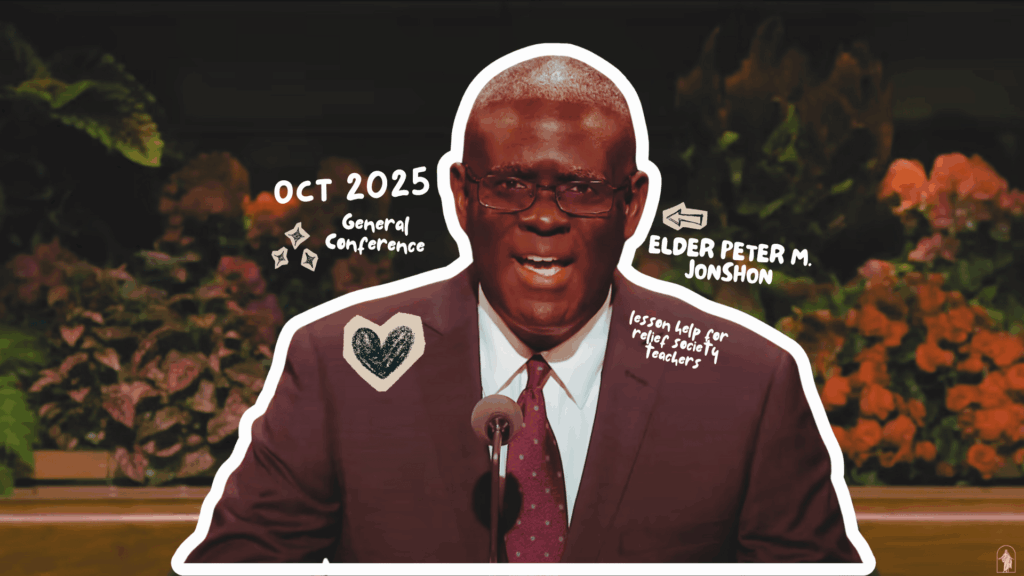
Elder Peter M. Johnson teaches that ministering to the one—with compassion, patience, and love without judgment—is the Lord’s way to form devoted disciples and lead hearts to the temple. This lesson help is designed to make your Relief Society preparation thorough and Spirit-led. It separates the talk into clear discussion points (following the speaker’s shifts), highlights powerful direct quotes to anchor doctrine, and provides rich teaching tools: engaging questions, simple object lessons, and personal sharing prompts. Use it to create an atmosphere of safety, testimony, and action—so sisters leave knowing who their “one” is and how to help her come unto Christ and worship in the house of the Lord.

Grab our free bundle of 50+ Presentation Backgrounds by clicking here: https://otherthanamom.myflodesk.com/freebackgrounds
Section 1 — “Now Is the Time”: Temple-Centered Discipleship
“Now is the time for you and for me to prepare for the Second Coming of our Lord and Savior, Jesus the Christ. Now is the time for us to make our discipleship our highest priority.” — President Russell M. Nelson
“Regular worship in the temple will help us. In the house of the Lord, we focus on Jesus Christ. … We come to know Him. … Every sincere seeker of Jesus Christ will find Him in the temple.”
Key Idea: Temple worship is President Nelson’s prophetic answer to a world of “dizzying distractions.” Temple patterns center us on Christ and move us to minister like He does.
10 Engaging Discussion Questions
- What does it look like in real life to make discipleship our “highest priority” this year?
- Why is the temple President Nelson’s answer to distractions?
- How does temple worship sharpen our discernment about who our “one” might be?
- In what ways does the temple help us “come to know Him,” not just know about Him?
- What distractors most challenge temple-centered living in your season of life?
- What changes in schedule or habits would actually put the temple first?
- How can Relief Society practically support more consistent temple attendance?
- When has a temple visit clarified a ministering nudge for you?
- How does covenant memory (remembering covenants) fuel courageous ministering?
- Which words from President Nelson in this section feel especially timely to you?
5 Object Lessons
- Compass vs. Clock: Hold a compass and a clock. The clock shows busyness; the compass shows direction. The temple is our compass.
- Noise-Canceling Headphones: The temple “cancels” noise so revelation can be heard.
- Temple Recommend in a Frame: Visual of identity and priority—who we are, where we’re going.
- Lens Cleaner and Glasses: The temple cleans our lens to see people the way the Lord sees them.
- Covenant Rope: A cord labeled “covenants”—what we hold to when life pulls.
10 Personal Sharing Prompts
- Share a time the temple cut through life’s noise for you.
- How has a specific ordinance anchored you during uncertainty?
- What did “putting the temple first” require you to sacrifice—and what came of it?
- Tell about a person who came to mind in the temple and how you ministered.
- When did temple worship help you forgive or be forgiven?
- How have covenants helped you feel known by the Lord?
- A moment in the temple you “came to know Him” more personally.
- A habit shift that made temple worship more consistent.
- How has the temple helped you identify your “one”?
- How does temple worship change how you hear the prophet?
Section 2 — Ministering to the One: What It Is and Where It Leads
“We minister to the one. Ministering in the Savior’s way involves compassion, kindness, patience, and love without judgment.”
“As we minister to the one, we invite the one to come unto Christ and to worship in the house of the Lord to receive of His redeeming power.”
Key Idea: Ministering is not the finish line; it’s the pathway to the temple. We love without judgment and gently point toward covenants and the Savior’s power.
10 Engaging Discussion Questions
- How would you explain “love without judgment” vs. “love without standards”?
- Why is the temple the natural destination of true ministering?
- What makes compassion and patience spiritually powerful, not just “nice”?
- How do we honor agency while still inviting to ordinances?
- Where is the line between rescuing and respecting growth pace?
- What practical steps turn a visit into a covenant-pointing visit?
- Which phrases or actions feel non-judgmental but still invitational?
- How do we minister when we can’t fix the problem?
- How do we keep ministering assignments from becoming checklists?
- What “house of the Lord” invitations have felt natural to you?
5 Object Lessons
- Bridge Model: Ministering is a bridge from isolation to covenant belonging.
- Two Arrows: One arrow “comfort,” one arrow “invite.” Both are needed.
- Warm Blanket & Map: Comfort (blanket) plus direction (map to the temple).
- First-Aid Kit: We dress wounds, but the Great Physician heals—at the altar.
- Doorway Photo: Our words are the threshold; the ordinances are inside.
10 Personal Sharing Prompts
- A time you felt “loved without judgment.”
- When someone’s patience kept you connected to the Savior.
- A ministering moment that naturally led to the temple.
- A time you honored pace and still kept inviting.
- A specific phrase that helped an invitation feel safe.
- How you navigate “I don’t want to push” vs. “I don’t want to be silent.”
- A time you watched the Lord heal where you could only love.
- An experience where small kindness unlocked a big conversation.
- What you’ve learned about the dignity of the one.
- A time your own “one” was actually you.
Section 3 — The Samaritan Woman: Loved, Seen, and Sent
“And yet, she was one of the first to whom Jesus Christ declared He was the Messiah. To Him, this woman was a daughter of God.”
“Whosoever drinketh of the water that I shall give … shall never thirst.”
“She returned to the city and invited others to come and see.”
Key Idea: Christ meets people at their well—in their shame or isolation—with living water, identity, and mission.
10 Engaging Discussion Questions
- Why do you think the Savior revealed Himself so plainly to her?
- What does it mean to meet people “at their well” today?
- How can we avoid imposing narratives on people we barely know?
- Why is identity (“daughter of God”) crucial before behavior change?
- What does “living water” look like in our ministering invitations?
- How do we help someone move from receiving to sharing?
- How do we minister when the past is complicated and public?
- What helps people who feel they “don’t belong” try again?
- How can we turn gossiping ground into holy ground?
- What converts a private encounter into a public witness?
5 Object Lessons
- Cup and Fountain: A small cup filled continually from a source: Christ never runs dry.
- Well Rope: How we lower compassion down into someone’s deep place.
- Door Sign “Come and See”: Ministering + invitation = discipleship.
- Map Pin at “Noon”: He meets us at our hottest, hardest hour.
- Name Tag “Daughter of God”: Identity precedes and empowers change.
10 Personal Sharing Prompts
- A time you felt truly “seen” by the Lord.
- What your “well” season looked like—and who met you there.
- How living water came through a person, scripture, or ordinance.
- A time shame lost power because someone honored your story.
- When the Spirit turned you outward to “come and see.”
- How identity in Christ changed behavior naturally.
- An invitation that quenched a deep thirst.
- How you’ve learned to see beyond labels to lineage.
- A moment you felt permission to begin again.
- Who in your circle might be at the well right now?
Section 4 — Peter, John, and the Lame Man: Ministering That Leads to the Temple
“Silver and gold have I none; but such as I have give I thee: In the name of Jesus Christ of Nazareth rise up and walk.”
“Immediately … he entered into the temple with Peter and John, ‘walking, and leaping, and praising God.’”
Key Idea: Consecrated ministering lifts, then leads to worship. We offer what we have—faith, the name of Christ—and help them enter the house of the Lord.
10 Engaging Discussion Questions
- What does “such as I have” look like in your ministering?
- How do we “take by the hand and lift up” without creating dependence?
- Why is the name of Jesus Christ central to true help?
- What does it teach us that the first stop was the temple?
- How do we help someone move from relief to worship?
- What small phrases in your invitations honor dignity and agency?
- How do we avoid becoming “ATM ministering” (only temporal help)?
- What’s the difference between rescuing and restoring?
- How do we kindle holy joy—“walking and leaping and praising God”?
- What systems in the ward can help lifted hearts enter the temple quickly?
5 Object Lessons
- Empty Wallet / Full Hands: “Silver and gold have I none …” We give Christ.
- Helping Hand Image: The gospel lifts; ordinances stabilize.
- Temple Outline + Footprints: From gate to worship, step by step.
- Crutches Laid Down: Tokens of what the Savior’s power replaces.
- Name Plate “In His Name”: Our authority and our offering.
10 Personal Sharing Prompts
- A time someone offered “such as I have” that changed you.
- How you’ve taken a hand and seen the Lord make whole.
- A time ministering turned into worship.
- Moments you felt the Lord’s name carry power beyond your own.
- How the temple became your first stop after being lifted.
- When spiritual help, not money, was the miracle.
- Who once helped you “rise up,” and how did it shape your discipleship?
- A practical way you make temple entry easy for your “one.”
- A story of unexpected joy in someone newly worshipping.
- What you wish you’d known earlier about “help that heals.”
Section 5 — Wrestling with Questions: Remembering, Revelation, and a Companion’s Love
“Learning this for the first time brought feelings of anger, confusion, doubt, and fear. These feelings were so intense that my ability to recognize the Holy Ghost was lost for a season.”
“Each night … my companion … would simply say … ‘I love you.’”
“Cast your mind upon the night that you cried unto me … Did I not speak peace to your mind … ?” (D&C 6:21–23)
“Because I remembered, I again was able to recognize the Holy Ghost.”
Key Idea: Ministering love opens hearts to remember past revelation, which restores the Spirit and re-anchors discipleship in Christ and the temple.
10 Engaging Discussion Questions
- What do you learn about safe companionship from Elder Johnson’s companion?
- Why can strong emotion temporarily drown out the Spirit?
- How does “remembering” restore faith?
- What is the role of lament and listening in faithful ministering?
- How do we minister when we can’t answer every question?
- Which scriptures do you use to guide someone back to prior revelation?
- How do covenants help during painful wrestles with history?
- What phrases avoid defensiveness and validate the wrestle?
- What is the difference between doubt as a stop and doubt as a doorway?
- How can Relief Society create a community where questions are held with faith?
5 Object Lessons
- Noise vs. Whisper: Play loud static, then turn it down—Spirit is heard in remembering.
- Memory Stones (Joshua 4): Prior witnesses stacked as a personal altar.
- Tuning Fork: We retune to earlier revelation to find resonance again.
- Blanket and Light: Love (blanket) precedes light (revelation) in the dark.
- Journal + Recommend: Written witnesses and covenant signs restore confidence.
10 Personal Sharing Prompts
- A time someone’s quiet love steadied your faith.
- Your own experience of “I remembered … and the Spirit returned.”
- A scripture the Lord used to bring you back to peace.
- A question you held with God until He held you.
- How covenants spoke louder than confusion for you.
- What “I love you” looked like from a companion, leader, or friend.
- How you protect others’ sacred wrestles while walking with them.
- A moment in the temple that reframed a hard question.
- A journal entry you return to when faith feels thin.
- How you help others remember past answers from God.
Section 6 — How We Minister Effectively: Live the Doctrine of Christ
“Living the doctrine of Christ … can produce the most powerful virtuous cycle, creating spiritual momentum in our lives.” — President Russell M. Nelson
“[That momentum] motivates us to help [to minister to] others in appropriate ways. The Savior’s job is to heal. Our job is to love.” — Elder Dale G. Renlund
“The Book of Mormon teaches the doctrine of Christ … [and] provides the fullest and clearest understanding of the Atonement of Jesus Christ.” — President Nelson
“In the ordinances … the power of godliness is manifest.”
Key Idea: The doctrine of Christ (faith, repentance, covenants, Holy Ghost, enduring) supplies the power, patterns, and momentum to love and invite effectively.
10 Engaging Discussion Questions
- Which part of the doctrine of Christ most fuels your ministering right now?
- What does “appropriate ways” mean in your setting and culture?
- How does weekly sacrament shape your capacity to love without judgment?
- How does the Book of Mormon focus, simplify, and embolden invitations?
- Where do you see “spiritual momentum” at work in your ministering?
- How do ordinances change the way we see the one we serve?
- What guardrails keep our ministering Christ-centered rather than self-driven?
- What does it look like to minister in step with the Holy Ghost?
- How can we help sisters tie ministering acts to covenant living?
- How do we sustain momentum when progress is slow?
5 Object Lessons
- Bicycle Momentum: Small pedals (daily doctrine) create forward movement.
- Battery Pack: Ordinances charge discipleship; we love with His power.
- Arrow with Five Feathers: Faith, repentance, baptism/covenants, Holy Ghost, enduring.
- Book of Mormon Ribbon: Tie invitations to a verse you love—“I will go with you.”
- Weekly Token (Sacrament Cup): The weekly renewal that renews our ministering.
10 Personal Sharing Prompts
- A Book of Mormon verse that animates your ministering now.
- How weekly sacrament changed your heart toward a “hard to love” situation.
- A time the Spirit corrected your approach from fixing to loving.
- When repentance (yours) opened space to love better.
- An ordinance experience that lit your desire to invite.
- Where you’ve seen “the power of godliness” manifest in the work.
- How you discern “appropriate ways” with a sensitive situation.
- A small, repeated practice that built real momentum.
- How the Holy Ghost reworded an invitation you were about to give.
- A line from President Nelson or Elder Renlund you’re living this month.
Section 7 — Promised Outcomes: Press Forward, Lead to His House, Receive His Power
“We will press forward with faith in Jesus Christ even amid unanswered questions and feelings of being unimportant, alone, discouraged, and unseen.”
“We will invite the one to come unto Jesus Christ and to worship in the house of the Lord … In the house of the Lord, we will ‘feel [the Savior’s] mercy. [We] will find answers to [our] most vexing questions. [And we] will better comprehend the joy of His gospel.’”
Key Idea: When we live the doctrine of Christ and minister to the one, we ourselves and those we love are led to the temple—to mercy, answers, and joy.
10 Engaging Discussion Questions
- Which promise in this section do you most need today?
- How do you press forward when your own questions are still unanswered?
- What practices keep you ministering when you feel unseen?
- What is the difference between “inviting to the temple” and “pressuring”?
- How do we help sisters recognize temple answers when they come?
- Where have you felt His mercy most tangibly?
- What does “joy of His gospel” mean to you right now?
- What can our Relief Society do this month to lead more hearts to His house?
- How do we record and remember promised outcomes?
- What will you act on this week because of Elder Johnson’s promises?
5 Object Lessons
- Road Sign: “Press Forward” — Our covenant direction, regardless of weather.
- Temple Photo + Heart Stickers: Place hearts as names you’ll invite.
- Mercy Envelope: Write “Mercy, Answers, Joy”—invite sisters to place prayer requests inside.
- Two Lamps: One dim (alone), one bright (together, covenant power).
- Footprints Poster: “From ministering to the temple”—mark your next step.
10 Personal Sharing Prompts
- A time you pressed forward amid unknowns and found God.
- Where you’ve felt the Lord’s mercy recently.
- An answer you received in the temple you didn’t expect.
- What “joy of His gospel” looked like in a hard month.
- Someone you will invite this week, and how you’ll do it.
- A Relief Society sister who helped you keep walking.
- A time an invitation to the temple changed your path.
- How you recognized an answer (even if it came quietly).
- What you’ll write in a mercy/answers/joy journal this month.
- Your testimony of the Savior’s house as a house of power.
Conclusion: A Pattern You Can Trust
Elder Johnson’s message gives Relief Society a simple, repeatable pattern: love the one as the Savior would, then invite her to the temple where Jesus Christ heals, answers, and fills with joy. This lesson help separates the talk into teachable moments, supplies deep-digging questions, and offers tactile object lessons and sharing prompts—so you can foster participation, safety, and covenant action.
When we live the doctrine of Christ, remember past revelation, and worship in His house, our ministering becomes more than friendly visits—it becomes a covenant-pointing, Christ-bearing work. As you prepare and teach, the Spirit will show you your “one,” give you words filled with patience and love, and open a way to the temple. There, the Lord keeps His promises: mercy, answers, and the joy of His gospel.