Introduction: What This Lesson Help Delivers
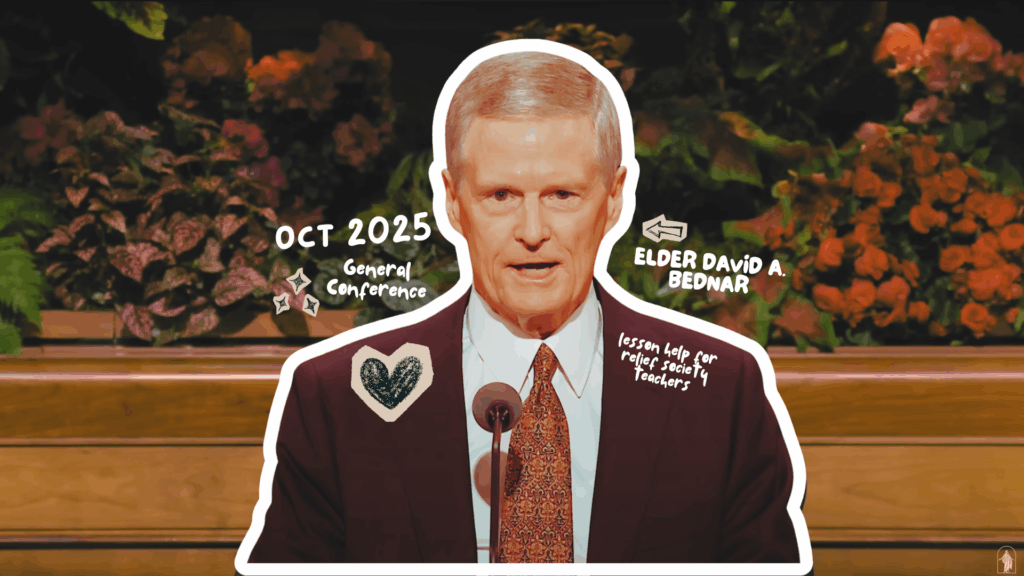
This guide gives you a ready-to-teach, in-depth plan that follows Elder Bednar’s talk point by point. For each section, you’ll find:
- Powerful quotes that teach doctrine and spark discussion
- 10 Engaging questions tailored for Relief Society dialogue
- 5 Simple object lessons to make doctrine tangible
- 10 Personal sharing prompts that invite testimony and story
Use the whole outline for a full lesson or select the sections your ward needs most. The aim: deepen our understanding of moral agency, becoming, the Atonement, godly fear, and why the Final Judgment can be “pleasing” to those who come unto Christ.

Grab our free bundle of 50+ Presentation Backgrounds by clicking here: https://otherthanamom.myflodesk.com/freebackgrounds

Interested in a done-for-you lesson plan with a teacher’s outline Google Doc, Canva Presentation Template, Lesson Handout Template, and themed presentation backgrounds? Click here: https://www.etsy.com/listing/4391617501/october-2025-general-conference-lesson?sr_prefetch=0&pf_from=shop_home&ref=shop_home_active_10&dd=1&logging_key=84e8ba1a7920be5d46eef4398acd4642bde45942%3A4391617501
Section 1 — “The Pleasing Bar”: Reframing Final Judgment
Anchor Quotes
- “Moroni… ‘to meet you before the pleasing bar of the great Jehovah.’”
- “Other prophets describe the Judgment as a ‘glorious day’ and one we should ‘look forward [to] with an eye of faith.’”
- “I believe this stark contrast … indicates that the doctrine of Christ enabled [them] to anticipate that great day with eager and hopeful anticipation.”
Doctrinal focus: Because of the doctrine of Christ (faith, covenants, repentance, enduring), Final Judgment can be anticipated with hope rather than dread.
10 Engaging Questions
- What does “pleasing bar” suggest about God’s character and our covenant relationship?
- Why do some prophets describe Judgment with joy, while warnings speak of dread?
- How does anticipating Judgment with hope change daily discipleship?
- What aspects of the doctrine of Christ specifically make that day “pleasing”?
- How do covenants reframe accountability—from terror to trust?
- What makes “an eye of faith” practical, not poetic, in a hard week?
- When have you felt hopeful accountability rather than anxious perfectionism?
- How can we teach youth to look forward to meeting Christ?
- What spiritual habits cultivate eager anticipation of that day?
- If you expected the Judgment to be “pleasing,” what would you do differently this month?
5 Object Lessons
- Calendar Page & Circle: Mark a joyful date (wedding, sealing). Compare to Judgment Day circled with hope—covenant confidence.
- Two Doors (Green/Red): Same hallway (Judgment), different readiness; green = repentant covenant-keeper, red = unprepared.
- Report Card + Teacher’s Note: The “grade” matters, but the teacher’s relationship and feedback (mercy and truth) shape hope.
- Mirror & Light: In dim light we fear flaws; in true light we see accurately, then cleanse—light invites hopeful correction.
- Legal Bench vs. Family Table: Contrast courtroom stiffness with covenant family welcome—same judge, different relationship.
10 Personal Sharing Prompts
- A time you felt peace, not panic, while pondering the Judgment.
- How a covenant memory (baptism, endowment, sealing) gives you hope.
- A scripture that changed your view of accountability.
- A priesthood blessing that reframed fear into purpose.
- A “judgment moment” in life (interview, review) that turned out to be encouraging.
- How “eye of faith” helped during repentance.
- A hymn that fills you with hope to meet the Savior.
- How the sacrament makes “that day” feel nearer and kinder.
- What “pleasing” motivates you to do this week.
- A youth conversation where you emphasized hope over dread.
Section 2 — The Father’s Plan of Happiness & Moral Agency
Anchor Quotes
- “Moral agency is central in God’s plan.”
- “‘Moral’ = good, honest, virtuous. ‘Agency’ = action, activity, work.”
- “God’s creations include both things to act and things to be acted upon.”
- “A primary purpose of the Creation … is to provide us the opportunity to act and become.”
- “We are commanded … to love one another and choose God.”
- “We have not been blessed with moral agency to do whatever we want … [but] to seek after and act in accordance with eternal truth.”
- “Lucifer … sought to destroy the agency of man.”
Doctrinal focus: Agency is a divine power to act in righteousness, not a permission slip to do anything. Its ends: love God and love neighbor.
10 Engaging Questions
- How does redefining agency as “power to act in goodness” reshape choices?
- Where do you feel tempted to be “acted upon” rather than act?
- Why are we commanded to use agency to love and choose God?
- How does “agent to act” protect against victimhood or passivity in trials?
- What does “moral” add to agency that “free” does not?
- How does Satan specifically target agency today?
- Which daily small choices most expand your power to act?
- How can Relief Society foster agency-rich discipleship (not dependency)?
- How do we help youth feel the joy—rather than weight—of agency?
- What “good cause” (D&C 58:27) are you acting in of your own free will?
5 Object Lessons
- Remote Control vs. Hand Tool: Remote (acted upon) vs. tool in your hand (agent to act).
- Compass & Map: Agency needs direction (commandments) to arrive at love of God/neighbor.
- Seed + Water: Growth requires your action; neglect = acted upon by environment.
- Two Arrows: Upstream (choose to act) vs. downstream (carried along).
- Locked vs. Unlocked Door: Keys = commandments enabling true freedom of movement.
10 Personal Sharing Prompts
- A time you stopped being “acted upon” and chose to act in Christ.
- Where obedience expanded your freedom.
- A small daily habit that increases your moral power.
- How a commandment enabled you to love better.
- When Satan’s attack on your agency became obvious—and how you resisted.
- A calling where you learned to act without being asked.
- Teaching youth to choose God in a specific dilemma.
- The most liberating “No” you ever said.
- A “good cause” you initiated this year.
- How temple covenants elevate your agency.
Section 3 — Doing and Becoming at the Judgment (President Dallin H. Oaks)
Anchor Quotes
- “Final Judgment … according to deeds or works or the desires of their hearts.”
- “We will be judged by the condition we have achieved.”
- “If their works have been filthiness they must needs be filthy … ‘He that is filthy shall be filthy still; and he that is righteous shall be righteous still.’”
- “Not just an evaluation of the sum total of acts—what we have done. It is an acknowledgment of what we have become.”
Doctrinal focus: The gospel transforms identity. Judgment recognizes our settled soul—who we are in Christ, not a last-minute tally sheet.
10 Engaging Questions
- What is the difference between behaving and becoming?
- How do repeated righteous acts reshape desire and identity?
- How does the sacrament help “re-condition” us in Christ?
- Which spiritual practices most move you from doing to becoming?
- How do we avoid checking boxes without changing hearts?
- What does “still” (righteous still/filthy still) teach about trajectory?
- How can we discern real becoming vs. temporary performance?
- How does the Holy Ghost confirm change at the level of character?
- What does “becoming” look like in ministering—not just visiting?
- Which attribute (Mosiah 3:19) is the Spirit inviting you to become more fully?
5 Object Lessons
- Two Jars (Clean/Cloudy Water): Repeated drops clarify or cloud—habits change the whole.
- Thermostat vs. Thermometer: Thermometer reports behavior; thermostat sets inner climate (becoming).
- Tree Rings: Growth is slow but cumulative—identity forms layer by layer.
- Ink Pen: Permanent dye vs. dry-erase marker—some choices soak into the soul.
- Sculptor’s Chisel: Small, consistent strikes transform stone—God’s grace chisels as we consent.
10 Personal Sharing Prompts
- A trait the Lord has helped you become over years.
- A commandment that changed your desires, not just actions.
- A calling that transformed your heart.
- When you realized your reflexes had become more Christlike.
- A “still” you’re grateful to have shed.
- A “still” you’re asking grace to overcome.
- A family practice shaping identity (not just behavior).
- Evidence you’ve seen that someone truly changed.
- A scripture that formed your inner life.
- How repentance re-sets your direction of becoming.
Section 4 — The Savior’s Atonement: Mercy, Grace, and Covenants
Anchor Quotes
- “Our works and desires alone do not and cannot save us.”
- “After all we can do … reconciled with God only through the mercy and grace of Christ.”
- “Believe in the Son of God … suffer and die … rise again … all men shall stand before him, to be judged … according to their works.”
- “We believe that through the Atonement of Christ, all mankind may be saved, by obedience to the laws and ordinances of the Gospel.”
- Our sins “will not stand as a testimony against us if we are truly born again … repent … endure to the end.”
Doctrinal focus: Salvation is in Christ; ordinances and covenants channel His power; obedient discipleship evidences faith and accesses grace.
10 Engaging Questions
- How do you keep “grace” and “obedience” in proper order and harmony?
- What does it mean to be “born again” repeatedly, not once?
- How do ordinances deliver power, not just permission?
- Where have you seen “after all we can do” misunderstood—how would you correct it?
- How does grace change your relationship to commandments?
- What does reconciliation with God feel like in daily life?
- How do we teach that works don’t earn salvation but express living faith?
- What personal evidence shows you the Atonement is infinite and intimate?
- How does enduring to the end rely on grace day by day?
- Which covenant blessing is most real to you right now?
5 Object Lessons
- Outlet & Plug: Ordinances = covenant connection to power; grace flows when we stay plugged in.
- Vine & Branch (String/Twig): Life flows from Christ; commandments keep the union intact.
- Debt Forgiven Receipt: Repentance receipts remove accusations.
- Lifeboat & Oars: Lifeboat (grace) saves; oars (obedience) align us with the Rescuer’s course.
- Hospital Wristband: You’re in the care of the Healer—follow the treatment plan.
10 Personal Sharing Prompts
- When you most felt reconciled to God.
- A covenant moment that clearly delivered power.
- How the sacrament became more than a symbol to you.
- A repentance experience where shame was replaced by hope.
- A time grace enabled obedience beyond your strength.
- The ordinance you feel prompted to prepare for or renew focus on.
- A hymn or scripture that anchors you in mercy.
- How you explain “after all we can do” to a youth.
- A witness that your sins will not stand against you.
- Where you are seeking the enabling power of the Atonement this month.
Section 5 — Godly Fear vs. Worldly Fear & “We Are Our Own Judges”
Anchor Quotes
- “Godly fear invites … peace, assurance, and confidence.”
- “Righteous fear encompasses … reverence, obedience, and anticipation of the Final Judgment.”
- “It is the prospect of acknowledging things as they really are.”
- “If our desires have been for righteousness … we shall see his face with pleasure.”
- “Conversely … ‘a lively sense of [our] own guilt’ … would hide us from his presence.”
- “Ultimately, we are our own judges … we will acknowledge what we have chosen to become.”
Doctrinal focus: Godly fear = reverent realism that propels repentance and covenant confidence. Judgment largely consists of self-revelation in God’s light.
10 Engaging Questions
- How does godly fear produce peace rather than anxiety?
- What practices cultivate reverence in a noisy world?
- How does anticipating truth “as it really is” motivate repentance now?
- Why is desire central to a “pleasing” judgment?
- What does it mean to “be your own judge” in Christ’s presence?
- How can we learn to tell the truth to ourselves sooner?
- What role does temple worship play in healthy, godly fear?
- How do we help loved ones move from worldly to godly fear?
- Where is the Spirit inviting you to become more honest before God?
- How can Relief Society be a sanctuary for courageous accountability?
5 Object Lessons
- Blacklight & Invisible Ink: God’s light reveals what is truly there; better to write truth now.
- Scale You Step On Daily: Frequent, gentle feedback prevents crisis-scale moments.
- Window & Cleaner: Regular repentance clears vision; smudges ignored become fog.
- X-Ray Film: God sees within; diagnosis leads to healing, not humiliation.
- White Garment: Temple clothing symbolizes present-tense worthiness and hopeful accountability.
10 Personal Sharing Prompts
- A time reverence brought assurance.
- A moment of honest self-assessment that changed your course.
- An experience where “fear of the Lord” felt like love.
- How temple worship increases your peace about Judgment.
- A practice that helps you tell the truth to yourself.
- Where you felt drawn into the light rather than shamed.
- A Relief Society conversation that modeled courageous kindness.
- A scripture about godly fear that steadies you.
- A specific desire you’ve asked God to purify.
- How confession/repentance restored confidence.
Section 6 — Promise of Restoration & Bednar’s Witness
Anchor Quotes
- “Restoration is to bring back again … good for that which is good … merciful for that which is merciful.”
- “Deal justly, judge righteously, and do good continually … then shall ye receive your reward … mercy … justice … righteous judgment … good restored unto you again.”
- “I joyfully witness that Jesus Christ is our living Savior.”
Doctrinal focus: God restores what we have sown and become—and in Christ, mercy and good are restored to covenant disciples.
10 Engaging Questions
- How does the doctrine of restoration intensify daily choices?
- Where have you already seen “good for good” restored in mortal life?
- How do mercy and justice harmonize in restoration?
- What does “do good continually” look like in real schedules?
- How do we keep “judge righteously” from becoming “be judgmental”?
- Where do you hope to see mercy restored “again” in your life?
- How does this promise change how you view hidden or unnoticed service?
- What practices help you sow what you truly want reaped?
- How does this doctrine motivate ministering to the one?
- How does Elder Bednar’s calm witness invite you to live with steadiness?
5 Object Lessons
- Bounced Echo: Words return—so do deeds, as restoration.
- Seed Packets Labeled “Justice/Mercy”: Plant what you hope to harvest.
- Bank Ledger: Deposits (good) and withdrawals (selfishness) return with interest.
- Boomerang: What you throw returns—choose carefully.
- Mirror Hallway: Multiplying reflections—good multiplies as it’s restored.
10 Personal Sharing Prompts
- A time mercy you extended came back to you.
- Where you have tasted “good for good” already.
- An unseen offering that later returned as strength.
- A habit of “doing good continually” that’s sustainable.
- Where you’re praying for restoration in a relationship.
- How a prior season of sowing now blesses your children.
- An experience that taught you the cost of sowing poorly.
- A Relief Society service that overflowed back into the ward.
- A scripture about restoration that motivates you.
- Your personal witness of the living Savior restoring what you cannot.
Conclusion: Why This Format Serves Relief Society Teachers
This lesson help breaks Elder Bednar’s message into six teachable movements: hopeful judgment, moral agency, becoming, the Atonement, godly fear, and restoration. For each, you have:
- Quotes ready to place in your outline or slides
- Questions designed to move beyond yes/no into application
- Object lessons that are brief, visual, and doable
- Sharing prompts that draw real experience and testimony
When used prayerfully, these tools help sisters not only understand but practice the doctrine of Christ—exercising moral agency to love and choose God, seeking the enabling power of the Atonement, and living so that the Final Judgment becomes, in Moroni’s words, “pleasing.” May this preparation bless your discussion, deepen conversion, and strengthen covenant confidence in Jesus Christ.