Introduction
Some truths don’t just inform us—they redefine us. Elder Brik V. Eyre’s message centers on one of those truths: who we really are and how God comes after us with relentless love. This lesson help is designed to guide a heartfelt Relief Society discussion that blends doctrine with compassion, and testimony with practice.
Each section includes a short quote from Elder Eyre, 10 discussion questions, 5 simple object lessons for class, and 10 personal-sharing prompts to help your sisters connect deeply with the Savior and with each other.

Grab our free bundle of 50+ Presentation Backgrounds by clicking here: https://otherthanamom.myflodesk.com/freebackgrounds
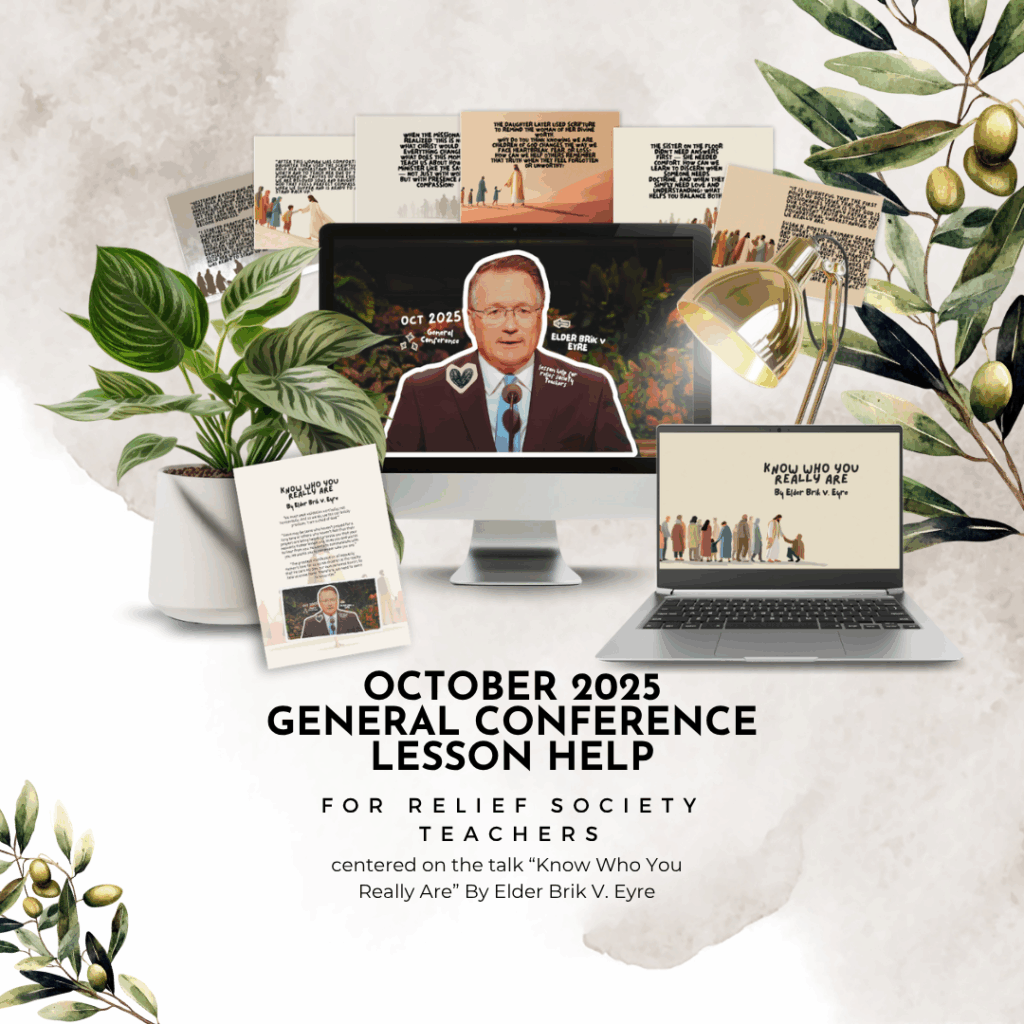
Interested in a done-for-you lesson plan with a teacher’s outline Google Doc, Canva Presentation Template, Lesson Handout Template, and themed presentation backgrounds? Click here: https://www.etsy.com/listing/4406922070/october-2025-general-conference-lesson?sr_prefetch=1&pf_from=shop_home&ref=shop_home_active_1&dd=1&logging_key=6e788d41bfdfb165c54c0c7743a7bbb1557e5d27%3A4406922070
Section 1: Compassion First—“This is a literal daughter of God”
“This is not a problem that I can solve, but this is a literal daughter of God that needs my help. So I closed my scriptures, knelt beside her, and held her while we cried together…”
Discussion Questions
- What does Christlike compassion look like in the moment of someone’s crisis?
- How do we balance comfort first and teaching truth (as the missionary did)?
- When is it better to close our scriptures and simply be with someone?
- How does seeing someone as a “literal daughter of God” change our response?
- What can keep us from offering this kind of presence (fear, time, discomfort)?
- How do we know when to move from comfort to counsel?
- How has ministering changed for you as you’ve focused on identity first?
- What might “kneel beside” look like in your current season?
- How can Relief Society create safety for real tears and real healing?
- What does the Savior teach us about showing up before speaking up?
Object Lesson Ideas
- Blanket & Tissue Box: Place them at the front; talk about covering and comforting.
- Bandage vs. Balm: Quick fix vs. soothing presence; both matter, order matters.
- Two Chairs Side-by-Side: Sit with someone, not across to “fix” them.
- Hand on Shoulder: (Ask a volunteer) Model nonverbal compassion.
- Stopwatch: Pause for 60 seconds of silence—feel how long “being with” can feel.
Personal Sharing Prompts
- Share a time someone’s presence (not a solution) changed everything.
- When did you feel God with you before He taught you?
- Tell about a ministering visit where compassion opened the door to truth.
- How has crisis taught you to receive help?
- What helps you resist the urge to “fix”?
- Share a time you felt seen as a daughter of God in your pain.
- What simple act of comfort you’ve given/received meant the most?
- When have you cried with someone and felt the Spirit heal?
- What gets in your way—and how can you remove it—when someone needs you?
- Who modeled Christlike comfort to you growing up?
Section 2: Foundational Identity—God Is Our Loving Father
“It is insightful that the first point of doctrine that our missionaries teach is that God is our loving Heavenly Father.”
Discussion Questions
- Why must identity (child of God) come before everything else?
- How does this truth shape how we repent, obey, and endure?
- What shifts when trials are viewed under a loving Father’s care?
- How does God’s love correct without condemning?
- Which commandments make more sense through the lens of love?
- What does it mean to be personally known by an omniscient Father?
- How can we speak identity to those who feel unworthy?
- What happens in a ward when identity language becomes normal?
- How do you remind yourself of this truth on hard days?
- How might this change your prayers this week?
Object Lesson Ideas
- Name Tag: Write “Child of God”—identity first, roles second.
- Family Photo Frame: We belong to His family; place a heart inside.
- Heart Sticker on Mirror: See yourself as He sees you.
- Nest & Egg: Safe belonging precedes growth.
- Warm Light Lamp: Love is the constant—flip it on at the start of class.
Personal Sharing Prompts
- Share a moment you felt unmistakably His.
- How has identity changed a decision you made?
- A time God’s love reframed a commandment for you.
- How do you teach identity to your children?
- When did you forget who you were—and how did God remind you?
- What phrase helps you remember your worth?
- Who taught you God is kind?
- What practice keeps identity front and center daily?
- How has identity healed comparison for you?
- Share your “I am…” identity statement.
Section 3: The Adversary’s Labels vs. God’s Voice
“While our Heavenly Father…reminds us that we are His children, the adversary will always try to label us by our weaknesses… Moses declared… ‘I am a son of God.’”
Discussion Questions
- What labels do you hear most (internal or external)?
- How do we detect when a label is from the adversary?
- What helps you respond like Moses?
- How can we stop labeling others by their weaknesses?
- What daily habits tune us to God’s voice over the world’s?
- Which identities from President Nelson (child of God, covenant, disciple) speak to you now?
- What language in your home reinforces divine identity?
- How can repentance replace labels with truth?
- Where do social media labels creep in?
- How do we lovingly correct identity-shaming?
Object Lesson Ideas
- Sticky Notes: Write false labels; peel off and replace with “Child of God.”
- Noise vs. Whisper: Play soft music; speak calmly—God’s voice is distinct.
- Magnets: Weak labels fall away; identity in Christ “holds.”
- Two Signs: “Son/Daughter of God” vs. “Son/Daughter of Man”—which do we pick up?
- Shredder (paper): Destroy false labels—keep truth.
Personal Sharing Prompts
- A label you laid down.
- A truth you picked up instead.
- How God corrected your self-talk.
- A time someone spoke identity over you.
- How you teach youth to answer labels.
- Where you need God’s voice louder.
- Your “Moses moment.”
- How covenant identity changed your choices.
- A boundary you set to protect identity.
- The phrase you’ll practice this week.
Section 4: Seek Validation Vertically
“We must seek validation vertically, not horizontally… ‘I am a child of God.’”
Discussion Questions
- What’s the difference between vertical and horizontal validation?
- Where do you most feel the pull for horizontal validation?
- How do you practically “seek vertical” in a busy life?
- What changes when you center your day on God’s approval?
- How do covenants make vertical validation easier?
- Why is the sacrament prayer’s name—“God, the Eternal Father”—significant?
- What does vertical validation do to fear of failure?
- How can ministering reflect vertical validation?
- What rhythms re-center you when you drift into comparison?
- What would your week look like if you checked heaven first?
Object Lesson Ideas
- Arrow Cards: Up arrow vs. side arrows—choose your source.
- Compass: True north is God’s will.
- Cell Signal Bars: Best reception comes from looking up.
- Mirror Tilted Upward: Reflect heaven’s view.
- Priority List: Put “God’s voice” at the top—visually reorder.
Personal Sharing Prompts
- When you chose God’s approval over popularity.
- How vertical validation softened anxiety.
- A habit that keeps you vertically grounded.
- A time you felt heaven’s “well done.”
- How sacrament re-centers you weekly.
- The cost of chasing horizontal validation.
- How you coach your kids to look up.
- A scripture/line you use to reset.
- Your biggest horizontal trap—and your plan.
- What “I am a child of God” changes for you today.
Section 5: “Relentless Pursuit”—The Father’s Plan Brings You Home
“Our Father’s beautiful plan…is designed to bring you home, not to keep you out. God is in relentless pursuit of you.”
Discussion Questions
- What does “relentless pursuit” teach you about God’s nature?
- When have you felt Him coming after you?
- How does this change how we view commandments and covenants?
- What might “home” feel like spiritually right now?
- How do we talk about this hope with those who fear they’re disqualified?
- How does this reframe repentance?
- What does relentless pursuit look like in ministering?
- How does this promise heal shame?
- What practices help you notice pursuit in daily life?
- How can Relief Society embody the Father’s welcome?
Object Lesson Ideas
- Shepherd Crook (picture/prop): Gathering, guiding—He seeks us.
- Door Hanger: “Welcome Home”—the plan’s end goal.
- Footprints: God’s steps toward us (grace) and ours toward Him (faith).
- Heartbeat Sound/Visual: Constant, faithful, pursuing love.
- Home Key: The plan gives us the key back home.
Personal Sharing Prompts
- A time you felt “found.”
- How God chased you through a hard season.
- What “home” means in your faith now.
- A commandment that felt like a barrier until you saw the love behind it.
- A minister who embodied pursuit.
- How you welcome others home.
- Where you need to be “found” today.
- How pursuit changes your prayers.
- A hymn/line that says “welcome home” to you.
- What you’ll do this week to be part of His pursuit.
Section 6: Be With God—Real Prayer, Real Places, Real Preparation
“Perhaps we should shift…from simply saying our prayers to taking sufficient time to really commune with and be with God each day.”
Discussion Questions
- What’s the difference between saying a prayer and being with God?
- How do preparation and place affect your prayers?
- What does pondering look like for you?
- How can we improve prayer quality in busy seasons?
- How do quick, urgent prayers connect to earlier communion?
- What helps when you haven’t felt heard in a long time?
- How do you pray out loud in a way that feels natural?
- What do you bring to God first—gratitude, questions, both?
- How can class members support each other’s prayer life?
- What one tweak will you try this week?
Object Lesson Ideas
- Do Not Disturb Sign: Create sacred space for God-time.
- Journal & Pen: Write a 30-second “pre-prayer” ponder list.
- Hourglass (small): Even two intentional minutes matter.
- Door/Closet Photo: Visual cue—go where the Spirit can reach you.
- Volume Dial: Turn down noise; turn up stillness.
Personal Sharing Prompts
- Your “closet” (real or symbolic) for prayer.
- A time prayer quality changed everything.
- What you do before you pray that helps most.
- How you pray when life is chaotic.
- A moment you felt undeniably heard.
- A phrase you say to begin real communion.
- A time the Spirit brought a name to mind.
- How writing prayers helped you focus.
- A tender mercy tied to a simple prayer.
- What you’ll try for seven days.
Section 7: Prepare for Revelation—Scripture Daily & Temple Worship
“Studying the Book of Mormon daily and worshiping in the temple will help prepare our minds for revelation.”
Discussion Questions
- How does daily scripture study change your spiritual sensitivity?
- What helps you make the temple a living, not occasional, part of your life?
- How has the Book of Mormon spoken directly to your questions?
- What obstacles keep us from these habits—and how do we remove them?
- How do you bring the temple pattern into your home?
- What small rhythms (time, place) make consistency easier?
- How do you study when you feel spiritually flat?
- How do these practices confirm identity as God’s child?
- What revelation came because you were already in the scriptures/temple?
- How can Relief Society support access and rides to the temple?
Object Lesson Ideas
- Lamp & Oil: Daily drops power bright light.
- Scripture Ribbon: Mark a page—“God will meet you here.”
- Temple Picture: Keep holy places before our eyes.
- Calendar Card: Write in your next temple time now.
- Small Stone Jar: One stone per day you read—watch the jar fill.
Personal Sharing Prompts
- A time the Book of Mormon answered you.
- A temple moment that re-centered your identity.
- Your best “small and simple” scripture habit.
- What gets you to the temple when you’re tired?
- How God met you in a quiet verse.
- A family rhythm that keeps scripture alive.
- Your favorite way to record revelation.
- A question you’re taking to the temple.
- How these practices softened your heart toward someone.
- One commitment you’ll make for 14 days.
Section 8: Know Jesus Is Your Savior—Mighty to Save
“It now asks if you have a testimony of His role as your Savior and Redeemer… ‘There is nothing that you have done that can’t be forgiven and ultimately corrected.’”
Discussion Questions
- What changes when you say my Savior instead of the Savior?
- How does personal forgiveness open the door to knowing Jesus?
- What keeps us from believing His Atonement works for me?
- How do you experience the “song of redeeming love”?
- Where do you need His “mighty to save” right now?
- How does repentance feel when rooted in identity, not shame?
- How do we testify of personal redemption without centering ourselves?
- What helps you come to know Him, not just know about Him?
- How has He corrected something you couldn’t fix?
- How can Relief Society cultivate a culture of hopeful repentance?
Object Lesson Ideas
- White Cloth & Stain Remover: Watch a stain lift—He really cleanses.
- Eraser: Marks remain until the Master erases them.
- Broken Item Repaired: Restoration is real.
- Name Card: Write “Jesus, my Savior”—hold it up together.
- Doorway: Step through as a class—He opens the way back.
Personal Sharing Prompts
- A time you felt forgiven.
- How Jesus made a personal difference in one week of your life.
- Your “mighty to save” story (big or small).
- A lyric/phrase that carries redeeming love to your soul.
- A quiet moment you knew He knew you.
- A change you made because you trust Him.
- Someone who mirrored the Savior’s mercy to you.
- A way you’ve learned to receive grace.
- A fear He’s healing now.
- The testimony sentence you can share today.
Conclusion: Say It Boldly—“I Am a Child of God”
Elder Eyre’s message calls us to live from our true name and let everything else flow from there—our compassion, our prayers, our scripture habits, our temple worship, and our relationship with Jesus Christ, our Savior. When we seek validation vertically and remember the Father’s relentless pursuit, repentance becomes hopeful, ministering becomes personal, and testimony becomes alive.
As you teach, invite your sisters to practice one identity habit this week—pray like a daughter, study like a daughter, serve like a daughter. Then, together, say it out loud: “I am a child of God.”
Let that truth change everything.


Love your lesson ideas! Do you have lessons for the rest of conference? Especially President Oaks?
Thank you! Yes! Here’s the link to President Oaks’s Talk! https://otherthanamom.com/october-2025-general-conference-relief-society-lesson-helps-exaltation-is-a-family-affair-president-dallin-h-oaks/