Introduction: Why This Lesson Help Matters
Planning a Relief Society lesson on repentance, healing, grace, and the Savior’s mercy can feel both sacred and tender. This guide breaks Elder Neil L. Andersen’s talk into clear discussion points with powerful quotes, deep-discussion questions, simple object lessons, and personal sharing prompts—so you can create a Spirit-filled, safe, and doctrine-rich space.
Use it to help sisters:
- Understand how forgiveness and healing are found in their fullness through Jesus Christ.
- Discern the roles of faith, honesty, restitution, patience, and grace in real repentance.
- Feel seen by the Savior whether they are the wrongdoer seeking forgiveness or the injured seeking healing.

Grab our free bundle of 50+ Presentation Backgrounds by clicking here: https://otherthanamom.myflodesk.com/freebackgrounds
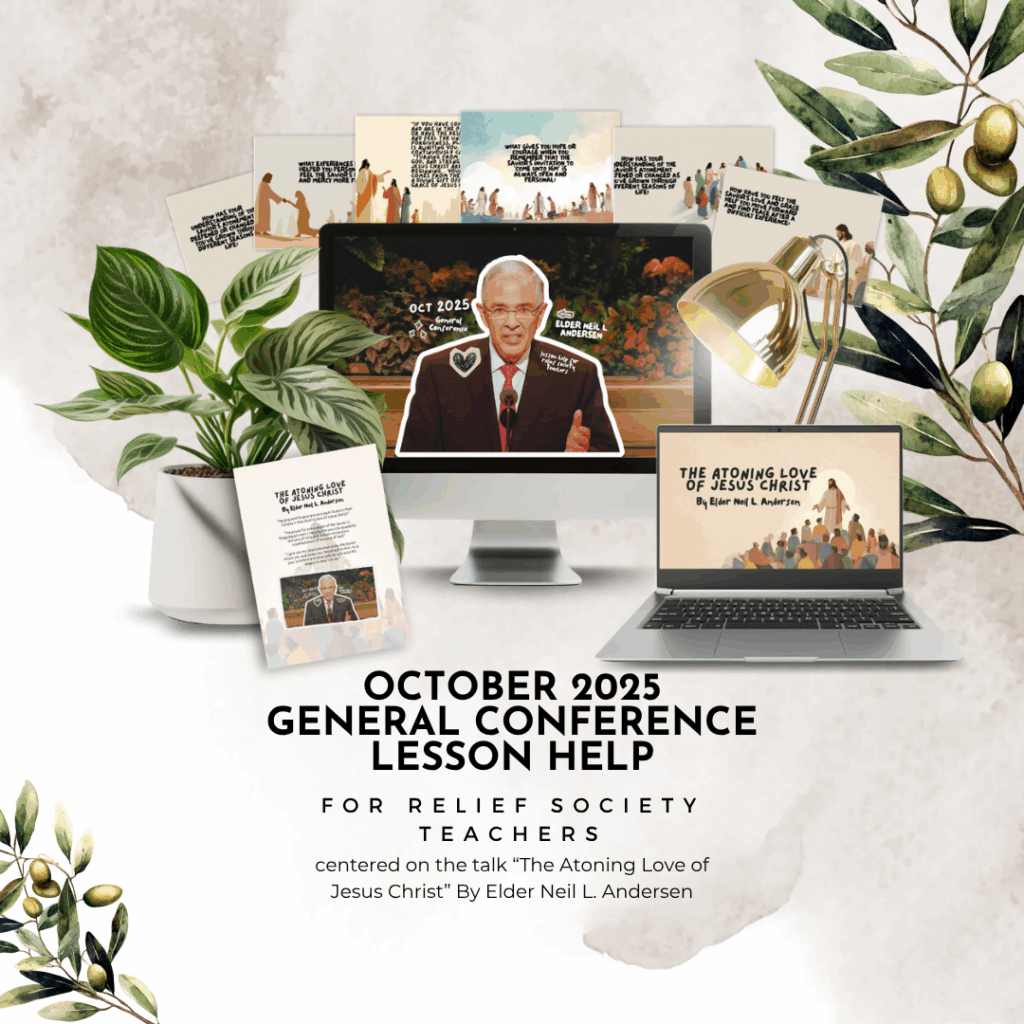
Interested in a done-for-you lesson plan with a teacher’s outline Google Doc, Canva Presentation Template, Lesson Handout Template, and themed presentation backgrounds? Click here: https://www.etsy.com/listing/4401047289/october-2025-general-conference-lesson?ref=listings_manager_grid
1) Thesis & Witness: The Atoning Love That Heals and Forgives
“With each passing year, I feel greater love for our Savior, Jesus Christ, and for His merciful Atonement.”
“His supreme sacrifice, securing victory over death and sin, is the most consequential contribution of all human history.”
“The powerful compassion of the Savior in forgiving sin and in healing the wounds caused by the sins of others is a most miraculous manifestation of the love of God.”
“Healing and forgiveness are each found in their fulness in the atoning love of Jesus Christ.”
10 Discussion Questions
- Why do both forgiveness (for sinners) and healing (for the injured) center in Christ’s Atonement?
- What does “fullness” of healing or forgiveness look and feel like?
- How does seeing the Atonement as “the most consequential contribution of all human history” change our daily discipleship?
- Where do you see “the powerful compassion of the Savior” in your life or others’?
- How might we unintentionally separate forgiveness and healing when the Lord unites them in His love?
- What helps you keep Christ, not performance, at the center of repentance and recovery?
- Why is it essential to speak of both justice and mercy when we teach repentance?
- What is the difference between human compassion and divine compassion?
- How can Relief Society become a place where both sinners and sufferers feel safe?
- What do you think Elder Andersen means by an “open-ended heavenly tutorial” about the Atonement?
5 Simple Object Lessons
- Two Vials (Oil & Water): Label one “Forgiveness” and one “Healing.” Both pour into one bowl labeled “The Atonement.” Emphasize that both blessings come from one Source.
- Bandage & Eraser: A bandage (healing) and an eraser (forgiveness) both placed at the foot of a small paper cross.
- Broken Pot Repaired (Kintsugi image or glued pot): The break lines now strengthened—beauty from brokenness.
- Light & Shadow: Shine a flashlight through your fingers—light penetrates both the wound and the wrongdoing.
- Two Doors, One Key: “Forgiveness” door and “Healing” door; one key labeled “Jesus Christ.”
10 Personal Sharing Prompts
- Share a time when the Savior’s compassion felt personal to you.
- How has your understanding of the Atonement deepened with time?
- When did you first sense the Atonement was for you, not just “everyone else”?
- Share a hymn line that helps you feel Christ’s mercy.
- How has the Lord helped you hold hope for both justice and mercy?
- Share a scripture that anchors your faith in His healing.
- When have you witnessed “beauty for ashes” (Isaiah 61) in real life?
- What helps you remember Christ when you feel overwhelmed?
- Share a moment when you felt spiritual “fullness”—even briefly.
- How has Relief Society nurtured your faith in Christ’s Atonement?
2) Faith in Jesus Christ: The Beginning of Real Change
“If you have committed serious sins … please know this miracle is awaiting you. The Savior continuously calls, ‘Come unto me.’”
“Enos asked … ‘Lord, how is it done?’ The Lord responded, ‘Because of thy faith in Christ…’”
“If ye shall deny yourselves of all ungodliness, and love God with all your might, mind and strength, then is his grace sufficient for you.”
“Turning from sin, turning toward God … includes acknowledging serious sins to your bishop … but your full forgiveness comes from the Savior. Forgiveness is a divine gift offered through the grace of Jesus Christ.”
10 Discussion Questions
- What does “Come unto me” look like for someone overwhelmed by serious sin?
- How does Enos’s question—“How is it done?”—help us teach repentance with compassion?
- What does it mean to “deny … all ungodliness” in practical, daily choices?
- Why is confession to a bishop essential and yet forgiveness still comes from Christ?
- What’s the difference between “turning from sin” and “turning toward God”?
- How is forgiveness a “divine gift,” not a wage we earn?
- What role does loving God with all our might, mind, and strength play in grace?
- How does faith in Christ ignite hope that change is possible?
- How do we make space in RS for women currently walking through repentance?
- How can we be careful teachers so the repentant feel drawn, not shamed?
5 Simple Object Lessons
- Compass & Turn: Show a compass; talk about “true north.” Repentance is a turning toward Christ.
- Gift Box: Label “Forgiveness.” We receive it—we don’t manufacture it.
- Two Arrows: One arrow away from sin; one arrow toward Christ. Both are needed.
- Door Hinge: Repentance is the hinge that allows the door to turn Godward.
- Light Switch: Faith is choosing to flip the switch; the power is Christ’s.
10 Personal Sharing Prompts
- Share a time “Come unto me” felt like an actual invitation to you.
- What helped you trust a priesthood leader during repentance?
- Where have you seen grace show up when you gave your “might, mind, and strength”?
- Share a small “turning” that led to big spiritual momentum.
- What scripture sustained you through change?
- When have you felt forgiveness as a gift rather than an achievement?
- Share a time you denied “ungodliness” in a specific habit or thought pattern.
- How do you talk to the Lord when you feel unworthy?
- When have you felt His call “continuously”?
- What helped you begin again after a setback?
3) Honesty, Godly Sorrow & a Contrite Spirit
“A desire to truly return to God is accompanied by the determination to be completely honest with your Heavenly Father, with yourself, with those who were harmed, and with your priesthood leader.”
“Your Heavenly Father rejoices in your resolve to come unto Him with a broken heart and contrite spirit.”
“Having a contrite spirit is humbly putting yourself in the hands of God; having a broken heart brings what the Apostle Paul described as ‘godly sorrow’—a deep longing of the soul to return to Him whatever the cost.”
10 Discussion Questions
- Why is complete honesty a spiritual turning point?
- What does a “broken heart and contrite spirit” feel like—and not feel like?
- How is godly sorrow different from toxic shame?
- Why does the Father rejoice in our resolve even before outcomes are perfect?
- What does “whatever the cost” look like in discipleship?
- How do we cultivate truth-telling with ourselves?
- How can we be careful not to weaponize “contrition” against others?
- What helps us apologize without excuses or self-justification?
- How might a class culture of honesty lead to miracles?
- What does it mean to be held in “the hands of God”?
5 Simple Object Lessons
- Mirror: Seeing ourselves truthfully—then turning to Christ.
- Clay in Hands: Soft clay vs. hardened clay—pliable hearts receive shape.
- Two Stones: One smooth (contrition) and one rough/hard (pride).
- Weights: Shame crushes; godly sorrow motivates movement toward Christ.
- Open Hands: Demonstrate surrender—open palms to symbolize yielding to God.
10 Personal Sharing Prompts
- When did honesty with God change everything for you?
- Share a time you felt godly sorrow instead of corrosive shame.
- What act of humility helped you move forward?
- Describe a moment the Father’s rejoicing felt real to you.
- What does a contrite prayer sound like for you?
- Share a time you owned a mistake fully—what followed?
- What helps you keep your heart soft?
- When has someone else’s honest repentance strengthened your faith?
- What spiritual practices keep you aligned with truth?
- When have you felt safely “in His hands”?
4) Restoring What Is Broken: Restitution & Repair
“Your yearning leads you to want to repair what you have broken.”
“Are you following the example of the sons of Mosiah, who were ‘zealously striving to repair all the injuries which they had done’?”
“I’ve learned that restitution isn’t just about money. It’s about humbly dedicating my life to the Lord … making and keeping promises without expecting anything in return.”
10 Discussion Questions
- Why does true repentance naturally seek to repair?
- What can restitution look like beyond money?
- How can we discern what repair is possible—and what only the Lord can heal?
- How do timing and consent matter when attempting repair?
- What safeguards should guide contact with those harmed (wisdom, safety, counsel)?
- How does “no strings attached” transform restitution?
- What does “zealously striving” look like in quiet, long-term ways?
- How can leaders lovingly help members see “what more” might bless those harmed?
- How do we avoid grand gestures and choose steady, humble service?
- How do we offer restitution without demanding forgiveness?
5 Simple Object Lessons
- Broken Vase + Glue: Some cracks remain visible, but love reassembles.
- IOU Cards: Brainstorm non-financial “IOUs” (time, childcare, tutoring, listening, consistent support).
- Two Seeds: One labeled “Words,” one “Actions”—both must be planted to rebuild trust.
- Knot in Rope: You can’t remove the knot, but you can tie a stronger line beyond it.
- Blank Check (Paper): “Lord, fill in what You want me to do”—a life of restitution.
10 Personal Sharing Prompts
- Share a time the Spirit showed you a small but meaningful way to repair harm.
- Tell how “no strings attached” changed your heart.
- When has quiet consistency mattered more than an apology speech?
- What “repairs” are you still praying to understand?
- Who helped you discern wise boundaries while seeking to make amends?
- Share a time your efforts were declined—how did you turn that over to the Lord?
- What does dedicating your life to the Lord look like this week?
- Tell about mercy you received that made you want to repair faster.
- How do you keep service pure when outcomes are uncertain?
- What promise are you keeping right now to rebuild trust?
5) Divine Approval—“By Degrees”
“The Lord was slow to hear their cry because of their iniquities.”
“Nevertheless the Lord did hear their cries, and began … to ease their burdens; … and … they began to prosper by degrees.”
“In the Lord’s time, you will feel His voice telling you, ‘Let these things trouble you no more.’ … [He will] take ‘away the guilt from [your heart], through the merits of his Son.’”
10 Discussion Questions
- Why does the Lord sometimes answer slowly during repentance?
- How does “prosper by degrees” protect us from discouragement?
- What does it feel like when guilt is truly lifted by Christ?
- How do we stay steady while waiting for divine assurance?
- How can leaders and friends support someone through the “in-between”?
- What small evidences of divine help have you seen “by degrees”?
- Why is timing part of the Lord’s tutoring love?
- How do we resist the lie that “nothing is happening”?
- What phrases of scripture help you trust the Lord’s clock?
- How can Relief Society teach patience with ourselves and others?
5 Simple Object Lessons
- Dimmer Switch: Brightness increases gradually—like spiritual assurance.
- Seedling in a Jar: Growth is real but slow and often unseen at first.
- Hourglass: The sand moves—quietly, steadily, surely.
- Stairs vs. Elevator: Repentance is often step-by-step.
- Polishing Cloth & Coin: Repeated gentle polishing brings back the shine.
10 Personal Sharing Prompts
- Share a “by degrees” moment in your discipleship.
- What whispered assurance from the Lord do you hold onto?
- How do you measure progress when change is slow?
- What helps you resist all-or-nothing thinking?
- Share a time the Lord said, “Let these things trouble you no more.”
- Who helped you stay in the process?
- Where do you see “easing of burdens” right now?
- Which scripture anchors you in waiting?
- What “small success” did God use to keep you moving?
- How have you seen someone else prosper “by degrees”?
6) To the Injured and Suffering: Beauty for Ashes
“The sadness you have felt … the suffocating feeling of being betrayed … I give you my absolute assurance, the Savior knows you and loves you. Reach out to Him.”
“He will send His angels to bear you up.”
“He has the power to bring beauty from the ashes of your suffering.”
“As you … trust in Him … ‘Your sorrow shall be turned into joy. … And your joy no [one] taketh from you.’ That moment will come.”
President Oaks: the Savior comforts, heals, and strengthens those who seek Him and ask for His help.
10 Discussion Questions
- What does it mean for the Savior to know your specific grief?
- How have you experienced “angels to bear you up” (seen or unseen)?
- What is the difference between “moving on” and “being healed”?
- How do we avoid urging people to “hurry up” their healing?
- What if trust feels scary—how can we begin safely?
- What does “beauty for ashes” look like in real life?
- How can Relief Society create a trauma-aware, compassionate space?
- What phrases in these promises feel most hopeful to you today?
- How do we help someone seek the Savior without prescribing timelines?
- How can we—appropriately—be part of the “angels” He sends?
5 Simple Object Lessons
- Ash & Flower: Show ash in a small dish; place a live flower beside it—life after devastation.
- Weighted Backpack: Remove items one by one as sisters name Christ’s promises.
- Tissue & Oil: Tears are seen; the oil symbolizes healing and consecration.
- Cracked Candle Holder with Lit Candle: Light still shines through broken places.
- Feather/Angel Wing Card: Write names of “earthly angels” who have helped.
10 Personal Sharing Prompts
- Share a time the Lord saw your private pain.
- Who has been an “angel” to you?
- What does safety feel like as you heal?
- When did a scripture become a lifeline?
- How is the Savior helping you carry something heavy?
- Where have you seen “beauty from ashes”—however small?
- What helps you ask the Lord for help when you feel numb?
- Share a way Relief Society supported you in a hard season.
- How do you know the Lord is near when answers are not immediate?
- What do you hope your future “joy no one taketh” will look like?
7) Grace in Action: Elder Robert E. Wells’s Witness
“Words will forever be inadequate in expressing the pain that swelled within me…”
“I found myself experiencing tremendous guilt for feeling I was responsible…”
“While praying … I felt as though the Savior came to my side and I heard an audible voice … ‘My atoning sacrifice paid for your sins and your mistakes … I will lift your burden.’”
“From that moment, the burden of guilt … was amazingly lifted from me. I had been rescued!”
“I had been given an unearned gift—the Lord’s gift of grace.”
10 Discussion Questions
- What stands out to you most in Elder Wells’s experience?
- How does the Lord address both grief and guilt?
- What does it mean to be “rescued” by grace?
- Why is it important to call grace an “unearned gift”?
- How does the Spirit sometimes communicate in unmistakable ways?
- How do we hold space for those who haven’t yet received this relief?
- What’s the relationship between seeking, asking, and receiving?
- How does grace change the way we view our past?
- What promises from the Lord help you lay down self-condemnation?
- How can we learn to recognize when burdens are being “lifted”?
5 Simple Object Lessons
- Heavy Stone → Empty Hands: Set down a stone into a basket labeled “Christ’s Atonement.”
- Tight Knot Loosened: Slowly loosen a rope knot while reading the Lord’s words to Elder Wells.
- Before & After Post-it: “Condemned” → “Rescued by Grace.”
- Life Preserver (picture or prop): Grace as rescue—not reward.
- Scale with Weight Removed: Burden lifted; balance restored.
10 Personal Sharing Prompts
- Share a time you were surprised by the Lord’s mercy.
- What helped you lay down self-blame?
- When did you feel “rescued”—suddenly or gradually?
- What words from God have stayed with you?
- Who modeled grace for you?
- How did prayer open a door to relief?
- Where do you still seek a lifted burden?
- What helps you let the past be covered by Christ?
- Share a hymn/verse that felt like rescue.
- What does “unearned gift” mean to you today?
Conclusion: Teaching in the Way He Heals
Elder Andersen teaches that forgiveness and healing are both found, in their fullness, in the atoning love of Jesus Christ. As you prepare and teach, this framework can help:
- Start with faith in Christ.
- Practice honesty and contrition.
- Seek restitution and quiet repair.
- Be patient—approval often comes by degrees.
- For the injured, promise His angels, His timing, His beauty for ashes.
- Trust His grace—it is an unearned gift that truly rescues.
Relief Society can become a sanctuary where sinners and sufferers meet the same Savior—and where His love, truth, and timing are honored. As you use these quotes, questions, object lessons, and sharing prompts, you’ll invite the Spirit to do what no outline can: heal hearts and lift burdens in Jesus Christ.
“As we believe in Him, follow Him, and trust Him, He will lift us from our sorrows and our sins … and we will live with Him forever and ever.”