Introduction
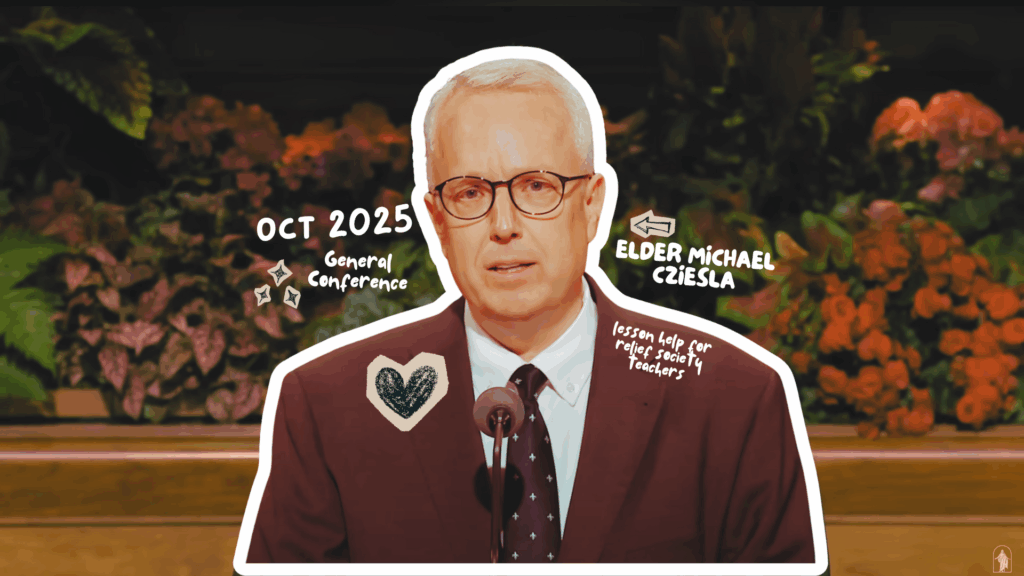
Elder Cziesla teaches that the simplicity that is in Christ is not laziness or spiritual minimalism—it’s the clarified, covenant-centered life that keeps the Savior at the center and lets everything else take its right-sized place.

Grab our free bundle of 50+ Presentation Backgrounds by clicking here: https://otherthanamom.myflodesk.com/freebackgrounds
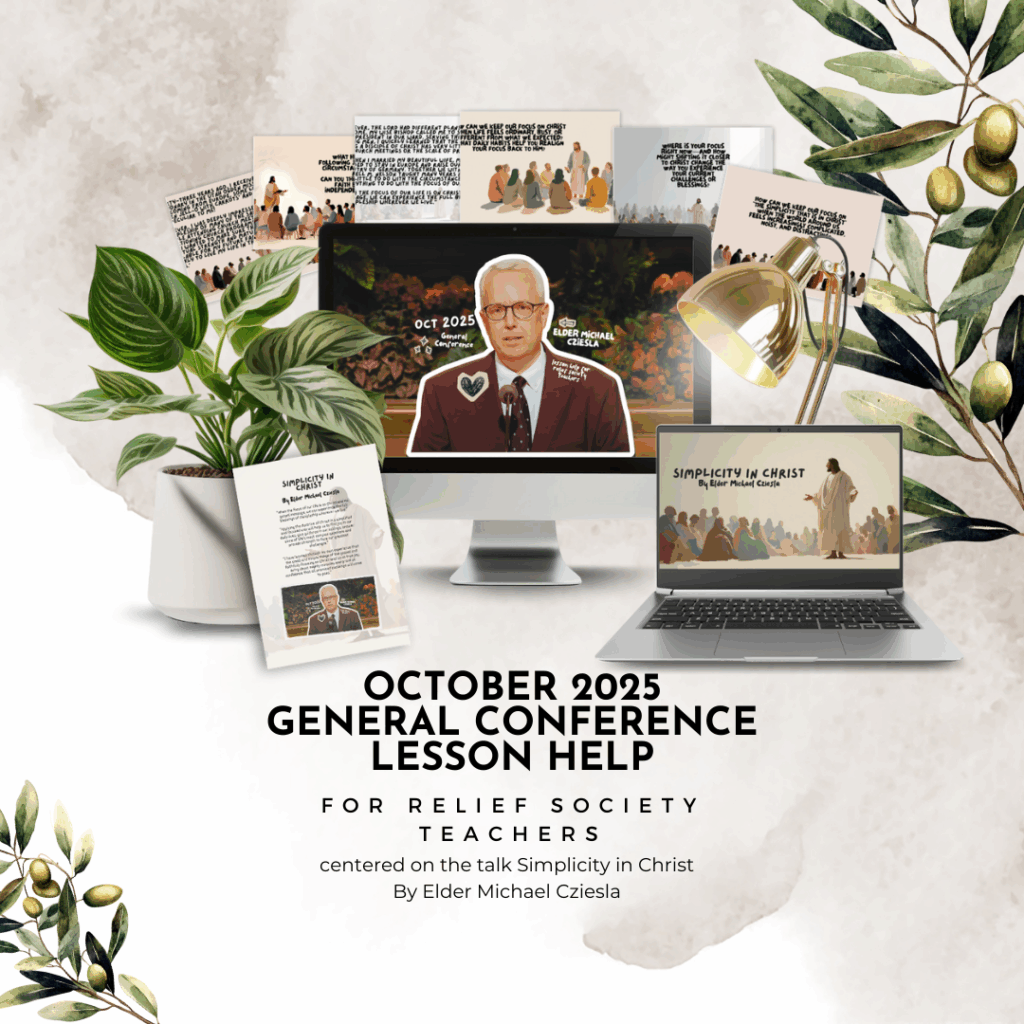
Interested in a done-for-you lesson plan with a teacher’s outline Google Doc, Canva Presentation Template, Lesson Handout Template, and themed presentation backgrounds? Click here: https://www.etsy.com/listing/4414275422/october-2025-general-conference-lesson?sr_prefetch=1&pf_from=shop_home&ref=shop_home_active_1&dd=1&logging_key=082f04b236bc6d56e64cb42dbc38c01fde39c015%3A4414275422
Section 1 — Joy ≠ Circumstance: “The focus of our life is on Christ”
“The joy we feel has little to do with the circumstances of our lives and everything to do with the focus of our lives.”
10 Deeper Discussion Questions
- When you’ve felt real joy amid unfavorable circumstances, what exactly were you focused on? Can you name the mental shift?
- What subtle “success metrics” (size of programs, numbers, visibility) creep into your discipleship—and how do they distort your joy?
- If joy is fruit of focus, which current focus feels most like a counterfeit center?
- Where do you confuse busyness with aliveness in Christ?
- What would change this week if you believed joy is available before your circumstances improve?
- Which part of your life most resists being re-centered on Christ—and why?
- What practices help you return your gaze to Jesus within 60 seconds?
- How do you teach your family to measure joy by faithfulness instead of outcomes?
- When have you seen a small, hidden work produce more joy than a big visible one?
- What courageous “no” would create space for a truer “yes” to Christ?
5 Simple In-Class Visuals
- Two concentric circles (outer: “circumstances,” inner: “Christ”)—place sticky notes where your focus sits now.
- Magnifying glass—what are you magnifying daily?
- Scale—on one side “visible success,” on the other “quiet faithfulness.”
- Reset card—write a 10-word refocusing prayer.
- Timer (60s)—practice a one-minute re-centering (breath + scripture phrase).
10 Personal Sharing Prompts
- A time joy preceded change.
- A hidden act that brought disproportionate joy.
- A counterfeit center you’re releasing.
- Your 60-second refocus tool.
- A “no” that guarded your “yes” to Christ.
- A family moment measured by faithfulness, not outcome.
- A joy thief you’ve unmasked.
- One place you’ll put Christ back in the center this week.
- A line you pray when you’re scattered.
- Your short witness that joy is focus.
Section 2 — “The Simplicity that is in Christ”: The Doctrine & the Path
Faith in Jesus Christ, repentance, baptism, the Holy Ghost, and enduring to the end—President Nelson’s “covenant path.”
10 Deeper Discussion Questions
- Where does the doctrine feel too simple to trust—and what fear sits underneath that?
- Which step on the path are you over-complicating right now?
- How does enduring differ from white-knuckling? What grace feels like endurance?
- If repentance is daily, how do you avoid making it self-critique instead of Christ-turn?
- Where have you experienced the Holy Ghost as sanctifier (not just comforter)?
- Which covenant promise is most alive in your current season?
- How do you discern between devotional depth and devotional volume?
- What would make your weekly sacrament astonishing again?
- Where are you tempted to “do some great thing” rather than the small thing God is asking?
- What would “one faithful step” look like today—not theoretical, today?
5 Simple Visuals
- Straight thread labeled “Covenant Path”: tie one knot for today’s step.
- Small stone “Endure with Grace”: carry it as a tactile reminder.
- Arrow card: write the very next faithful action.
- Two jars “Great Thing” vs. “Small Thing”: drop your slip where God is leading.
- Bread + water icons (paper): name one way to prepare more reverently.
10 Personal Sharing Prompts
- A time simple obedience outperformed a grand plan.
- What daily repentance feels like when it’s about turning toward.
- A sacrament practice that re-astonishes you.
- One sanctifying experience with the Spirit.
- Your next faithful step today.
- A fear that made the path seem complicated.
- Promise you’re noticing kept.
- Volume you’ll reduce; depth you’ll increase.
- Where you stopped white-knuckling and received grace.
- Your covenant-path testimony.
Section 3 — Simplicity ≠ Easy: “Put off the natural man”
“We may misinterpret simplicity as something easy… Following Christ requires constant effort and continual change.”
10 Deeper Discussion Questions
- Where have you confused clarity with ease, and what did that cost you?
- What part of your “natural self” feels most threatened by Christlike simplicity?
- How do you distinguish holy limits from avoidance?
- If simplicity requires trust, where do you demand total explanation before obedience?
- Which relationship would benefit from childlike (not childish) trust?
- What personal complexity are you ready to lay down as a spiritual offering?
- Where has the Lord asked you to decrease (noise, pace) so He can increase?
- What does mature meekness look like in your voice, calendar, and attention?
- When is “hard” a sign of growth, not misdirection?
- What continual change is God already empowering in you?
5 Simple Visuals
- Backpack labeled “complexity”—drop in a paper slip you’ll remove this week.
- Child’s block “Trust”—pass it and share one trust-act.
- Two lists: “Explained obedience” / “Trusted obedience.”
- Eraser: one habit to erase to make room for grace.
- Volume knob: what will you turn down?
10 Personal Sharing Prompts
- An obedience you did before full explanation.
- A complexity you’re surrendering.
- A meekness practice you’re trying.
- A “hard” that meant growth.
- A limit that was actually holy.
- A trust story in a relationship.
- Where you reduced pace to hear God.
- A continual change you see over time.
- The cost of needing control.
- Your witness that simple ≠ easy, and it’s worth it.
Section 4 — Pure Truth, Pure Doctrine, Pure Revelation: “What would the Lord have me do?”
“Regularly asking, ‘What would the Lord Jesus Christ have me do?’ reveals profound direction.”
10 Deeper Discussion Questions
- When you ask that question, what usually gets revealed first: duty, desire, or deception?
- How do you test whether an impression is pure revelation vs. anxiety, people-pleasing, or preference?
- Where does Jesus’s actual example contradict your cultural reflexes?
- What would shift if you sought revelation about what to stop as much as what to do?
- When revelation disrupts your plan, how do you yield without resentment?
- Which attribute of Christ (Peace-giver, Shepherd, Deliverer) needs to mentor your current decision?
- What keeps your scripture study revelation-ready instead of content-heavy?
- How do you record and act before the glow fades?
- What have you learned about God’s timing as part of revelation, not a delay to it?
- If Jesus answered your hardest question with one small step, would you take it this week?
5 Simple Visuals
- Three small cards: Truth / Doctrine / Revelation—place your current issue under one.
- Stop sign (paper): write one Spirit-led “stop.”
- Footprint: one revealed step to take in 48 hours.
- Journal strip: capture a sentence you’ll act on today.
- Name tag with a title of Christ guiding this choice.
10 Personal Sharing Prompts
- A time revelation contradicted preference.
- A “stop” that freed you.
- How you test and confirm impressions.
- The scripture that read you back.
- A recorded prompting you acted on quickly.
- A timing miracle you only saw later.
- Which title of Christ guided a choice.
- One step you’ll take in 48 hours.
- How you handle dry seasons of revelation.
- Your testimony of the question: “Lord, what would You have me do?”
Section 5 — Small & Simple Practices that Actually Carry Us
Prayer, fasting, scripture, daily repentance, sacrament, temple worship—“the gospel works wonderfully.”
10 Deeper Discussion Questions
- Which practice currently feels hollow—and what small shift could make it honest again?
- How do you keep the sacrament from becoming symbolic only and let it be sanctifying?
- Which practice most reliably opens your heart when you’re numb?
- What’s the line between habit (good) and automation (spiritless)?
- If you could only keep one practice during a crisis, which would you keep and why?
- How has temple worship reframed a fear this year?
- What does daily repentance look like without self-fixation?
- Where did fasting clarify desire vs. demand?
- How do these practices prioritize people over processes in ministering?
- What practice will you simplify to increase sincerity?
5 Simple Visuals
- Habit stack card: anchor a practice to an existing routine.
- Two cups: “Symbolic” vs “Sanctifying”—where’s your sacrament experience today?
- Temple card: write one fear + the truth you learned there.
- Fasting compass: draw where fasting is pointing your desire.
- Checkmark vs. heart stickers to label current habits.
10 Personal Sharing Prompts
- A hollow practice you made honest.
- One sacrament preparation that changed Sunday.
- Your crisis-practice.
- A temple truth that re-framed fear.
- A repentance that felt like relief.
- A fast that clarified desire.
- A ministering moment where you chose person > process.
- A simplification you’ll make this week.
- A habit stack that works for you.
- Your witness that “the gospel works wonderfully.”
Section 6 — Oma Cziesla: A Case Study in Covenant Perseverance
“She focused on what she could do… prayed, read, sang… and after 25 years the sacrament meeting where she returned was where her son knew the Church was true.”
10 Deeper Discussion Questions
- Where might faithful obscurity be your current calling?
- What do you do when you can’t do everything—what is your “can do”?
- Which simple practice would you keep if all structure vanished tomorrow?
- What if your obedience blesses someone else decades later—does that change your stamina?
- Which story or hymn has become your survival liturgy?
- How do you keep covenant identity when ordinance access is difficult (distance, illness, war, crisis)?
- What’s your bicycle ride—the inconvenient act that reunites you with the Saints?
- How do you narrate God’s faithfulness to your children during scarcity?
- Where are you tempted to label yourself “inactive” when you’re actually being faithful in place?
- What legacy of small and simple are you intentionally building?
5 Simple Visuals
- Bicycle cutout: write your “ride” back to worship.
- Seed: faithful obscurity now, fruit later.
- Hymn line on a card: your survival lyric.
- Map with a dot: where you’ll gather, even if it’s far.
- “Can Do” jar: drop one doable act for this week.
10 Personal Sharing Prompts
- Your faithful-in-place story.
- A hymn/verse you carried in lean years.
- Your inconvenient “ride” back to community.
- A child/friend who caught faith from your routine.
- One “can do” you’ll commit to during limitation.
- A scarcity where God met you.
- A long-arc miracle you witnessed.
- How you’ll narrate God’s goodness at home.
- A legacy practice you’re planting.
- Your witness of Oma-style perseverance.
Section 7 — “Out of Small Things Proceedeth That Which Is Great”
“Small and simple things… lead us to true joy, bring about mighty miracles, and grant confidence that all promised blessings will come.”
10 Deeper Discussion Questions
- What promise are you waiting on—and what small act keeps your lamp trimmed?
- Where have you mistaken quiet for absence instead of incubation?
- Which miracle in your life arrived seed-small before it was obvious?
- What does confidence before God feel like in your body?
- Which “small” obedience is disproportionately forming you right now?
- What blessing do you trust will come even if it’s not soon?
- How will you keep bitterness from colonizing an in-between?
- Where does gratitude re-open a door that sorrow shut?
- What is your next faithful mustard-seed action?
- If God answered only with strength to continue, would that be enough today?
5 Simple Visuals
- Mustard seed (paper dot): write the tiniest step you’ll take.
- Hourglass: name what God is forming during the waiting.
- Lamp cutout: one action that keeps oil in your lamp.
- Two jars “Bitterness / Gratitude”—move one bead today.
- Postcard to Future You: “Dear me, the promise is still good because…”
10 Personal Sharing Prompts
- A seed-sized beginning that became a miracle.
- How you experience “confidence before God.”
- A promise you’re still trusting.
- A gratitude that shifted a heavy day.
- Your mustard-seed action.
- A waiting you interpret as incubation.
- Strength you received instead of solution.
- A small obedience shaping you.
- How you keep bitterness small.
- Your closing witness that small + simple + Christ = great.
Conclusion
Simplicity in Christ is not less of a life—it’s life clarified by covenants and powered by the grace of Jesus. Invite your class to choose one simplification, one small-and-simple practice, and one revealed next step they will take in the next 48 hours. The gospel really does “work wonderfully” when we do the small things with a whole heart. 💛