Introduction
Some talks are memorable because of a phrase. Others stay with you because of an image. Elder Edward B. Rowe’s talk, “Choose Jesus Christ as Your Guide,” gives us both. His image of walking through a former war zone filled with hidden land mines is powerful on its own, but when he connects that experience to discipleship, the whole talk becomes deeply personal. Life is beautiful, sacred, and full of purpose, but it is also full of spiritual dangers we cannot always see on our own. That is why we need a guide. And not just any guide. We need Jesus Christ.
This Relief Society lesson help is designed to make your preparation more meaningful and much easier to organize. The talk is broken into chronological discussion sections, following the speaker’s natural progression of thought. Each section includes longer direct quotes from the talk, discussion questions, object lesson ideas, and personal sharing prompts to help you lead a discussion that is thoughtful, doctrinal, and open to real testimony and story sharing.
One of the greatest blessings of a lesson help like this is that it allows the teacher to spend less time scrambling for structure and more time seeking the Spirit. Instead of wondering where to break the talk apart or what to ask, you can focus on the women in your class, the truths that need to be emphasized, and the ways the Savior may want to speak to them through this message.

Grab our free bundle of 50+ Presentation Backgrounds by clicking here: https://otherthanamom.myflodesk.com/freebackgrounds
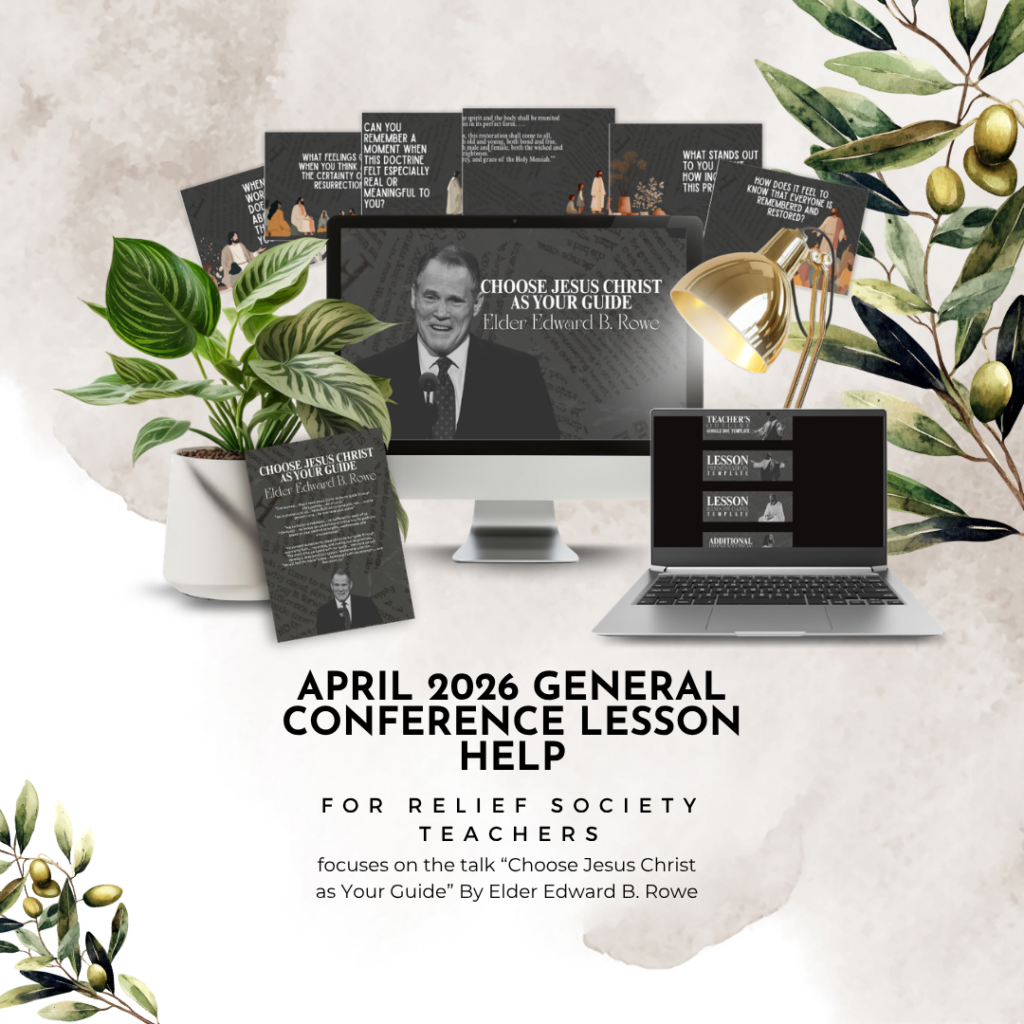
Interested in a done-for-you lesson plan with a teacher’s outline Google Doc, Canva Presentation Template, Lesson Handout Template, and themed presentation backgrounds? Click here: https://choose-jesus-christ-as-your-guide-by-elder-edward-b-rowe.teachery.co/payment?preview=true
Section 1: Life Can Feel Beautiful and Dangerous at the Same Time
Teach
Elder Rowe begins by describing a real-life assignment in a former war zone. The setting is striking because it mirrors mortality so well. On the surface, he was simply traveling through remote terrain. In reality, danger was hidden underfoot. This becomes an important framework for the whole talk: life often contains unseen spiritual hazards, and that reality should make us humble, not afraid.
Direct Quotes from the Talk
“Several years ago, as a young lawyer, I was involved in resolving a border dispute between countries that had been at war. The work required me to travel on foot through remote areas that were part of the recent war zone. Thousands of land mines had been laid during the war. Expert deminers were there, working to deactivate the mines; however, to my surprise, not all locations of the mines were known. Consequently, on occasion people would accidentally step on them and be injured or killed.”
Discussion Questions
- What stood out to you most in Elder Rowe’s opening story?
- Why is the image of hidden land mines such an effective metaphor for mortality?
- What kinds of “spiritual land mines” do people face today?
- Why are unseen dangers often more frightening than visible ones?
- How can this story help us view mortality more realistically?
- In what ways can life look ordinary on the surface while holding deeper spiritual risk?
- Why is humility so important when navigating life?
- How can we stay aware without becoming fearful?
- What does this opening section teach us about dependence on God?
- How does this story prepare us for the rest of the talk?
Object Lessons
- Create a paper “path” with hidden notes under some stepping stones labeled temptation, discouragement, pride, deception, resentment.
- Use a simple obstacle course where only some hazards are visible.
- Show a beautiful photograph with a warning sign added to it to illustrate hidden danger in lovely places.
- Place several identical cups upside down and hide a warning slip under a few.
- Draw a map with “safe” and “unsafe” zones to discuss the need for guidance.
Personal Sharing Prompts
- Share a time when you later realized a situation was spiritually more dangerous than it first seemed.
- Describe a season when life looked normal but felt spiritually heavy or uncertain.
- Share how the Lord has warned or protected you from something unseen.
- Talk about a time you felt vulnerable and needed guidance.
- Share what helps you stay spiritually alert.
- Describe a “land mine” you have learned to recognize in your life.
- Share a time the Lord protected you from a wrong step.
- Talk about how your awareness of spiritual danger has changed with age or experience.
- Share how humility has helped keep you safe.
- Describe what this opening story teaches you personally.
Section 2: A Guide Makes Safe Progress Possible
Teach
Elder Rowe then introduces Winta, the guide who knew the terrain personally. The instructions were simple and exact: follow closely, walk where he walks, step where he steps. This section is powerful because it teaches that guidance is not abstract. It is practical, specific, and often step-by-step.
Direct Quotes from the Talk
“To help me complete my work, I’d been provided a special guide named Winta. Winta was well known in the area. He was from a border town that had been attacked. He escaped and then volunteered to stay in the region throughout the war to observe the activities of the opposing army. He knew the terrain and what occurred during the war.
“Because it was possible that some places I would travel had undetected mines, I was given the following instructions: Carefully follow your guide. Winta knows this border area from personal experience. Walk in his footsteps a few paces behind him. Where he goes, you go. Where he steps, you step. I was literally to follow in Winta’s footsteps.”
“For several days I followed Winta through many areas in the border region. At first I felt uncertain and apprehensive, hiking at times in abandoned trenches, destroyed villages, and other areas where the armies had been. The more we walked together and I remained safe, the more my confidence grew. Thanks to Winta, I completed my work without harm and safely returned home. As I followed in his footsteps, walking with my guide, I developed great trust and gratitude for him.”
Discussion Questions
- Why do you think Elder Rowe includes so much detail about the guide?
- What does it mean spiritually to “walk in his footsteps”?
- Why is close following different from simply admiring a guide from a distance?
- How does experience build trust?
- Why do you think his confidence grew as he stayed safe over time?
- What does this teach about obedience when we do not fully understand the danger?
- How can trust in the Lord deepen through repeated experiences?
- Why is gratitude a natural outcome of being guided and protected?
- What are some ways the Lord asks us to follow step by step instead of all at once?
- How do you know when you are trying to lead yourself instead of following the Guide?
Object Lessons
- Lay down paper footprints and have someone follow them exactly.
- Use a blindfold and a trusted guide for a short safe exercise.
- Show a hiking trail marker and discuss the importance of staying on the path.
- Use a rope connecting two people to symbolize close following.
- Place “safe steps” and “unsafe steps” on the floor to illustrate precise obedience.
Personal Sharing Prompts
- Share a time you followed spiritual promptings closely and were protected.
- Describe how your trust in the Savior has grown over time.
- Share an experience where obedience made sense only afterward.
- Talk about a time you felt uncertain but safe because you followed the Lord.
- Share what has helped you develop gratitude for divine guidance.
- Describe a moment when the Lord led you step by step.
- Share how following Christ has brought peace in uncertainty.
- Talk about a lesson you learned from walking slowly with God.
- Share how a hard season increased your trust in Him.
- Describe what “walking in His footsteps” means to you.
Section 3: Jesus Christ Is Our Perfect and Personal Guide
Teach
Now Elder Rowe makes the transition from story to doctrine. Just as Winta was essential in the war zone, Jesus Christ is essential in mortality. The key phrase here is not only that Christ is our guide, but that He is both perfect and personal. He does not guide humanity only in general. He guides each of us individually.
Direct Quotes from the Talk
“Brothers and sisters, as much as I needed Winta to be my guide then, I’ve learned, more importantly, that I need Jesus Christ to be my guide through life’s journey amid its spiritual land mines. All of us do.”
“Christ’s invitation is constant and consistent: ‘Come, follow me.’ ‘Walk with me.’ ‘Return unto me.’ His invitation is to all—whoever we are, wherever we are. For ‘he inviteth … all to come unto him and partake of his goodness; and he denieth none that come unto him.’ Jesus Christ denieth none! No one need walk alone!”
“The Son of God, the Father of heaven and earth, the Creator of all things from the beginning invites us—we who ‘labour and are heavy laden’ with our weaknesses and imperfections—to walk with Him as our guide.”
Discussion Questions
- What difference does it make to think of Jesus Christ as your guide, not just your Savior in a distant sense?
- Why is the phrase “All of us do” important?
- What do you notice about Christ’s repeated invitations: come, follow, walk, return?
- Why do you think Elder Rowe emphasizes that Jesus denies none?
- How can this doctrine help someone who feels spiritually behind or inadequate?
- What does it mean that no one needs to walk alone?
- How have you felt the Savior guide you personally?
- Why is it comforting that Christ invites those who are weak and heavy laden?
- How can we respond more fully to His invitations?
- What does this section teach about the nature of Jesus Christ?
Object Lessons
- Use a signpost with the words Come, Follow, Walk, Return.
- Show an open gate to symbolize Christ denying none.
- Place one chair next to another to represent not walking alone.
- Use a shepherd image guiding sheep.
- Hold a map labeled “Life” with Christ marked as Guide.
Personal Sharing Prompts
- Share a time you felt the Savior guide you personally.
- Describe which of His invitations means the most to you right now: come, follow, walk, or return.
- Share how it has helped you to know that Christ denies none.
- Talk about a season when you felt especially aware that you were not walking alone.
- Share what it means to you that Jesus is a personal guide.
- Describe how Christ meets you in weakness.
- Share how His invitations have changed your life.
- Talk about a moment you chose to return to Him.
- Share how this section answers a fear or need in your life.
- Describe what kind of guide the Savior has been to you.
Section 4: He Knows Exactly How to Guide You Because He Knows You Personally
Teach
This is one of the most tender parts of the talk. Elder Rowe explains that because of the Savior’s Atonement, He knows each of us individually—our sins, pains, heartaches, infirmities, strengths, weaknesses, and circumstances. That means His guidance is not generic.
Direct Quotes from the Talk
“Jesus Christ was completely obedient to the Father and declared: ‘I have set an example for you.’ ‘That which ye have seen me do even that shall ye do.’ As we strive to follow His perfect example, He will strengthen us and protect us from Satan’s spiritual land mines.”
“While the Savior’s Atonement is infinite, His invitation is individual. He invites you and me to accept Him as our personal guide. He suffered not just for humanity—He suffered for each of us individually. As President Russell M. Nelson taught, ‘Jesus Christ took upon Himself your sins, your pains, your heartaches, and your infirmities.’ In short, He knows you personally and thus how to guide you based on your distinct strengths, weaknesses, and circumstances.”
Discussion Questions
- Why is it important that Christ’s invitation is individual?
- How does the Atonement make Christ’s guidance personal rather than general?
- What does it mean that He knows your specific strengths and weaknesses?
- How does this change the way you pray for guidance?
- Why do you think some people still feel unseen, even while believing in Christ?
- How can we trust the Savior’s guidance when it differs from what works for someone else?
- What do you learn about discipleship from the phrase “He suffered for each of us individually”?
- How does the Savior’s perfect obedience help Him guide us safely?
- How can this section bring comfort to someone with complex circumstances?
- What does this teach about the intimacy of the Atonement?
Object Lessons
- Show a general road map and a personalized route to compare generic versus individual guidance.
- Use name cards to emphasize individual care.
- Hold a custom-fit key and discuss how the Savior knows what uniquely fits us.
- Show a medical chart to symbolize individualized healing and care.
- Use a shepherd analogy with one sheep needing different care than another.
Personal Sharing Prompts
- Share a time you felt Christ’s guidance was personal to your situation.
- Describe how the Savior has helped you in a way that fit your unique needs.
- Share what it means to you that He knows your pains and heartaches.
- Talk about a time you felt individually seen by the Lord.
- Share how your trust has grown because Christ knows you so well.
- Describe a moment when generic advice was not enough, but the Spirit’s guidance was.
- Share how the Atonement has become more personal to you.
- Talk about a weakness the Savior has helped you navigate.
- Share how Christ’s example influences the way you make decisions.
- Describe what “personal guide” means in your current life.
Section 5: The Covenant Path Connects Us to Our Guide
Teach
Elder Rowe next teaches that our path is unique, but it must remain within the covenant path because that is Christ’s path. He then explains how we connect ourselves to Him as our guide—through faith, repentance, ordinances, covenants, and holy places.
Direct Quotes from the Talk
“Though our paths in life are unique, each is to be within the covenant path. For that is Christ’s path. We enter that path and connect ourselves to Jesus Christ as our guide through exercising faith in Him, repenting, and making sacred promises, or covenants, with Him.”
“We follow in His footsteps within the covenant path by being in holy places, like the temple, and by having sacred experiences through partaking of the sacrament, praying, studying the scriptures, and ministering to others. The more time we spend with our guide in this way—and strive to follow His example—the more we will develop a deep bond and special relationship with Him and our Heavenly Father.”
“We will feel the Savior’s love, be blessed with His strength, and have greater trust in Him. Even our very natures will change to become more like Him. We will feel more joy. And our love and gratitude for Him will grow.”
Discussion Questions
- Why does Elder Rowe say each person’s path is unique but still must stay within the covenant path?
- How do faith and repentance connect us more fully to Jesus Christ as our guide?
- Why are covenants described as sacred promises that connect us to Him?
- What role do holy places play in following Christ?
- How do ordinary practices like prayer, scripture study, sacrament worship, and ministering deepen our bond with the Savior?
- What does it mean to develop a “deep bond” with Christ?
- How have your covenants changed the way you experience daily discipleship?
- Why does joy increase as we stay closer to the Savior?
- How does our nature actually begin to change through this kind of discipleship?
- Which of these practices most strengthens your sense of walking with Christ?
Object Lessons
- Use a covenant path visual with markers for faith, repentance, ordinances, and endurance.
- Show footprints leading along a path labeled temple, sacrament, prayer, scriptures, ministering.
- Use a rope tied at several points to symbolize covenant connection.
- Show a trail map with checkpoints representing holy practices.
- Bring a small bundle of objects representing temple worship, scriptures, prayer, and sacrament.
Personal Sharing Prompts
- Share a time the temple helped you feel closer to the Savior as your guide.
- Describe how sacrament worship helps you stay on Christ’s path.
- Share how prayer has helped you follow Him more clearly.
- Talk about how ministering has deepened your relationship with Jesus Christ.
- Share a time your covenants gave you strength in a difficult season.
- Describe how your trust in the Savior has grown through repeated spiritual practices.
- Share how your nature has changed as you have stayed on the covenant path.
- Talk about a holy place that became especially meaningful to you.
- Share which spiritual habit most helps you feel guided.
- Describe how joy has grown as you have stayed closer to Christ.
Section 6: Christ Not Only Guides Imperfect Followers—He Heals Them
Teach
This section is especially hopeful because Elder Rowe acknowledges that even when Christ is our guide, we remain imperfect followers. But that imperfection is not the end of the story. Because of the Atonement, Christ has power not only to guide but also to heal us completely when we walk imperfectly.
Direct Quotes from the Talk
“While the Savior is our perfect guide, we are imperfect followers. Indeed, ‘all have sinned, and come short of the glory of God.’ Our loving Heavenly Father knew this would be so. He therefore provided a Savior for us; and because Christ answered the ends of the law through His Atonement, the Father gave Him all power to heal us completely when we walk imperfectly.”
“I know this to be true. When injured by spiritual land mines, I have experienced Christ’s redeeming and healing power by exercising faith in Him and repenting with real intent. I have been spiritually healed by Jesus Christ. I promise you can be too!”
Discussion Questions
- Why is it important that Elder Rowe openly says we are imperfect followers?
- What difference is there between a perfect guide and imperfect followers?
- How does the Atonement make healing possible after spiritual injury?
- What does “repenting with real intent” mean to you?
- Why is it significant that Christ can heal completely, not partially?
- How does this section change the way we think about failure in discipleship?
- What kinds of spiritual injuries do people often carry silently?
- Why do you think Elder Rowe includes his own witness of healing?
- How can this message help someone who feels too damaged to recover?
- What does this section teach about the mercy of Heavenly Father’s plan?
Object Lessons
- Use a bandage or first aid kit to symbolize healing after injury.
- Show a torn paper mended carefully to represent redemption.
- Use a broken object that can be repaired to discuss complete healing.
- Place stones labeled shame, guilt, addiction, regret, and then remove them one by one.
- Show a wound healing over time to discuss spiritual recovery.
Personal Sharing Prompts
- Share a time you experienced Christ’s healing after a wrong step.
- Describe what repentance with real intent has looked like in your life.
- Share how the Savior has helped you recover from spiritual injury.
- Talk about a time the Atonement felt not just true, but active.
- Share how hope returned after a discouraging season.
- Describe what healing in Christ means to you.
- Share a time you learned that the Lord was not done with you.
- Talk about how your understanding of repentance has become more hopeful.
- Share how Christ has helped you walk again after feeling broken.
- Describe a promise of healing you hold onto.
Section 7: His Arm of Mercy Is Extended Right Now
Teach
Elder Rowe then becomes even more direct and pastoral. This section is a plea. The Savior’s invitation is not theoretical. It is immediate. His arm of mercy is extended now, and no matter how inadequate or injured we feel, His hand is available.
Direct Quotes from the Talk
“Please accept His invitation: ‘Will [you] not now return unto me, and repent of your sins, and be converted, that I may heal you? … [My] arm of mercy is extended towards you, and whosoever will come, him will I receive.’”
“Jesus Christ is thus not only a perfect and personal guide—He is also the resurrected Redeemer and Master Healer! No matter how injured you are or how imperfect and inadequate you feel at following Him, He loves you. His merciful hand is extended to you even now. Please take it!”
Discussion Questions
- Why does this invitation feel so personal and urgent?
- What does it mean to you that His arm of mercy is extended right now?
- Why do people sometimes hesitate to accept His healing?
- How can we help others trust that Christ will receive them?
- What does “return unto me” look like in practical ways?
- Why does Elder Rowe address feelings of inadequacy so directly?
- How does it change your heart to know the Savior’s merciful hand is extended even now?
- What are some reasons people feel afraid to take His hand?
- How have you experienced Christ receiving you when you returned?
- What does this section teach about the nature of mercy?
Object Lessons
- Extend a hand and invite someone to take it.
- Use an open door to symbolize the Savior receiving all who return.
- Show a lifeline or rope thrown to someone in danger.
- Use the image of a shepherd reaching for a sheep.
- Place a sign reading “Return” on a path leading back toward a light.
Personal Sharing Prompts
- Share a time you felt the Lord inviting you to return.
- Describe what it means to you that His mercy is extended now.
- Share an experience where Christ received you with mercy.
- Talk about how the Savior has met you in inadequacy.
- Share what helps you take His hand instead of pulling away.
- Describe a time mercy felt stronger than shame.
- Share how you have seen Christ welcome someone back.
- Talk about what “Master Healer” means in your life.
- Share a moment when the Lord’s love felt immediate and real.
- Describe why you trust His invitation.
Section 8: Jesus Christ Is the Way—and He Will Lead You Home
Teach
Elder Rowe closes with Easter witness and a final invitation: let Christ be your guide, walk with Him, and when you struggle or stray, return to Him for healing. The talk ends not just with doctrine, but with testimony.
Direct Quotes from the Talk
“This Easter morning, may we all accept Christ’s invitation to be our guide and walk with Him. And when we struggle or stray, let us return unto Him that He may heal us—that He may heal you. As President Dallin H. Oaks declared, ‘Jesus Christ is the way!’ He lives! He is our Savior and Redeemer, the resurrected Christ, whom I love. Of Him I bear witness in the name of Jesus Christ, amen.”
Discussion Questions
- Why is Easter such a fitting time to hear this invitation?
- What does it mean to accept Christ as your guide, not just admire Him?
- Why do you think Elder Rowe repeats the invitation to return when we stray?
- How does the Resurrection strengthen the promise that Christ can guide and heal?
- What does the phrase “Jesus Christ is the way” mean to you personally?
- How does testimony change the tone of the whole talk?
- What do you think Elder Rowe most wants listeners to do after hearing this message?
- How can we walk with Christ more deliberately this week?
- What does it mean to be led safely home?
- What part of this talk do you feel you most need right now?
Object Lessons
- End with a path leading to a home image labeled “safely home.”
- Use a risen Christ image beside a pathway illustration.
- Show a guidepost with the words “Walk with Him” and “Return to Him.”
- Use a lantern and a path to symbolize ongoing guidance.
- Place a cross and an empty tomb image beside footprints.
Personal Sharing Prompts
- Share what it means to you that Jesus Christ is the way.
- Describe how the risen Christ gives you hope in your journey.
- Share a time you returned to Him and found healing.
- Talk about what it means to let Him lead you home.
- Share how your witness of Christ as guide has grown.
- Describe one way you want to walk with Him more deliberately.
- Share which line from the talk touched you most.
- Talk about how Easter strengthens your discipleship.
- Share your testimony of Jesus Christ as Savior, Redeemer, and Guide.
- Describe what safe arrival means to you spiritually.
Conclusion
Preparing a Relief Society lesson can sometimes feel like trying to find a path through too many ideas at once. A well-structured lesson help removes some of that weight. When the talk is already divided into its natural teaching sections, when the strongest quotes are already gathered, and when meaningful questions and prompts are ready, you are freer to prepare spiritually instead of just administratively.
Elder Edward B. Rowe’s talk is especially powerful for Relief Society because it speaks to something nearly every woman understands: life can feel uncertain, dangerous, exhausting, and hard to navigate. There are spiritual land mines we cannot always see. There are stretches of life when we feel apprehensive, inadequate, or injured. But his message is profoundly hopeful. We do not have to lead ourselves. Jesus Christ is our perfect and personal guide. He knows the path, He knows us, He walks with us, and when we are hurt, He heals us. He is not only the one who leads us safely. He is also the one who welcomes us back when we have wandered and strengthens us to keep going. That is why this talk makes such a beautiful Relief Society lesson: it does not just teach doctrine. It invites trust. It invites return. And it points every heart back to the living Christ, who truly is the way.