Introduction
Some Relief Society lessons are built around a doctrine. Others are built around an invitation. Elder Pedro X. Larreal’s talk, “I Feel My Savior’s Love,” is both. At its center is a deeply personal question: Do you know how much the Savior loves you? And his answer points us to one of the most sacred recurring gifts in the Church—the ordinance of the sacrament.
This talk is especially meaningful for Relief Society because it turns our attention to something we experience every single week, but may not always approach with full spiritual preparation. Elder Larreal teaches that the sacrament is not just a routine part of Sunday worship. It is a sacred opportunity to remember Jesus Christ, renew our access to the companionship of the Holy Ghost, and personally feel the Savior’s love. In a world where truth is disguised and spiritual survival requires the constant influence of the Holy Ghost, this message feels both timely and tender.
This lesson help is designed to make preparation easier while also going much deeper. The talk is divided into chronological discussion sections that follow Elder Larreal’s flow of thought. Each section includes direct quotes from the talk, discussion questions, object lesson ideas, and personal sharing prompts to help create meaningful Relief Society conversation. Rather than piecing together a lesson at the last minute, you can focus on listening to the Spirit, understanding the needs of the sisters in your class, and inviting a deeper reverence for the sacrament and the Savior.

Grab our free bundle of 50+ Presentation Backgrounds by clicking here: https://otherthanamom.myflodesk.com/freebackgrounds
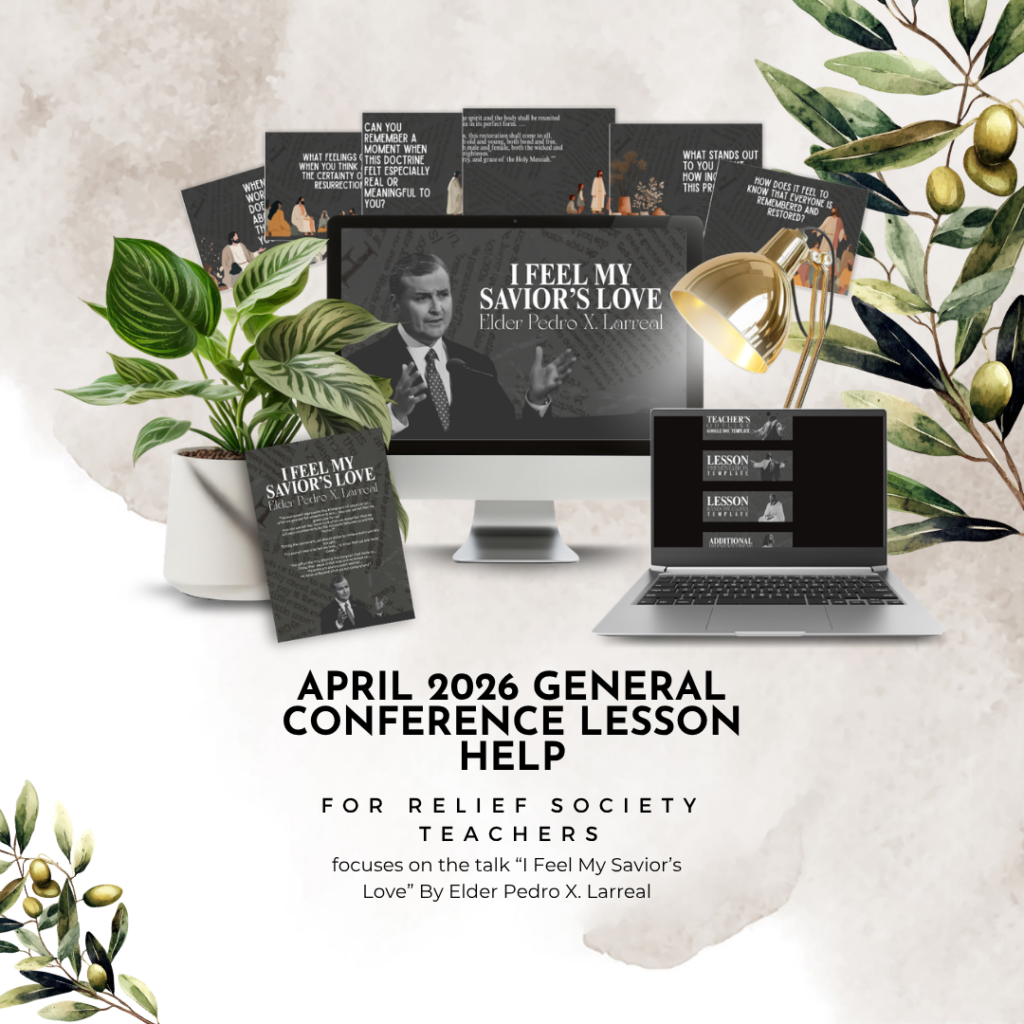
Interested in a done-for-you lesson plan with a teacher’s outline Google Doc, Canva Presentation Template, Lesson Handout Template, and themed presentation backgrounds? Click here: https://www.teachery.co/editor/courses/i-feel-my-savior-s-love-by-elder-pedro-x-larreal/landing_pages/payment/edit
Section 1: The Question at the Heart of the Talk
Teach
Elder Larreal opens with a searching and tender question: Do you know how much the Savior loves you? That question sets the tone for the entire message. This is not just a doctrinal talk about the sacrament. It is a personal invitation to discover, or rediscover, the love of Jesus Christ in a sacred weekly ordinance.
Direct Quotes from the Talk
“My dear brothers and sisters, do you know how much the Savior loves you? If you do not know or have never thought about it before, I hope by the end of this message you will know how to find the answer to this question.”
Discussion Questions
- Why do you think Elder Larreal begins with this question?
- How would you answer that question personally right now?
- Why do some people believe in Jesus Christ but still struggle to feel His love personally?
- What are some ways people try to measure their worth incorrectly instead of looking to the Savior?
- How can a question like this open hearts in a lesson?
- Why is it important not just to believe that Christ loves people generally, but that He loves you?
- What experiences have helped you feel the Savior’s love more personally?
- Why do you think Elder Larreal says we can “find the answer” to this question?
- How does this opening shift the way we think about the sacrament?
- What part of your life most needs the reassurance of the Savior’s love right now?
Object Lessons
- Hand each sister a small card with the words “He loves you” and invite quiet reflection.
- Use a mirror labeled “Beloved of Christ” to discuss personal identity.
- Hold up a question mark and then a heart to show the movement from uncertainty to assurance.
- Use a family photo to discuss the difference between knowing love exists and knowing it is personally directed toward you.
- Show an unopened gift and discuss how some blessings are real even before they are fully opened and felt.
Personal Sharing Prompts
- Share a time when you felt the Savior’s love in a personal way.
- Describe a season when you needed reassurance that Christ knew and loved you.
- Share how your understanding of the Savior’s love has changed over time.
- Talk about a moment when a gospel truth felt deeply personal rather than general.
- Share what helps you remember that the Savior’s love is real.
- Describe an experience where a question led you to greater faith.
- Share a time when you felt spiritually seen.
- Talk about what the phrase “He loves me” means to you.
- Share how the Lord has taught you that you matter to Him.
- Describe one way the Savior has answered this question for you.
Section 2: Why the Holy Ghost Is Vital in Our Day
Teach
Elder Larreal next anchors the talk in prophetic warning. Spiritual survival in the latter days will require the constant influence of the Holy Ghost. This makes the sacrament not just beautiful, but urgent. The need is not optional or occasional. It is essential.
Direct Quotes from the Talk
“A few weeks ago, at a devotional for students at Brigham Young University, our prophet, President Dallin H. Oaks, began his talk by sharing this thought: ‘I feel to emphasize the warning President Russell M. Nelson issued us: that “in coming days, it will not be possible to survive spiritually without the guiding, directing, comforting, and constant influence of the Holy Ghost.” One of the many reasons you will need the constant influence of the Holy Ghost is that you live in a season in which the adversary has become so effective at disguising truth that if you don’t have the Holy Ghost, you will be deceived.’
“We can renew that influence of the Holy Ghost each week by personally preparing to partake of the sacrament.”
Discussion Questions
- Why is the companionship of the Holy Ghost described as essential for spiritual survival?
- What does it mean that the adversary has become effective at disguising truth?
- How have you seen the need for spiritual discernment increase in recent years?
- Why is deception especially dangerous when it looks close to truth?
- What role does the sacrament play in renewing spiritual protection?
- How does personal preparation affect what we receive at sacrament meeting?
- Why do you think Elder Larreal connects prophetic warning directly to sacrament preparation?
- What are some signs that we may be relying too little on the Holy Ghost?
- How can sisters in Relief Society help one another seek constant spiritual guidance?
- What changes when we approach the sacrament as a matter of spiritual survival, not just routine worship?
Object Lessons
- Use a compass to illustrate the Holy Ghost guiding us in confusing terrain.
- Show two nearly identical objects, one genuine and one counterfeit, to discuss disguised truth.
- Use a flashlight in a dark room to symbolize the guiding influence of the Spirit.
- Hold up a life preserver to represent spiritual survival.
- Show a phone map app that only works when connected, comparing it to spiritual guidance through the Holy Ghost.
Personal Sharing Prompts
- Share a time when the Holy Ghost protected you from being misled.
- Describe how the Spirit has guided you in a confusing situation.
- Share why you feel the companionship of the Holy Ghost matters more to you now than it once did.
- Talk about a time when sacrament meeting renewed your spiritual strength.
- Share an experience when you recognized truth through the Spirit.
- Describe a time when you felt deceived or confused until the Spirit brought clarity.
- Share how you personally prepare to seek the Holy Ghost.
- Talk about what spiritual survival means in your life.
- Share how prophetic counsel has helped you see the need for greater reverence.
- Describe one way the Holy Ghost has comforted you recently.
Section 3: The Savior Instituted the Sacrament with a Promise
Teach
Elder Larreal then turns to the Lord’s visit to the Americas and emphasizes that the sacrament came with a command and a promise. The command is to remember Him. The promise is that if we always remember Him, we will have His Spirit to be with us.
Direct Quotes from the Talk
“The resurrected Lord emphasized the importance of the sacrament when He visited the Americas and instituted this ordinance among the faithful Nephites and Lamanites. He blessed the emblems of the sacrament. He gave them to His disciples and then the multitude, and at the same time, He commanded them, saying: ‘And this shall ye always do to those who repent and are baptized in my name; and ye shall do it in remembrance of my blood, which I have shed for you, that ye may witness unto the Father that ye do always remember me. And if ye do always remember me ye shall have my Spirit to be with you.’”
Discussion Questions
- What do you notice about the Savior’s own emphasis on the sacrament?
- Why do you think the ordinance is tied so directly to remembrance?
- What does it mean to “always remember” Jesus Christ?
- How is remembrance more than simply thinking about Him?
- Why is the promise of His Spirit connected to this ordinance?
- What does this teach us about the purpose of sacrament meeting?
- How does covenant remembrance affect daily discipleship outside the chapel?
- Why is it significant that the Savior Himself instituted this ordinance among the Nephites?
- How might the sacrament change if we focused more deeply on the promise attached to it?
- What does this section teach about the Lord’s desire to stay near us?
Object Lessons
- Use a written promise card with two columns: “What I do” and “What He promises.”
- Bring bread and water imagery to discuss the simplicity and sacredness of the ordinance.
- Use a ribbon tied around a finger to symbolize remembrance.
- Show a covenant path chart and place sacrament renewal at regular intervals.
- Use a recurring calendar reminder to illustrate weekly spiritual renewal.
Personal Sharing Prompts
- Share how your understanding of the sacrament has deepened over time.
- Describe a sacrament meeting when you especially felt the Spirit.
- Share how remembering Christ has affected your choices during the week.
- Talk about a time you felt the Lord keeping His promise to be near you.
- Share what “always remember Him” means in your daily life.
- Describe how the sacrament has brought consistency to your discipleship.
- Share a moment when the sacrament felt especially personal.
- Talk about how you explain the sacrament to children or family members.
- Share what part of the sacrament prayers means the most to you.
- Describe how the Savior has used this ordinance to teach you.
Section 4: A Broken Heart and a Contrite Spirit Invite the Holy Ghost
Teach
This section moves from the ordinance itself to the condition of the heart with which we approach it. Elder Larreal emphasizes that as we partake with a broken heart, the Lord promises the companionship and constant guidance of the Holy Ghost.
Direct Quotes from the Talk
“The sacrament is the ordinance that replaces the sacrifices of blood and burnt offerings of the Mosaic law. As we partake of this ordinance, we can receive the promise given by the Savior. In 3 Nephi 9:20 we read, ‘And whoso cometh unto me with a broken heart and a contrite spirit, him will I baptize with fire and with the Holy Ghost.’
“As we partake of this ordinance with a broken heart, the Lord promises us the blessing of having the companionship and constant guidance of the Holy Ghost.”
Discussion Questions
- What does a broken heart and contrite spirit mean in the context of the sacrament?
- Why is humility so important in receiving what the sacrament offers?
- How is this different from shame or self-condemnation?
- What does it mean to come to Christ honestly rather than casually?
- Why does a softened heart invite greater companionship of the Holy Ghost?
- How can weekly sacrament worship become an act of real repentance?
- What might keep us from bringing a contrite spirit to the sacrament?
- How does this teaching connect the sacrament to healing, not just remembrance?
- How can we prepare our hearts before Sunday?
- What changes when we approach the sacrament as someone coming to Christ for renewal?
Object Lessons
- Use a hardened clump of soil and softened soil to show receptivity.
- Show a closed fist and an open hand to represent pride versus humility.
- Use a cracked heart image repaired with light to symbolize healing repentance.
- Bring a kneeling cushion or prayer journal to represent preparation of heart.
- Pour water onto hard ground versus softened soil to illustrate what can be received.
Personal Sharing Prompts
- Share what a broken heart and contrite spirit means to you now.
- Describe a time the sacrament became a place of healing for you.
- Share how repentance has changed the way you experience Sunday worship.
- Talk about a time when humility opened the door for greater peace.
- Share how the Lord has softened your heart over time.
- Describe an experience of receiving guidance through sacrament worship.
- Share what helps you come to church more prepared spiritually.
- Talk about the difference between going to sacrament meeting physically and arriving there spiritually.
- Share how the Lord has met you in weakness.
- Describe how reverence has changed your experience of the sacrament.
Section 5: The Sacrament Represents the Atonement of Jesus Christ
Teach
Elder Larreal then brings the message to its emotional center: the sacrament represents the Atonement of Jesus Christ. If we truly focus on Him during that sacred moment, how could we not feel His love?
Direct Quotes from the Talk
“The sacrament represents the Atonement of Jesus Christ. During that sacred moment, when we give our full attention to Him and focus on His atoning sacrifice, how can we not feel His great love for us? How can we not feel important when we remember that He willingly volunteered to be the Advocate between us and the Father?”
Discussion Questions
- Why is it important to remember that the sacrament represents the Atonement, not just a church routine?
- What does it mean to give our full attention to Him during the sacrament?
- Why do you think Elder Larreal ties feeling loved to focusing on the Atonement?
- How does remembering Christ as our Advocate change our sense of worth?
- What parts of the Savior’s sacrifice come to your mind during the sacrament?
- Why is it sometimes hard to stay focused on the Savior in those moments?
- How can sisters cultivate more sacred attention during the ordinance?
- What does this section teach about the relationship between remembrance and love?
- How has the Atonement helped you feel important to the Father?
- Why do you think the sacrament can become one of the clearest weekly witnesses of divine love?
Object Lessons
- Use a heart and a sacrament tray image together to connect love and ordinance.
- Place a cross or Savior image near bread and water symbols.
- Use a courtroom image to discuss what it means that Christ is our Advocate.
- Show a handwritten note labeled “for you” to foreshadow the next section.
- Use a spotlight image to illustrate giving full attention to Him.
Personal Sharing Prompts
- Share a time the sacrament helped you feel the Savior’s love.
- Describe what helps you focus on the Atonement during sacrament meeting.
- Share how the role of Christ as Advocate has become meaningful to you.
- Talk about a moment when you felt important to the Lord.
- Share how your feelings during the sacrament have changed over time.
- Describe what the Atonement means to you personally.
- Share a sacrament experience that brought peace.
- Talk about how Jesus Christ has stood between you and despair.
- Share what part of the sacrament ordinance most often turns your heart to Him.
- Describe how remembering His sacrifice has strengthened you.
Section 6: “For You” – The Sacrament Is Personal
Teach
This is one of the most tender parts of the talk. Elder Larreal emphasizes the repeated use of the pronoun you in the Savior’s words at the Last Supper. The sacrament is not abstract. It is personal. It is for us—for you and for me.
Direct Quotes from the Talk
“In Luke 22:19–20 we read:
‘And he took bread, and gave thanks, and brake it, and gave unto them, saying, This is my body which is given for you: [do this] in remembrance of me.
‘Likewise also the cup after supper, saying, This cup is the new testament in my blood, which is shed for you.’
“When Christ spoke these words found in Luke, He was focused on us; the sacrament was given for our benefit. Notice again what He says: ‘This is my body which is given for you.’ And in the following verse, He says, ‘This cup is the new testament in my blood, which is shed for you.’
“Dear brothers and sisters, the Lord uses the pronoun you again and again to emphasize and remind us that the sacrament is for us—for you and for me!”
Discussion Questions
- What does it do to your heart to hear the Savior’s words as personally directed to you?
- Why do you think Elder Larreal emphasizes the word you so strongly?
- How does the sacrament become more meaningful when we remember it was given for our benefit?
- What changes when the ordinance stops feeling general and starts feeling personal?
- Why do people sometimes find it easier to believe Christ loves others than to believe He loves them?
- How can this section help someone who feels overlooked or spiritually invisible?
- What does it mean to partake of the sacrament as someone deeply known by Christ?
- How can teachers help others feel the personal nature of the Savior’s sacrifice?
- Why does personal doctrine often change behavior more than abstract doctrine?
- Which part of this section feels most healing to you?
Object Lessons
- Write “for you” on a card and place it near bread and water imagery.
- Hand out a small printed scripture card with the phrase “given for you.”
- Use a personalized note or gift tag to illustrate direct, individual love.
- Show a group photo and then a single portrait to discuss general versus personal love.
- Use name cards to connect the Savior’s personal sacrifice with individual identity.
Personal Sharing Prompts
- Share a time the gospel became personal instead of just true in general.
- Describe how you have come to believe the Savior’s sacrifice was truly for you.
- Share a moment when you felt personally remembered in sacrament meeting.
- Talk about a phrase in the scriptures that felt written for you.
- Share what the repeated word you means in your life.
- Describe how this part of the talk affected you emotionally.
- Share a time you felt individually loved by God.
- Talk about how personal doctrine changes your worship.
- Share how Christ’s love has become more intimate and real to you.
- Describe what “for you and for me” means to your heart.
Section 7: Sacrament Meeting Should Be the Most Sacred Meeting in the Church
Teach
Elder Larreal becomes very practical here. If the sacrament is this sacred, then sacrament meeting should be approached with reverence. He specifically teaches what this sacred time is and is not for. This section lends itself well to application and discussion about habits, family culture, and reverence.
Direct Quotes from the Talk
“The ordinance of the sacrament makes sacrament meeting the most sacred and important meeting in the Church. During the sacrament, we should strive to remove every worldly thought from our minds. This is time to be prayerful and reverent, not a time for reading secular books or magazines, nor is it a time for checking our cell phones. This sacred time is to feel His love for us and remember Him, to know that we are never alone and that His Spirit will be with us to help us during trials and challenges.”
“President Dallin H. Oaks taught, ‘By participating weekly and appropriately in the ordinance of the sacrament, we qualify for the promise that we will “always have his Spirit to be with [us]” (D&C 20:77).’”
Discussion Questions
- Why do you think Elder Larreal calls sacrament meeting the most sacred and important meeting in the Church?
- What are some of the most common distractions that pull our minds away from the ordinance?
- Why does reverence matter so much in receiving spiritual gifts?
- What does “participating weekly and appropriately” mean to you?
- How can we prepare our minds before church so that reverence comes more naturally?
- In what ways can family habits either support or weaken sacrament reverence?
- How do small distractions affect our ability to feel His love?
- What helps you set aside worldly thoughts during the sacrament?
- How can we teach children reverence without making the sacrament feel harsh or tense?
- What practical changes could make sacrament meeting more sacred for you?
Object Lessons
- Use a phone and place it face down under a cloth to symbolize setting distractions aside.
- Show a “Do Not Disturb” sign as a metaphor for sacrament reverence.
- Use a bowl of water and stir it, then let it become still, to represent a reverent mind.
- Bring two books, one secular and one scriptures, to discuss focus during sacred time.
- Use a temple photo to compare preparation and reverence.
Personal Sharing Prompts
- Share what helps you feel more reverent during the sacrament.
- Describe a time sacrament meeting felt especially sacred to you.
- Share a practical change that improved your worship experience.
- Talk about how you help your family prepare for the sacrament.
- Share how setting aside distractions has changed what you feel at church.
- Describe a moment when reverence opened the door to revelation.
- Share what the phrase “we are never alone” means to you during the sacrament.
- Talk about a challenge you have had with focus and what has helped.
- Share how the Spirit has taught you in sacrament meeting.
- Describe what sacrament reverence looks like in your life right now.
Section 8: The Holy Ghost Is Our Compass, and We Need Him
Teach
Elder Larreal concludes by circling back to the need for the Holy Ghost and issuing a direct invitation: elevate your spiritual preparation and reverence as you partake of the sacrament. This is vital, not optional.
Direct Quotes from the Talk
“The gift of the Holy Ghost is the compass that leads us to make correct choices and sanctifies us from all sin.
“On this Easter Sunday, as we celebrate the Resurrection of Jesus Christ, I want to invite you, with all my strength and with all my love, to leave today determined to elevate your spiritual preparation and reverence as you partake of the sacrament. It is vital. As President Nelson said, it will not be possible to survive spiritually without the companionship of the Holy Ghost in these latter days.”
“I know that Jesus Christ lives and He knows us. His arms are always outstretched and ready to help us. He loves us beyond what we can comprehend. It is my prayer that each of us will feel our Savior’s love as we partake of the sacrament and have the influence of the Holy Ghost in these days when the adversary does not rest.”
Discussion Questions
- Why is the image of the Holy Ghost as a compass so meaningful?
- How does the Holy Ghost help us make correct choices?
- What does sanctification have to do with the sacrament?
- Why is Elder Larreal’s final invitation so urgent?
- What would it look like for you to elevate your preparation?
- Why does reverence lead to greater spiritual sensitivity?
- What do you love in his testimony that Christ’s arms are always outstretched?
- How does Easter deepen the meaning of sacrament worship?
- What is one specific way you feel prompted to change your approach to sacrament meeting?
- How can Relief Society sisters help each other live this invitation?
Object Lessons
- Use a compass and map together to illustrate guidance.
- Show a clean white cloth being washed to discuss sanctification.
- Use open arms imagery to symbolize the Savior’s readiness to help.
- Place stepping stones labeled prepare, repent, remember, receive.
- Use a lighthouse image to represent guidance through stormy latter-day conditions.
Personal Sharing Prompts
- Share a time the Holy Ghost guided you in an important choice.
- Describe how the sacrament has helped you feel spiritually steadier.
- Share what helps you prepare more intentionally each week.
- Talk about how the Savior has helped you in days when the adversary felt especially active.
- Share a time you felt Christ’s love during the sacrament.
- Describe how reverence has changed your ability to hear the Spirit.
- Share what “His arms are always outstretched” means in your life.
- Talk about one area where you feel invited to elevate your worship.
- Share how the Resurrection of Jesus Christ shapes your Sunday worship.
- Describe the role of the Holy Ghost as your spiritual compass.
Conclusion
One of the greatest blessings of a lesson help like this is that it frees the teacher to focus less on building structure and more on seeking the Spirit. When the talk has already been divided into its natural discussion points, when the strongest quotes are already gathered, and when meaningful questions and prompts are already prepared, you can spend more time praying over the needs of the sisters in your class and discerning how to teach in a way that invites real worship and real change.
Elder Pedro X. Larreal’s message is powerful because it turns us back to something very familiar and asks us to see it with fresh eyes. The sacrament is not just a recurring ordinance. It is a weekly invitation to feel the Savior’s love, remember His Atonement, renew our access to the Holy Ghost, and approach Christ with a broken heart and a contrite spirit. In a time when spiritual survival requires constant divine guidance, this matters profoundly. And perhaps that is one of the greatest gifts of this talk: it reminds us that every week, in a sacred and quiet way, the Lord is offering us not only remembrance, but relief, companionship, sanctification, and love.