Introduction
Some Relief Society lessons feel especially timely because they speak directly to the way many women are actually living. Elder Dale G. Renlund’s talk, “Because of Jesus Christ,” is one of those messages. It begins with a surprisingly relatable picture of confusion and overwhelm, then gently redirects our attention to the one place where clarity, peace, and joy are always found: Jesus Christ and His infinite Atonement.
This talk is especially helpful for Relief Society because it meets women in the middle of real life. It acknowledges that modern life is full of competing concerns, emotional overload, and constant demands. But rather than simply telling us to try harder or do more, Elder Renlund teaches that not all things are of equal value. He invites us to focus on what matters most. On Easter Sunday, he reminds us that because of Jesus Christ, death is conquered, sin can be forgiven, sorrow can be sanctified, unfairness can be made right, and our lives can be filled with greater joy and clarity.
This lesson help is designed to make your preparation easier while also helping you go deeper. The talk is divided into chronological discussion sections that follow Elder Renlund’s movement from overwhelm, to eternal perspective, to the blessings that come because of Jesus Christ. Each section includes direct quotes from the talk, discussion questions, object lesson ideas, and personal sharing prompts to help create a Relief Society discussion that is doctrinal, heartfelt, and engaging.

Grab our free bundle of 50+ Presentation Backgrounds by clicking here: https://otherthanamom.myflodesk.com/freebackgrounds
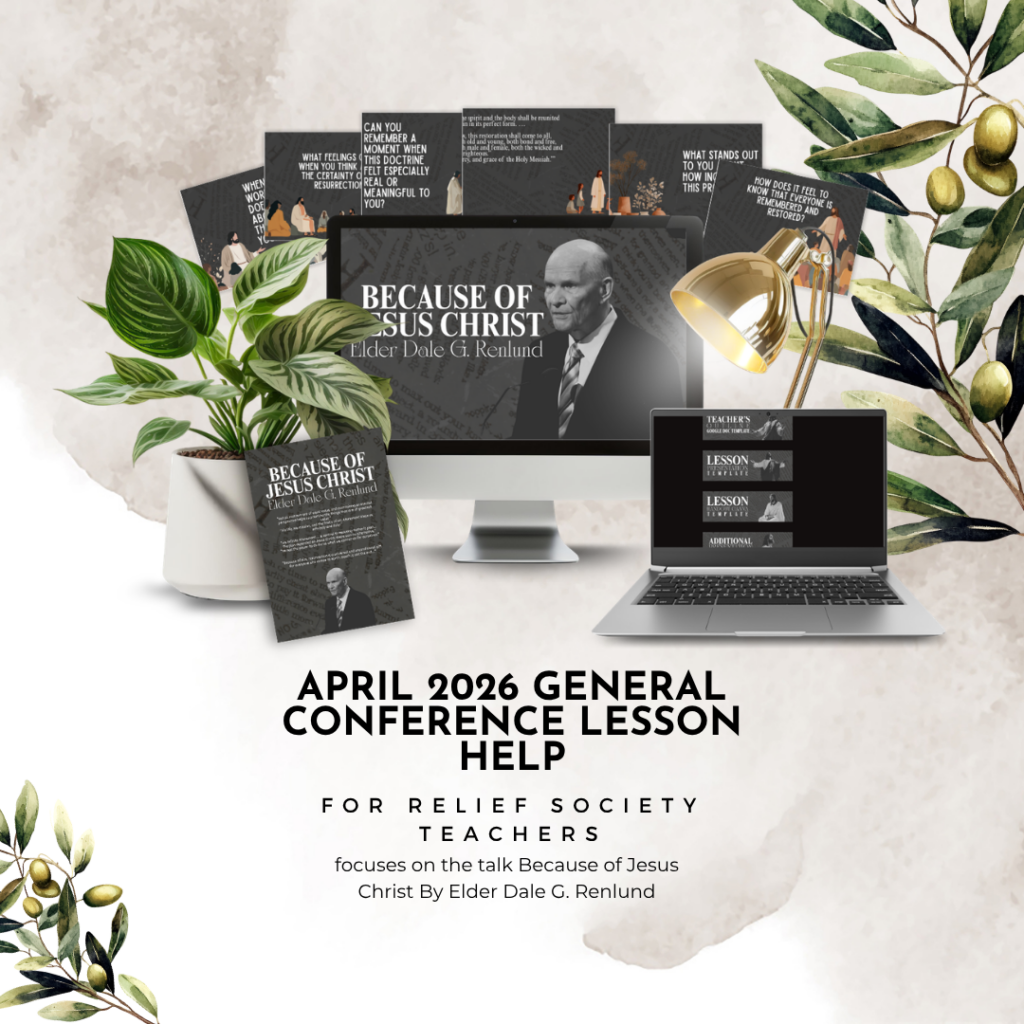
Interested in a done-for-you lesson plan with a teacher’s outline Google Doc, Canva Presentation Template, Lesson Handout Template, and themed presentation backgrounds? Click here: https://www.etsy.com/listing/4498246113/april-2026-general-conference-lesson?ref=listings_manager_grid
Section 1: When Life Feels Like Too Many Balls at Once
Teach
Elder Renlund opens with a memorable story about the family dog, Lady, who became confused and discouraged trying to chase two balls at once. That image immediately connects to modern life. Many women do not feel overwhelmed by one concern, but by many at the same time. This opening is not just clever. It is diagnostic. It names the emotional reality of trying to manage too much at once.
Direct Quotes from the Talk
“One day, after repeatedly throwing a ball for her to fetch, I decided to throw two balls at the same time, one blue and one yellow. Lady chased after the blue ball, picked it up, began running back to me, and then saw the yellow ball. She dropped the blue ball, dashed to the yellow ball, picked it up, and started back to me. Then she seemed to think of the blue ball, dropped the yellow ball, turned around, ran back to the blue ball, picked it up, and began returning. As she was passing the yellow ball, she stopped, dropped the blue ball, picked up the yellow ball, and resumed running back. Then she dropped the yellow ball, turned around, scampered back to the blue ball, picked it up, and began running to me. As Lady passed the yellow ball again, she came to a screeching halt. She dropped the blue ball, looked back and forth from the blue ball to the yellow ball. Then she gave up, walked to her basket, and lay down. For Lady, two balls were too many. She became confused, overwhelmed, and discouraged.”
“In our lives, we need to deal not just with blue and yellow concerns but also with red and green, orange and purple, polka dots and stripes, and every possible combination. We may feel like Lady—overwhelmed and discouraged—and just want to crawl back into bed.”
Discussion Questions
- What stood out to you most in Elder Renlund’s story about Lady?
- Why is that image of chasing too many things at once so relatable?
- What are some of the “blue and yellow concerns” women often carry at the same time?
- Why does overwhelm sometimes lead not just to fatigue, but discouragement?
- How can confusion make even simple decisions feel harder?
- What do you think Elder Renlund wants us to recognize about ourselves through this story?
- Why do we sometimes keep running back and forth instead of stopping and refocusing?
- What are some signs that we are spiritually or emotionally overloaded?
- How does this opening create space for compassion rather than shame?
- In what ways are you tempted to “crawl back into bed” when life feels too full?
Object Lessons
- Bring two brightly colored balls and toss them one after another to illustrate divided focus.
- Set several objects on a table and ask someone to try holding all of them at once.
- Use a backpack and gradually add items to show what accumulated concerns feel like.
- Spin several paper plates at once to illustrate exhaustion from trying to maintain everything equally.
- Place many sticky notes on a board with different responsibilities written on them to visualize overload.
Personal Sharing Prompts
- Share a season when life felt like too many balls at once.
- Describe a time when overwhelm made it hard to think clearly.
- Share what usually pushes you from busy into discouraged.
- Talk about a moment when you realized you were trying to carry too much equally.
- Share how the Lord has met you in a season of overload.
- Describe what helps you when you feel mentally scattered.
- Share about a time you needed to stop and reset spiritually.
- Talk about how you know when your soul needs simplification.
- Share a lesson you have learned about priorities through exhaustion.
- Describe what part of Lady’s story felt most familiar to you.
Section 2: Not All Matters Are of Equal Value
Teach
After naming overwhelm, Elder Renlund offers a corrective principle: not all concerns are of equal value. Eternal perspective helps us prioritize rightly. This is one of the most useful teachings in the entire talk, especially for women who are constantly sorting through responsibilities, expectations, and demands.
Direct Quotes from the Talk
“I cannot add more time to your days or eliminate the many concerns modern life brings. But I can offer this counsel: Not all matters are of equal value, and maintaining an eternal perspective helps us prioritize the things that are of greatest value. On this Easter Sunday, let us consider why focusing on Jesus Christ and the ‘infinite virtue of His great atoning sacrifice’ is of greatest value and helps us no matter how many other concerns we must manage.”
“His life, His mission, and the fruits of His Atonement bless us infinitely and daily.”
Discussion Questions
- Why is it important to remember that not all matters are of equal value?
- How does eternal perspective help us sort what is urgent from what is truly important?
- Why do lesser concerns often crowd out greater ones?
- What happens when we give equal emotional weight to everything?
- Why is focusing on Jesus Christ of greatest value?
- How do the Savior’s life, mission, and Atonement bless us daily, not just eternally?
- What are some practical ways to recover eternal perspective during a busy week?
- How does this principle help reduce discouragement?
- What are some common distractions that feel important but are not of greatest value?
- What does it look like to prioritize in a Christ-centered way rather than a fear-centered way?
Object Lessons
- Use a jar, large rocks, pebbles, and sand to show how what goes in first determines what fits.
- Write several concerns on cards and sort them into “eternal,” “important,” and “temporary.”
- Use a magnifying glass to discuss what we enlarge in our minds.
- Hold up a calendar and ask which priorities are actually getting the best space.
- Show a compass to illustrate direction versus distraction.
Personal Sharing Prompts
- Share a time when eternal perspective changed how you handled a hard week.
- Describe something you once treated as urgent that later proved less important.
- Share how focusing on the Savior has brought more clarity into your life.
- Talk about a season when your priorities were refined.
- Share what helps you remember what matters most.
- Describe a daily blessing you receive because of Jesus Christ.
- Share how you have learned to let some lesser concerns stay lesser.
- Talk about a time when Christ-centered priorities brought peace.
- Share what eternal perspective looks like for you in motherhood, marriage, work, or service.
- Describe one thing you feel prompted to re-prioritize.
Section 3: The Atonement of Jesus Christ Is Central to the Plan
Teach
Elder Renlund now moves from the problem of overwhelm to the doctrinal center of hope: the infinite Atonement of Jesus Christ. This section grounds everything else. The Savior’s mission was not optional in Heavenly Father’s plan. There was no alternative. That alone gives weight and clarity to the rest of the talk.
Direct Quotes from the Talk
“Jesus lived and died to do His Father’s will. His infinite Atonement—the series of events He experienced from Gethsemane through His death on the cross and on to His glorious Resurrection—is central to Heavenly Father’s plan for our salvation. The plan depended on Jesus Christ; there was no alternative. He completed the Atonement and thereby received ‘all power … in heaven and in earth.’”
“Because of the merits, mercy, and grace of Jesus Christ, we can return home to our Heavenly Father and live in His presence. This is only possible through Jesus Christ. The Savior Himself said, ‘I am the way, the truth, and the life: no man cometh unto the Father, but by me.’ Jesus, who leads us to salvation, has the power to do for us what we cannot do for ourselves because He completed His Atonement.”
Discussion Questions
- Why is it significant that Elder Renlund says there was no alternative to Jesus Christ?
- What does it mean that the Atonement includes Gethsemane, the cross, and the Resurrection together?
- How does the phrase “merits, mercy, and grace” deepen your understanding of salvation?
- Why can Jesus Christ do for us what we cannot do for ourselves?
- How does this section shape the way we view dependence on the Savior?
- What is lost when people reduce Jesus to only an example and not Redeemer?
- Why is it important that the plan depended on Christ completely?
- How does this doctrine help when we feel inadequate?
- What does “return home” mean to you personally?
- Which phrase in this section most strengthens your testimony?
Object Lessons
- Use a bridge image to show Christ as the only way across a gap we cannot cross alone.
- Place three cards labeled Gethsemane, Cross, Resurrection to show the Atonement as a connected whole.
- Use a key and locked door to represent Christ opening what we cannot open ourselves.
- Show an unpaid debt and then a receipt marked “paid in full.”
- Use a path leading home to symbolize return through the Savior.
Personal Sharing Prompts
- Share how your understanding of the Atonement has grown.
- Describe what it means to you that Christ did what no one else could do.
- Share how the Savior has helped you where your own strength was not enough.
- Talk about a time you felt carried by mercy and grace.
- Share how the phrase “return home” feels in your heart.
- Describe a moment when the Atonement became more than a doctrine to you.
- Share what the Savior’s sacrifice means in your daily life.
- Talk about how Christ’s unique role has become clearer to you over time.
- Share how this section changes the way you see your need for Him.
- Describe what it means to believe that Jesus Christ is the way.
Section 4: Because of Jesus Christ, Death Is Not the End
Teach
The first reason Elder Renlund gives for celebrating Easter is that Jesus Christ conquered death. This section is simple, powerful, and full of hope. The Resurrection is described as universal and unconditional. That makes it especially meaningful for Relief Society discussions centered on grief, loved ones, aging, illness, and eternal family ties.
Direct Quotes from the Talk
“Reflect on these reasons we celebrate Easter. First, Jesus Christ conquered death; He literally rose from the tomb. Because of Him, resurrection is a universal and unconditional gift for everyone who comes to earth. Death is not the end because the spirit and the body will be reunited, never again to be divided.”
Discussion Questions
- What does it mean to you that resurrection is universal and unconditional?
- Why is it important that Elder Renlund says Jesus “literally” rose from the tomb?
- How does this doctrine change the way we think about death?
- Why is the promise that spirit and body will never again be divided so comforting?
- How does the Resurrection affect the way we view loved ones who have died?
- What do you think it means to live as someone who truly believes death is not the end?
- How does this section shape Christian hope differently from mere optimism?
- Why is the bodily aspect of resurrection important?
- How can this doctrine bring peace into everyday sorrow, not just funeral settings?
- What does this section make you feel about Jesus Christ?
Object Lessons
- Use a seed and a blooming plant to represent life after burial.
- Show two puzzle pieces separated and then joined to symbolize spirit and body reunited.
- Use a closed box and then open it to illustrate a tomb opened.
- Show a wilted flower beside a fresh one to discuss renewal and life.
- Use a timeline extending beyond mortality to visualize resurrection hope.
Personal Sharing Prompts
- Share what the Resurrection means to you personally.
- Describe how belief in resurrection has helped you with grief.
- Share a time this doctrine brought peace to your heart.
- Talk about a loved one you long to see again.
- Share how the reality of resurrection affects your view of mortality.
- Describe what Easter hope feels like in your life.
- Share how this truth has strengthened your faith.
- Talk about a time you felt comfort through resurrection doctrine.
- Share why bodily resurrection matters to you.
- Describe what “death is not the end” means in your own words.
Section 5: Because of Jesus Christ, Even You Can Be Forgiven
Teach
This is one of the most tender and powerful sections in the talk. Elder Renlund takes the doctrine of forgiveness and makes it intensely personal. He moves from “all mankind” to “everyone” to “anyone” to “even one” to “even you.” This progression is beautiful and especially helpful for sisters who struggle to believe grace applies personally to them.
Direct Quotes from the Talk
“Second, Jesus Christ has both the power and the desire to save us from our sins. Because of Jesus Christ, when we repent and follow Him, ‘immediately [will] the great plan of redemption be brought about unto [us].’ The Redeemer suffered the punishment for everyone’s sins, transgressions, and mistakes. He can and will declare guiltless all who believe on His name, repent, follow the covenant path, and strive to endure to the end. ‘All mankind may be saved’ because of Him and His atoning sacrifice. All means everyone. If everyone, then anyone. If anyone, then even one. And if even one, then even you.”
“Jesus Christ has infinite capacity to forgive, promising that ‘as often as my people repent will I forgive them their trespasses against me.’”
“Because of Jesus Christ, sins for which we have sincerely repented leave no spiritual scar, track, or trace. There is no scarlet letter to wear, now or in the eternities. When we repent with real intent, the entirety of our sin, not just a part, is figuratively nailed to the cross and we no longer bear its spiritual consequences. After we have repented, we owe no more to justice because Jesus has paid the debt; He pardons us from deserved punishment. We are forgiven, our hearts and hands are made clean, and the Lord remembers our sins no more. The Lord our God ‘is mighty; he will save, [and] he will rejoice over [us].’”
Discussion Questions
- Which phrase in this section feels most powerful or healing to you?
- Why is it important that Elder Renlund says Christ has both the power and the desire to save us?
- What does the phrase “even you” do to this doctrine emotionally and spiritually?
- Why do so many people believe in forgiveness generally but struggle to receive it personally?
- What does it mean that repented sins leave no spiritual scar, track, or trace?
- How does this section change the way we view sincere repentance?
- What difference is there between feeling guilty and believing we must permanently carry guilt?
- Why is it significant that the Lord rejoices over those He saves?
- How can this doctrine change the way we talk to ourselves after real repentance?
- What do you think Elder Renlund most wants listeners to believe about Jesus Christ here?
Object Lessons
- Write on a whiteboard and then erase it completely to symbolize no scar, track, or trace.
- Use a paid invoice marked “debt satisfied.”
- Show a stain removed from white cloth to represent cleansing.
- Use a scarlet ribbon removed from a garment to symbolize no scarlet letter.
- Place heavy stones labeled guilt, shame, regret into a bag and then remove them.
Personal Sharing Prompts
- Share what the phrase “even you” means to your heart.
- Describe how your understanding of repentance has become more hopeful.
- Share a time you felt Christ’s desire to forgive, not just His power.
- Talk about a moment when mercy felt more real than shame.
- Share how the Lord has helped you stop carrying what He already paid for.
- Describe what sincere repentance has looked like in your life.
- Share a scripture or truth about forgiveness that has healed you.
- Talk about how clean hands and a clean heart feel spiritually.
- Share what it means that God can rejoice over us.
- Describe a way this doctrine changes how you see yourself.
Section 6: Because of Jesus Christ, He Understands Everything That Shapes You
Teach
Elder Renlund next teaches one of the most compassionate truths of the talk: Jesus Christ did not only take our sins. He also took our griefs, sicknesses, and frailties. He understands every factor that shapes who we are. That makes His empathy and judgment perfect.
Direct Quotes from the Talk
“Third, Jesus Christ understands our challenges, having taken on not only our sins but also our griefs, sicknesses, and frailties. Because He endured and completed the infinite atoning sacrifice, He empathizes perfectly with us. He can ‘calm [our] anguish’ and offers ‘gentle … peace … for [our] beseeching.’ He, and only He, can consider every factor that shapes who we are: our genetics, intellectual abilities, traditions, experiences, mental and emotional conditions, and every other circumstance that affects who we are. He, and only He, will eventually judge us ‘according to [our] works, according to the desire of [our] hearts.’”
Discussion Questions
- What does this section teach about the depth of Christ’s empathy?
- Why is it important that He understands not only sin but also griefs, sicknesses, and frailties?
- How does knowing Christ understands every factor that shapes you change the way you see Him?
- What comfort comes from knowing His judgment is perfectly informed and perfectly just?
- Why do you think Elder Renlund specifically mentions mental and emotional conditions?
- How can this doctrine bring relief to those who feel misunderstood by others?
- What does it mean that Christ can calm anguish?
- How does this section deepen your trust in the Savior?
- What difference does it make that He judges according to the desire of our hearts?
- How can this teaching help us be more compassionate toward others?
Object Lessons
- Use a tangled cord to represent the many factors that shape a person’s life.
- Show a medical chart or layered diagram to illustrate complexity only Christ fully understands.
- Use a weighted blanket or shawl to symbolize calm and gentle peace.
- Place many labeled cards—grief, health, childhood, emotions, habits—into one basket to show the fullness of what Christ sees.
- Use a heart symbol beside a checklist to discuss outward works and inward desires.
Personal Sharing Prompts
- Share a time you felt deeply understood by the Savior.
- Describe how this doctrine brings comfort in weakness.
- Share what it means to you that Christ understands every factor in your life.
- Talk about a time His peace calmed anguish.
- Share how your trust in His judgment has grown.
- Describe a season when you felt misunderstood by others but known by Christ.
- Share how this section softens your view of yourself.
- Talk about how it changes the way you view other people’s struggles.
- Share a moment when the Lord’s compassion felt very near.
- Describe why Christ is uniquely able to judge and heal.
Section 7: Because of Jesus Christ, All That Is Unfair Will Be Made Right
Teach
This section expands the doctrine outward. Elder Renlund teaches that because of Jesus Christ, all unfairness can and will be made right. He not only repairs what is sinful but also consecrates affliction, sanctifies distress, sweetens bitterness, and makes us whole. This is one of the most hope-filled parts of the message.
Direct Quotes from the Talk
“Because of Jesus Christ, all that is unfair in life can and will be made right. He will consecrate our afflictions for our gain. He will sanctify to us our deepest distress. He will fill with sweet a bitter cup. He will dependably and consistently make us whole. If we let Him, we will ‘suffer no manner of afflictions, save it [is] swallowed up in the joy of Christ.’”
Discussion Questions
- What does it mean that all that is unfair can and will be made right?
- Why is this doctrine so important in a fallen world?
- What does it mean for afflictions to be consecrated for our gain?
- How have you seen the Lord bring sweetness into something bitter?
- Why is wholeness such a powerful promise?
- What does the phrase “if we let Him” teach about agency?
- How can the joy of Christ swallow up affliction without pretending the affliction was small?
- What does this section teach about hope for long-term pain or injustice?
- How can this doctrine change the way we endure present suffering?
- Which promise in this section speaks most to you?
Object Lessons
- Place a bitter herb beside honey to symbolize a bitter cup filled with sweet.
- Use a cracked bowl repaired to represent becoming whole.
- Show a dark cloth gradually covered with light to represent affliction swallowed up in joy.
- Use a refining fire image to discuss consecrated affliction.
- Bring a mended quilt or repaired fabric to illustrate sanctified distress.
Personal Sharing Prompts
- Share a time the Lord consecrated affliction for your good.
- Describe how He brought sweetness into a bitter season.
- Share what “make us whole” means in your life.
- Talk about a time you saw Christ bring good from pain.
- Share how hope in future justice affects your present faith.
- Describe a sorrow you are still waiting to see made right.
- Share how the joy of Christ has met you in distress.
- Talk about how this doctrine changes the way you endure unfairness.
- Share what promise in this section feels most personal to you.
- Describe how Christ has begun healing something broken in you.
Section 8: Keep Your Eye on the Ball—Focus on the Savior
Teach
Elder Renlund now returns to the image of Lady. His counsel is plain: keep your eye on the ball. Focus on the Savior. Seek the gifts His Atonement can impart. This practical turn helps the whole talk become usable, not just inspiring.
Direct Quotes from the Talk
“Focusing on the Savior, His infinite Atonement, and what He has done for us will bring joy and clarity into our lives, no matter how many other concerns we have. This is why ancient and modern prophets have and always will direct us to Christ. You may remember that President Russell M. Nelson taught, ‘Whatever questions or problems you have, the answer is always found in the life and teachings of Jesus Christ.’ And President Dallin H. Oaks, the Lord’s living prophet today, simply declared, ‘Jesus Christ is the way.’”
“You need not be like our little dog, Lady—confused, discouraged, and overwhelmed—when facing too many balls; you do not need to crawl back to bed and cower. Instead, keep your eye on the ball. Focus on the Savior. Seek for the ‘precious gifts His Atonement can impart.’”
“Then you can joyfully and confidently sing with the children:
I will trust in Jesus. I will hear His call.
He will never leave me, even when I fall.
Jesus gives me power, lifts and comforts me,
Helping me to live and grow eternally.”
Discussion Questions
- What does it mean in practical terms to keep your eye on the ball?
- Why does focusing on the Savior bring joy and clarity?
- How do prophets help us refocus on Jesus Christ?
- What “precious gifts” of the Atonement have you experienced?
- Why are joy and confidence possible even in a complicated life?
- What does it mean to trust in Jesus when you fall?
- How can a teacher help sisters focus on Christ rather than just their problems?
- What are some simple ways to redirect attention back to the Savior during overwhelming days?
- Which line from the children’s song feels especially meaningful to you?
- What might change in your life if you more deliberately focused on what Christ has done for you?
Object Lessons
- Use one ball and several distractions around it to illustrate focused attention.
- Write “questions,” “problems,” and “Jesus Christ” on cards and connect them with string.
- Bring a magnifying glass to discuss what we choose to enlarge in our minds.
- Use a child’s hymnbook to show how simple truths often teach the deepest doctrine.
- Place one bright object in the middle of a cluttered table to symbolize central focus.
Personal Sharing Prompts
- Share a time focusing on the Savior brought clarity to a confusing situation.
- Describe a “precious gift” you have received because of His Atonement.
- Share how prophetic counsel has helped you re-center on Christ.
- Talk about a time you felt lifted and comforted by Jesus.
- Share what trusting in Jesus looks like in your present life.
- Describe a moment when the Savior gave you power beyond your own.
- Share how simple gospel truths have anchored you.
- Talk about a time you felt He did not leave you, even when you fell.
- Share what helps you refocus when life feels noisy or scattered.
- Describe what “keep your eye on the ball” means to you spiritually.
Section 9: Celebrate Easter Every Day Because of Him
Teach
Elder Renlund closes with witness and invitation. Because Jesus Christ completed the Atonement, He has power to help us now and redeem us fully. Easter should not be celebrated only annually. Its message can be lived daily by reflecting on the blessings that come because of Him.
Direct Quotes from the Talk
“Because Jesus Christ completed the Atonement, He has the power to help you along your earthly journey and to redeem you from death, both physical and spiritual. Celebrate the joyous message of Easter every day by reflecting every day on the blessings you receive because of Him. ‘Open wide your broken heart and let your Savior in!’”
“On this Easter morning, I add my witness of ‘the great and wonderful love made manifest by the Father and the Son in the coming of the Redeemer into the world.’ Jesus Christ is the Resurrection and the Life, the Only Begotten of the Father, the Worthy Lamb who was slain, our Redeemer, our Savior, our Advocate, and most assuredly the Risen Lord. ‘He lives, who once was dead.’”
Discussion Questions
- What does it look like to celebrate Easter every day?
- Why is daily reflection on what we receive because of Christ so powerful?
- What does it mean to “open wide your broken heart and let your Savior in”?
- Which title of Jesus Christ in Elder Renlund’s closing witness speaks most to you?
- How can daily Easter living change the tone of ordinary life?
- What are some ways to remember the blessings that come because of Him?
- Why is it important that Christ helps us both now and eternally?
- How does the phrase “He lives, who once was dead” affect you?
- What does this section invite you to do differently after hearing the talk?
- How would your home or family change if Easter truth were more consciously lived every day?
Object Lessons
- Use a sunrise image to represent daily Easter hope.
- Show a journal labeled “Because of Him” for recording daily blessings.
- Open a door or window to symbolize “open wide your broken heart.”
- Write several titles of Christ on cards and invite reflection on each.
- Use a calendar with Easter marked on every day to symbolize ongoing remembrance.
Personal Sharing Prompts
- Share one blessing you receive every day because of Jesus Christ.
- Describe what “open wide your broken heart” means in your experience.
- Share which title of Christ feels most meaningful to you right now.
- Talk about how you want to live Easter more intentionally.
- Share how Christ helps you along your earthly journey.
- Describe a daily practice that keeps resurrection hope alive for you.
- Share what it means to say, “He lives.”
- Talk about a time reflecting on Christ changed the tone of your day.
- Share a witness of the Savior you would want your family to hear.
- Describe what daily gratitude “because of Him” looks like in your life.
Conclusion
A Relief Society lesson on Elder Renlund’s “Because of Jesus Christ” has the potential to do more than organize a good discussion. It can help sisters reorder their hearts. This talk is not just about Easter doctrine in a seasonal sense. It is about the daily effect of the Savior’s Atonement in ordinary overwhelmed lives. It reminds us that clarity comes when Christ becomes central, that joy grows when forgiveness is received personally, and that hope deepens when we remember that death, sin, sorrow, and unfairness are all answered in Him.
That is one of the greatest benefits of a lesson help like this. It gives you a structure strong enough to hold the conversation while leaving room for the Spirit to shape what happens in the room. With the talk already broken into its natural movement, with the strongest quotes pulled out, and with thoughtful questions and prompts already prepared, you can prayerfully choose which truths need the most attention for your class. Elder Renlund’s message is one that can steady overwhelmed women, heal discouraged hearts, and refocus a Relief Society on the truth that matters most: because of Jesus Christ, there is clarity, forgiveness, healing, justice, resurrection, and joy.