Introduction
Some Relief Society lessons are easier to prepare when the talk itself already carries a strong, sacred rhythm. Elder Ronald A. Rasband’s talk “He Is Risen” does exactly that. It moves from testimony, to doctrine, to scripture witness, to personal witness, to promised hope. It is centered on the Resurrection of Jesus Christ, but it is also deeply personal in the way it ties the Resurrection to grief, family, healing, identity, and eternal reunion.
This lesson help is designed to make your preparation more meaningful and more manageable. Instead of having to sort through the talk and decide where the major discussion shifts happen, this outline follows the talk in chronological order, breaking it into clear sections where the speaker changes emphasis. Each section includes direct quotes from the talk, discussion questions, object lessons, and personal sharing prompts so that your Relief Society discussion can move beyond surface comments into deeper testimony, reflection, and connection.
One of the biggest blessings of using a lesson help like this is that it gives you a clear framework before Sunday even begins. That means you can spend less time wondering what to ask and more time praying about the needs of the sisters in your class, choosing which sections to emphasize, and seeking the Spirit as you teach. Elder Rasband’s message is especially powerful for Relief Society because it reminds us that the Resurrection is not just doctrine to admire. It is truth to lean on. It gives meaning to sorrow, hope to families, and peace to every faithful disciple of Jesus Christ.

Grab our free bundle of 50+ Presentation Backgrounds by clicking here: https://otherthanamom.myflodesk.com/freebackgrounds
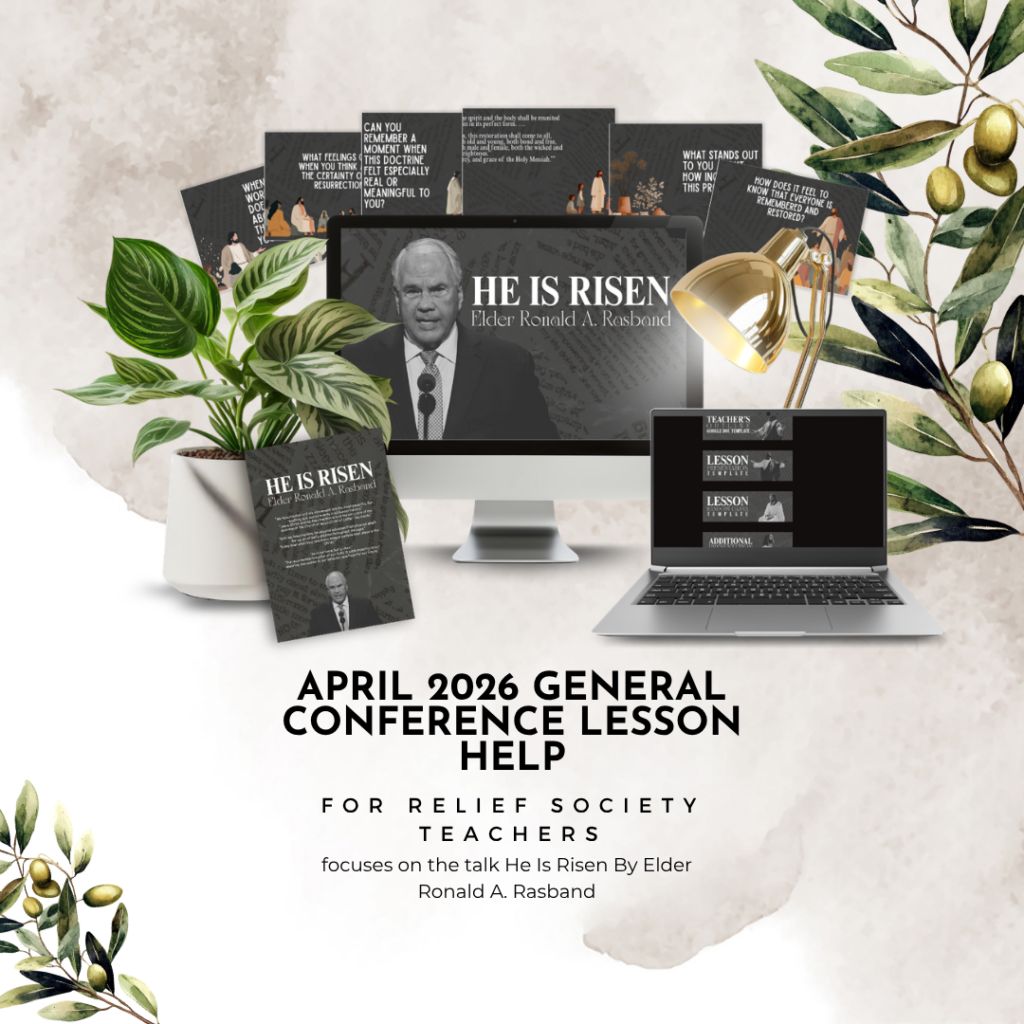
Interested in a done-for-you lesson plan with a teacher’s outline Google Doc, Canva Presentation Template, Lesson Handout Template, and themed presentation backgrounds? Click here: https://www.etsy.com/listing/4498243743/april-2026-general-conference-lesson?ref=listings_manager_grid
Section 1: The Resurrection Is at the Core of Our Faith
Teach
Elder Rasband opens by placing the Resurrection at the very center of Christian belief and restored gospel doctrine. This first section establishes the scope of the talk: the Resurrection and Atonement of Jesus Christ are not side doctrines. They are the most sacred and far-reaching events in all human history.
Direct Quotes from the Talk
“This Easter Sunday, all Christians, brothers and sisters in the Lord, honor and celebrate the Resurrection of our Redeemer, Jesus Christ. His Resurrection and His Atonement are the most powerful, far-reaching, and sacred events in all human history.”
“Jesus Christ and His Resurrection are at the very core of the doctrine of The Church of Jesus Christ of Latter-day Saints. The Prophet Joseph Smith, the first prophet of the Restoration, who saw and spoke with God the Father and His Beloved Son, taught, ‘The fundamental principles of our religion are the testimony of the Apostles and Prophets, concerning Jesus Christ, that He died, was buried, and rose again the third day, and ascended into heaven.’ As an Apostle called of Jesus Christ, I bear my testimony to all the world of that truth.”
Discussion Questions
- What stands out to you about Elder Rasband calling the Resurrection and Atonement the most powerful and sacred events in human history?
- Why do you think the Resurrection is described as being at the very core of our doctrine?
- How does putting the Resurrection at the center change the way we view the gospel as a whole?
- What does Joseph Smith’s statement teach about the foundation of our religion?
- Why is apostolic witness so important in matters of the Resurrection?
- How does the Resurrection affect the way we understand mortality?
- Why do you think Elder Rasband begins with such broad and sweeping testimony?
- How does Easter doctrine shape the way you think about Jesus Christ every week, not just once a year?
- In what ways does this section invite us to be more rooted in first principles?
- How would your daily faith look different if the Resurrection were more consciously at the center of it?
Object Lessons
- Place a stone labeled “Resurrection” in the center of several gospel words like hope, salvation, family, healing, and joy.
- Use a wheel with a hub to show how the Resurrection is central, not peripheral.
- Hold up a foundation block beneath a small structure to illustrate what everything else rests on.
- Show a temple recommend or scriptures and ask what truth gives all ordinances and teachings eternal meaning.
- Use concentric circles with “Jesus Christ” and “Resurrection” in the middle to show doctrinal centrality.
Personal Sharing Prompts
- Share when the Resurrection became more than a historical belief for you.
- Describe what it means to you that Jesus Christ is at the center of our faith.
- Share how your testimony of the Resurrection has grown over time.
- Talk about a moment when apostolic testimony strengthened your own.
- Share what Easter means to you personally.
- Describe how the Resurrection affects the way you view your life.
- Share how your faith has changed because Christ lives.
- Talk about why foundational truths matter in uncertain times.
- Share a scripture about the Resurrection that has become precious to you.
- Describe what it means to build your life around this core truth.
Section 2: Because He Rose, All Will Rise
Teach
Elder Rasband next emphasizes one of the grand doctrinal gifts of the Resurrection: universal victory over physical death. This section is expansive and doctrinally rich, grounding our hope in the truth that Christ’s Resurrection applies to all God’s children throughout the ages.
Direct Quotes from the Talk
“Jesus Christ is ‘the God of Abraham, of Isaac, and of Jacob,’ ‘the Almighty God’ of the Old Testament, ‘the light of the world’ of the New Testament, ‘the Messiah’ and ‘Savior of the world’ of the Book of Mormon and other latter-day revelation. He came, was crucified, and rose again.”
“After three days in a borrowed tomb, Jesus Christ broke the bands of death imposed by the Fall. With His Resurrection, He secured salvation from physical death for us, all of God’s children throughout the ages. That includes the just, who herald Him as the Son of God, and the unjust, who will someday recognize Him as ‘the King of kings,’ for it is prophesied, ‘Every knee shall bow, and every tongue confess’ that Jesus is the Christ.”
Discussion Questions
- What does it mean that Christ “broke the bands of death”?
- Why is it significant that His Resurrection secures salvation from physical death for all people?
- How does the universality of the Resurrection reflect the mercy and power of God?
- Why do you think Elder Rasband includes so many scriptural titles for Jesus Christ in this section?
- How does this doctrine shape the way we view death?
- What difference is there between physical resurrection for all and eternal life with God?
- Why is it powerful that even those who do not recognize Him now will one day confess that Jesus is the Christ?
- How does this section enlarge your view of the Savior’s mission?
- What peace comes from knowing the grave is not permanent?
- How does belief in universal resurrection change the way we grieve?
Object Lessons
- Use a chain or ribbon tied in a knot and untie it to symbolize broken bands of death.
- Show an empty box or open container to represent the borrowed tomb.
- Use a timeline from mortality to resurrection to illustrate continuation, not ending.
- Bring a seed and blooming flower to represent life emerging from what appeared finished.
- Use a locked and unlocked door to symbolize death conquered.
Personal Sharing Prompts
- Share what it means to you that all God’s children will rise.
- Describe how this doctrine has affected your view of death.
- Share how the Resurrection has brought comfort to your family.
- Talk about a time this truth gave you peace.
- Share how one of Christ’s scriptural titles speaks to you personally.
- Describe how your hope has changed because the grave is temporary.
- Share a moment when resurrection doctrine felt very real.
- Talk about why universal resurrection is such a merciful truth.
- Share how this doctrine affects the way you think about loved ones who have died.
- Describe what “He came, was crucified, and rose again” means in your heart.
Section 3: “He Is Not Here, but Is Risen”
Teach
This section moves to the women at the Garden Tomb and the angelic declaration that has echoed through centuries of Christian worship. Elder Rasband shows that these words are not only historical but faith-shaping. They continue to generate gratitude, worship, and hope.
Direct Quotes from the Talk
“When Mary and other faithful women approached the Garden Tomb to care for the body of their Lord, they found two angels, who announced, ‘He is not here, but is risen.’”
“Those glorious words, ‘He is risen,’ have sparked religious ceremony, gratitude, faith in Jesus Christ and His promises for centuries. President Dallin H. Oaks has testified: ‘The resurrection is a pillar of our faith. It adds meaning to our doctrine, motivation to our behavior, and hope for our future.’”
Discussion Questions
- Why do you think the phrase “He is risen” has had such enduring power for centuries?
- What feelings come when you hear those words?
- How does the Resurrection add meaning to doctrine?
- How does it add motivation to behavior?
- How does it add hope for the future?
- Why do you think Elder Rasband includes President Oaks’s phrase “pillar of our faith” here?
- What might be missing in gospel living if the Resurrection were minimized?
- How does Easter language deepen everyday discipleship?
- What promise of Christ feels stronger to you because He rose?
- How can we keep the joy of “He is risen” alive beyond Easter Sunday?
Object Lessons
- Display a stone rolled away from a small model tomb.
- Write “He is risen” on the board and invite sisters to share one word they associate with it.
- Use a pillar image or column to represent support and strength.
- Show a dark cloth removed from a lighted candle to symbolize victory over darkness.
- Use a morning sunrise image to represent the dawning of hope.
Personal Sharing Prompts
- Share what the phrase “He is risen” means to you personally.
- Describe how resurrection doctrine has influenced your behavior.
- Share how it has increased your hope for the future.
- Talk about a time these words brought peace to your heart.
- Share why the Resurrection feels like a pillar in your life.
- Describe how Easter hymns or scriptures have strengthened your faith.
- Share what doctrine feels more meaningful because Christ lives.
- Talk about how the risen Lord affects your day-to-day discipleship.
- Share a family memory or tradition connected to Easter faith.
- Describe why this declaration still matters today.
Section 4: The Resurrected Lord Is Real, Tangible, and Personal
Teach
Elder Rasband next emphasizes that the Resurrection was not symbolic or abstract. Jesus Christ truly rose with a glorified body. He spoke names, invited touch, walked with disciples, and appeared to many. This section is powerful for discussing the reality of the resurrected Christ.
Direct Quotes from the Talk
“Jesus Christ is more than a mortal first laid in a manger, more than a friend, teacher, rabbi, minister, or prophet. He is the Only Begotten Son of the Father. And by divine design, His Resurrection by His own godly power reunited His body and His spirit. What a majestic and monumental event in Father in Heaven’s eternal plan.”
“The resurrected Jesus Christ first appeared to Mary and with tenderness spoke her name. He appeared to His Apostles, saying, ‘Handle me, and see; for a spirit hath not flesh and bones, as ye see me have.’ He walked with two of His disciples, on the road to Emmaus, who pleaded, ‘Abide with us.’ The risen Lord, ‘Endless and Eternal,’ appeared to hundreds in the Holy Land.”
Discussion Questions
- Why is it important that the resurrected Christ had a body of flesh and bones?
- What do you notice about the tenderness in the phrase “spoke her name”?
- How does the physical reality of the Resurrection strengthen your faith?
- What is added to your testimony by the fact that He appeared to many witnesses?
- Why do you think Elder Rasband includes both intimate and public appearances of the Savior?
- How does this section deepen your understanding of who Jesus Christ really is?
- Why is it important that the Savior is more than teacher or prophet?
- What does “Abide with us” mean differently when spoken to a resurrected Lord?
- How does the real, embodied Resurrection affect our hope for our own resurrection?
- What part of this section feels most sacred to you?
Object Lessons
- Use a simple outline of body and spirit joined together to discuss reunion in resurrection.
- Read the words “He spoke her name” while showing a name card to emphasize personal recognition.
- Use handprints on paper to discuss the invitation to “handle me, and see.”
- Show a road map to Emmaus and discuss walking with Christ.
- Use a family photo of loved ones to connect the reality of Christ’s body to hope for our own.
Personal Sharing Prompts
- Share how the reality of a literal Resurrection affects your testimony.
- Describe what it means to you that Jesus spoke Mary’s name.
- Share a time you felt personally recognized by the Savior.
- Talk about a scripture account of the resurrected Christ that feels especially real to you.
- Share how this doctrine changes the way you think about your own body and eternal future.
- Describe what the phrase “Handle me, and see” teaches you.
- Share how the Savior has felt near and personal in your life.
- Talk about the power of many witnesses.
- Share how this section strengthens your faith in restored truth.
- Describe what you feel when you think of the risen Christ as real and present.
Section 5: His Outstretched Hand Is for All of Us
Teach
This section is one of the richest in the talk. Elder Rasband focuses on the image of the Savior stretching forth His hand. He ties together multiple scriptural moments where the Lord’s hands healed, rescued, washed, blessed, and upheld. The talk becomes deeply personal here, especially with the statement, “That promise is for all of us.”
Direct Quotes from the Talk
“Accounts in the Book of Mormon: Another Testament of Jesus Christ also bear witness of Him resurrected. A gathering at a temple in the New World, in the land Bountiful, heard a voice from the heavens saying, ‘Behold my Beloved Son, in whom I am well pleased, in whom I have glorified my name—hear ye him.’
“Then they beheld ‘a Man descending out of heaven; and he was clothed in a white robe; and he came down and stood in the midst of them.’ And ‘he stretched forth his hand.’ I love the image of Him stretching forth His hand. He said, ‘Behold, I am Jesus Christ, whom the prophets testified shall come into the world.’”
“That outstretched hand was well known in His earthly ministry. His hand rescued Peter as he began to sink in the choppy waves of the Sea of Galilee. His hand motioned for the crippled man at the Pool of Bethesda to ‘rise … and walk.’ His hands washed the feet of His disciples, and His hands ‘took bread, and gave thanks, and brake it,’ initiating the sacrament ‘in remembrance of’ Him. He promised the prophet Isaiah, ‘Fear thou not; for I am with thee: … for I am thy God: … I will uphold thee with the right hand of my righteousness.’ That promise is for all of us.”
Discussion Questions
- Why do you think Elder Rasband focuses so much on the image of the Savior’s hands?
- What does an outstretched hand communicate that words alone may not?
- Which scriptural example of the Savior’s hands speaks most to you?
- How have you seen the Lord rescue, uphold, or strengthen you?
- Why is it meaningful that the same hands that rescued and healed also washed feet and instituted the sacrament?
- What does this teach about the nature of divine power?
- How does the phrase “That promise is for all of us” affect the way you hear Isaiah’s words?
- Why are the Savior’s hands such a recurring and powerful symbol in Christian faith?
- What does this section teach about Jesus Christ’s willingness to act in our lives?
- How can we become more aware of His hand in our own daily experiences?
Object Lessons
- Trace handprints on paper and label them rescue, uphold, bless, serve, heal.
- Use a hand reaching down to lift an object from water to symbolize Peter.
- Wash someone’s hands with water to discuss Christlike service and tenderness.
- Hold bread to connect Christ’s hands to the sacrament.
- Show clasped hands versus an extended hand to discuss invitation and help.
Personal Sharing Prompts
- Share a time you felt the Savior’s hand in your life.
- Describe a moment when you felt upheld rather than left alone.
- Share how the Lord has rescued you from sinking spiritually or emotionally.
- Talk about a scripture story involving the Savior’s hands that means a lot to you.
- Share how the sacrament helps you remember Him personally.
- Describe a time you felt strengthened when you could not stand alone.
- Share how you have seen divine help arrive in a tangible way.
- Talk about what Christ’s hands symbolize to you.
- Share how the Lord has served or comforted you.
- Describe what it means to you that His right hand of righteousness is for all of us.
Section 6: He Knows and Blesses Us One by One
Teach
Elder Rasband then turns to the Savior’s ministry among the Nephites, especially the intimate nature of that ministry. The people felt the prints in His hands and feet one by one, and then He blessed the little children one by one. This section is ideal for discussing personal worth, family love, and the Savior’s individual ministry.
Direct Quotes from the Talk
“He stood before them resurrected and said, ‘Arise and come forth unto me, that ye may thrust your hands into my side, and also that ye may feel the prints of the nails in my hands and in my feet, that ye may know that I am the God of Israel, and the God of the whole earth, and have been slain for the sins of the world.’
“The multitude of 2,500 souls ‘went forth, … and did see with their eyes and did feel with their hands, and did know of a surety and did bear record, that it was he.’
“He invited ‘their little children’ to be brought to Him and took them ‘one by one, and blessed them, and prayed unto the Father for them.’”
Discussion Questions
- Why is the phrase “one by one” so important in understanding the Savior?
- What does it mean that the multitude came to know “of a surety”?
- Why do you think the Lord invited physical witness in that moment?
- What does this account teach about how Jesus ministers to individuals within a crowd?
- Why is the blessing of little children included in this section of the talk?
- How does the Savior’s one-by-one ministry affect the way you think about your own worth?
- What does it teach about the Savior that He wants people to know with certainty?
- How can this section bring comfort to someone who feels overlooked?
- What do you think it would have felt like to watch Him bless children one by one?
- How does this account shape the way we minister to others?
Object Lessons
- Invite sisters one by one to take a small token from a table to symbolize individual ministry.
- Use handprints and footprints as symbols of personal witness.
- Place a large group photo beside a single portrait to contrast crowd and individual.
- Use children’s shoes to represent the blessing of little ones.
- Show a line of people and discuss the Savior’s ability to see the one within the many.
Personal Sharing Prompts
- Share a time you felt the Savior was ministering to you individually.
- Describe what “one by one” means in your life.
- Share an experience where you gained greater certainty about Jesus Christ.
- Talk about how the Lord has blessed your children, family, or loved ones.
- Share a moment when you felt noticed in a crowd.
- Describe how this section affects your view of your own worth.
- Share how you have seen Christ’s love expressed through one-by-one ministering.
- Talk about a quiet but certain witness you have received.
- Share how this account influences the way you want to serve others.
- Describe what you imagine feeling if you were there.
Section 7: The Resurrection Gives Hope to Grieving Families
Teach
This is the most personal section of the talk. Elder Rasband shares about his grandson Paxton, whose short life deeply shaped their family’s trust in the Lord. He ties this experience directly to the Resurrection, promising that Paxton’s spirit and body will be reunited in perfect form. This section offers extraordinary comfort and hope.
Direct Quotes from the Talk
“Some years ago at a general conference, I spoke of our grandson Paxton, who was born with a very rare chromosomal deletion. His parents would have carried him to the Savior when He called for all ‘afflicted in any manner’ to come that He might heal them.”
“Paxton lived three treasured years. He could not speak, crawl, walk, or run after his brothers. But little Paxton’s hands reached out to ours and to our Savior with love and affection.”
“I remember the first time Paxton’s father and I gave him a priesthood blessing that, as it says in the scriptures, ‘the works of God should be made manifest in him.’ They were. He brought immense joy to our family. Families with such a precious member know what a privilege it is to be blessed with one with special needs. Associating with Paxton, our whole family gained an increased, deep, and abiding trust in the Lord. Then God reached out and took him home.”
“The words of the psalmist say it all: ‘Weeping may endure for a night, but joy cometh in the morning.’
“That joy is, as the Savior said, ‘Because I live, ye shall live also.’
“I know Paxton’s tender ‘spirit and [his] body shall be reunited again in … perfect form.’ By the power of the Atonement of Jesus Christ, his joy will be in not only a resurrected body but one that is resurrected whole and perfect.”
Discussion Questions
- What stands out to you most in Elder Rasband’s story about Paxton?
- How does the Resurrection speak into grief differently than comfort alone?
- Why is the promise of a “perfect form” so healing and hopeful?
- What does this section teach about children with special needs and their eternal worth?
- How did Paxton bless not just his parents but the whole family?
- Why do you think Elder Rasband includes both weeping and morning joy?
- How does the phrase “Because I live, ye shall live also” change the way we mourn?
- What role does trust in the Lord play in family sorrow?
- How does the Resurrection transform not only doctrine but personal grief?
- How can this section help sisters carrying loss right now?
Object Lessons
- Use a broken crayon or bent flower stem and discuss restoration to perfect form.
- Show a sunrise image to illustrate “joy cometh in the morning.”
- Hold a family picture and discuss eternal reunion.
- Use a seed growing into fullness to symbolize wholeness after resurrection.
- Display a soft blanket or treasured child object to represent cherished family love.
Personal Sharing Prompts
- Share how the Resurrection has brought comfort in grief.
- Describe a loved one you look forward to seeing whole and healed.
- Share how sorrow has increased your trust in the Lord.
- Talk about a family member whose life changed your faith.
- Share what “perfect form” means to your heart.
- Describe how hope in Christ affects mourning.
- Share how the promise of reunion has blessed you.
- Talk about a time you felt morning joy after a night of weeping.
- Share how a child has taught you about Christ.
- Describe why the Resurrection matters so much to families.
Section 8: We Are Graven Upon the Palms of His Hands
Teach
Elder Rasband closes by bringing the imagery of the Savior’s hands back one more time, now tied to covenant remembrance, peace, witness, and joy. This final section is a call to live and testify in ways shaped by the Resurrection.
Direct Quotes from the Talk
“May we be at peace, brothers and sisters, for the Lord has promised, ‘Where I am, there ye may be also.’ May we believe the Lord’s words in Isaiah: ‘I have graven thee upon the palms of my hands.’ May we testify of Him by the way we live and what we love. May we feel to our very souls these stirring words: ‘He is risen! He is risen! Tell it out with joyful voice’ and ‘let the whole wide earth rejoice.’”
“As a special witness of the name of Jesus Christ—the King of glory, the Messiah triumphant, the Bright and Morning Star, and on this Easter morn, the Resurrection and the Life—I bear my witness of Him in reverence and in gratitude in the name of Jesus Christ, amen.”
Discussion Questions
- What does it mean to you to be graven upon the palms of His hands?
- How does this image connect with all the earlier references to the Savior’s hands?
- Why is peace one of the final blessings Elder Rasband emphasizes?
- What does it look like to testify of Christ by the way we live and what we love?
- How can resurrection faith shape daily choices?
- Why is joy an appropriate response to the Resurrection?
- Which title for Jesus Christ in Elder Rasband’s final testimony speaks most to you?
- How can we better “tell it out with joyful voice” in our modern lives?
- What part of this talk most moves you toward witness?
- How do reverence and gratitude deepen our testimony?
Object Lessons
- Trace hands on paper and write “graven thee” across the palms.
- Use a hymnbook and read the words “He is risen! He is risen!”
- Hold a small morning star image to discuss the Savior’s titles.
- Use a peace symbol or olive branch to talk about resurrection peace.
- Show a heart and hands together to discuss living testimony through love and action.
Personal Sharing Prompts
- Share what it means to you that the Lord has graven you upon His hands.
- Describe how resurrection faith brings peace into your life.
- Share one way you want your life to testify of Christ.
- Talk about a title of the Savior that feels especially meaningful to you.
- Share how gratitude deepens your witness of Him.
- Describe a time joy in Christ felt stronger than sorrow.
- Share what this talk invites you to love more deeply.
- Talk about how you want to speak more openly of the risen Lord.
- Share your testimony that He is risen.
- Describe what living as a witness of Christ looks like to you.
Conclusion
A Relief Society lesson on Elder Rasband’s “He Is Risen” has the potential to become much more than a discussion about Easter history. It can become a lesson about the central truth that gives meaning to every other doctrine we teach: Jesus Christ truly rose from the dead, and because He lives, everything changes. Grief changes. Doctrine changes. Hope changes. The future changes. Families change. Even the way we live now changes.
That is one of the great benefits of a lesson help like this. When the sections, quotes, questions, and prompts are already organized, you are freer to focus on helping sisters feel what Elder Rasband is testifying of. You can choose the sections most needed for your class, follow the Spirit more easily, and invite not just good comments but deeper witness. This talk offers rich opportunities to discuss the universal promise of resurrection, the personal ministry of the Savior, the hope of families reunited, and the peace that comes from knowing we are remembered by the One whose hands still bear the prints of His sacrifice. It is a talk that can bring comfort to the grieving, courage to the weary, and renewed joy to every disciple who needs to hear again those glorious words: He is risen.