
If you’re teaching Young Men or Young Women this week, Doctrine and Covenants 111–114 is a great opportunity to talk about trusting the Lord’s timing, learning from mistakes, and staying faithful even when things don’t go as planned. These sections show how the Lord guides His work—even when His servants don’t fully understand the bigger picture—and how He prepares and calls each of us to play a part in building His kingdom. To help your youth connect with these principles in a personal and meaningful way, we’ve put together a mix of engaging questions, hands-on object lesson ideas, and personal sharing prompts that will invite the Spirit and spark thoughtful discussion in your class.
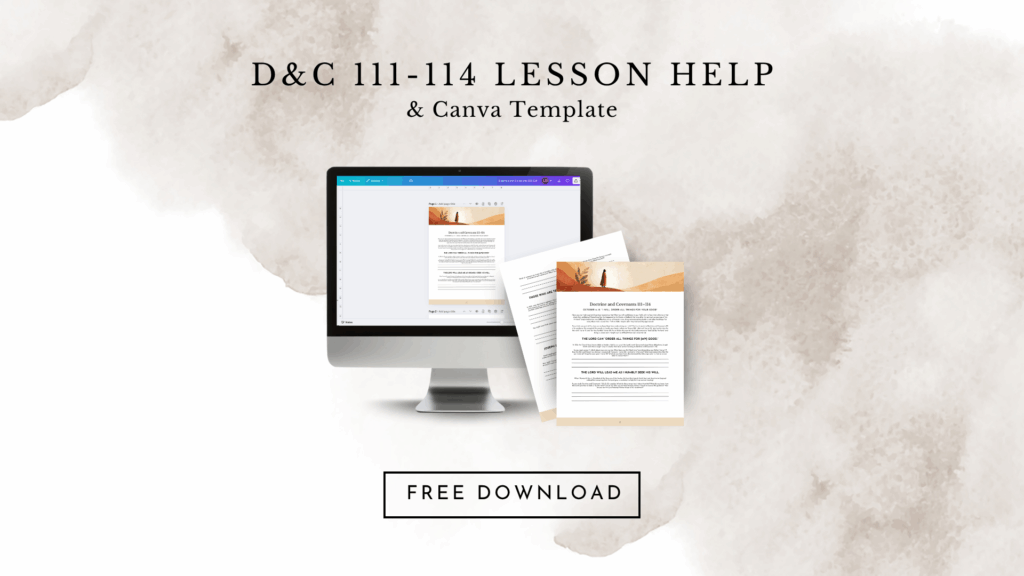
Grab our free lesson help by clicking this link: https://otherthanamom.myflodesk.com/dc111-114
The Lord can “order all things for [my] good.” (Doctrine and Covenants 111)
10 Engaging Questions
- What do you think the Lord meant by saying He would “order all things for your good”?
- How does God’s ability to bring good out of our mistakes give you hope?
- Why do you think He said He loved Joseph “notwithstanding [his] follies”?
- Have you ever seen “unexpected treasures” come from a trial?
- How do these verses change the way you view financial or personal struggles?
- What does “as fast as ye are able to receive them” teach you about God’s timing?
- Why do you think God allows us to experience uncertainty while He is still guiding us?
- How can we better recognize treasures from the Lord in ordinary moments?
- How do Matthew 6:33 and D&C 111 connect in their teachings?
- What does this section teach about God’s patience and mercy toward His children?
5 Object Lessons
- Puzzle Pieces – God orders scattered pieces into a complete picture.
- GPS Recalculation – Even wrong turns can be redirected to the right destination.
- Broken Pot with Flowers – Out of something broken, beauty still grows.
- Refiner’s Gold – Mistakes can still be purified into strength.
- Knotted Yarn – Though messy, with patience it can be untangled into something useful.
10 Personal Sharing Prompts
- Share a time the Lord turned a mistake into a blessing.
- Reflect on an “unexpected treasure” in your life.
- Tell about a moment when God’s timing was different from yours but better.
- Share how you’ve seen trials shape your faith.
- Reflect on how you’ve felt God’s love despite personal weakness.
- Share how financial or temporal struggles built spiritual growth.
- Tell about a time you recognized God’s hand only in hindsight.
- Reflect on how you’ve seen “order” come from what once felt chaotic.
- Share a lesson you learned from a trial that became a blessing.
- Tell how God has gently taught you through your follies.
The Lord will lead me as I humbly seek His will. (Doctrine and Covenants 112:3–15, 22)
10 Engaging Questions
- What does it mean for the Lord to lead you “by the hand”?
- How do these verses define humility?
- Why do you think humility is key to receiving revelation?
- How can pride block spiritual guidance?
- What do you learn from the example of Thomas B. Marsh?
- Why does the Lord invite us to “be thou humble” before promising to “lead [us]”?
- How can we show humility in disagreements or misunderstandings?
- How does Jesus Christ exemplify humility in His life?
- What blessings have you noticed when you’ve chosen humility?
- How do these verses apply to leadership in the Church and in families?
5 Object Lessons
- Empty Cup – Only when empty can it be filled, just like humility allows us to receive.
- Compass – Works only when held steady, symbolizing humble alignment with God’s will.
- Soft Clay – Humble hearts are moldable, while pride hardens.
- Child’s Hand in Parent’s Hand – Shows trusting humility as God leads us.
- Kneeling Figure – A simple visual of prayerful humility opening heaven’s guidance.
10 Personal Sharing Prompts
- Share an experience when humility brought clarity.
- Tell about a time pride clouded your ability to receive guidance.
- Reflect on how you’ve felt the Lord “lead you by the hand.”
- Share how you’ve learned humility through parenting or leadership.
- Tell about a time you saw humility heal conflict.
- Reflect on a moment when Christ’s example of humility touched you.
- Share how you’ve learned to recognize pride creeping into decisions.
- Tell about someone whose humility inspires you.
- Share a personal prayer experience where humility changed your heart.
- Reflect on how humility has deepened your relationship with the Savior.
Those who are truly converted come to know Jesus Christ. (Doctrine and Covenants 112:12–26, 28, 33–34)
10 Engaging Questions
- What is the difference between knowing about Jesus and truly knowing Him?
- How do these verses describe conversion?
- Why do even leaders need constant nourishment of their testimonies?
- What does it mean to be “converted unto the Lord, and not unto men”?
- How can trials test and deepen conversion?
- What practices help keep your testimony rooted in Christ?
- What warnings do you see about relying on position or knowledge alone?
- How does conversion bring joy even in adversity?
- What does it mean to “lift up the hands which hang down”?
- How do you help others strengthen their conversion?
5 Object Lessons
- Rooted Tree – Deep roots (conversion) help withstand storms.
- Anchor – Conversion keeps us from drifting in rough seas.
- Battery Charger – Constantly recharged faith keeps us strong.
- House Foundation – True conversion is the solid rock under our spiritual house.
- Flame – Conversion must be fed or it will go out.
10 Personal Sharing Prompts
- Share a trial that deepened your conversion.
- Tell about a moment when Christ became more real to you.
- Reflect on what keeps your testimony alive.
- Share how others have helped you remain strong in faith.
- Tell about a scripture or hymn that strengthens your conversion.
- Share how you’ve felt joy through Christ even in hardship.
- Reflect on a moment when you felt rooted and unshaken in Him.
- Tell about an example of someone whose conversion inspired you.
- Share how you’ve helped someone else grow in conversion.
- Reflect on how your conversion changes your daily choices.
Joseph Smith was “a servant in the hands of Christ.” (Doctrine and Covenants 113)
10 Engaging Questions
- What does it mean to be “a servant in the hands of Christ”?
- How does D&C 113 connect Isaiah’s prophecies to Joseph Smith?
- Why do you think God often works through chosen servants?
- How could these verses encourage the Saints during turmoil?
- How does Joseph’s calling strengthen your faith in God’s plan?
- What do you learn about God’s promises to gather Israel?
- How does this revelation help you feel part of the latter-day work?
- Why is it important to sustain the prophet even when times are hard?
- How do these verses strengthen your confidence in continuing revelation?
- What does it mean for you personally to serve in the Lord’s work today?
5 Object Lessons
- Rod and Root of a Plant – Visualizing Isaiah’s prophecy fulfilled.
- Conductor’s Baton – Symbolizes God directing His servant to lead.
- Torch – Joseph carried light to guide others through darkness.
- Tool in a Hand – Power comes not from the tool but the hand using it.
- Messenger Bag – Represents carrying Christ’s message to the world.
10 Personal Sharing Prompts
- Share how Joseph Smith’s life inspires you.
- Tell about a time you felt strengthened by following a prophet.
- Reflect on how you see yourself as “a servant in the hands of Christ.”
- Share a moment when you felt part of gathering Israel.
- Tell how your testimony of Joseph Smith affects your faith in Christ.
- Reflect on what it means to you that God works through chosen servants.
- Share how the Restoration blesses your daily life.
- Tell about a time when you sustained a leader even when it was hard.
- Reflect on how you’ve felt guided by modern revelation.
- Share how participating in God’s work has given you strength.