Introduction
Some Relief Society lessons are easier to teach when the talk itself already has a strong image running through it. Elder Ulisses Soares’s talk “Jesus Christ—the True Vine” is one of those talks. His central metaphor is memorable, doctrinally rich, and deeply practical: Jesus Christ is the True Vine, and we are the branches. In a world full of competing voices, counterfeit sources, distractions, and spiritual confusion, this image helps us see clearly where real nourishment, strength, truth, and joy actually come from.
This lesson help is designed to make preparation simpler while also helping you go deeper. Instead of having to figure out where the talk shifts, what quotes to use, or how to lead meaningful discussion, the talk is already broken into chronological discussion points. Each section includes direct quotes from the talk, 10 discussion questions, 5 object lesson ideas, and 10 personal sharing prompts to help invite reflection, story sharing, and testimony.
This structure also helps preserve the spirit of the talk itself. Rather than reducing the message to a few short ideas, it lets you stay close to Elder Soares’s language and movement: from Christ as the True Vine, to abiding in Him, to the many false voices of the world, to the need for discernment, to the invitation to receive nourishment directly from Him, and finally to the promise that He lives and continues to minister to us. All quotes below are taken directly from the uploaded talk text.

Grab our free bundle of 50+ Presentation Backgrounds by clicking here: https://otherthanamom.myflodesk.com/freebackgrounds
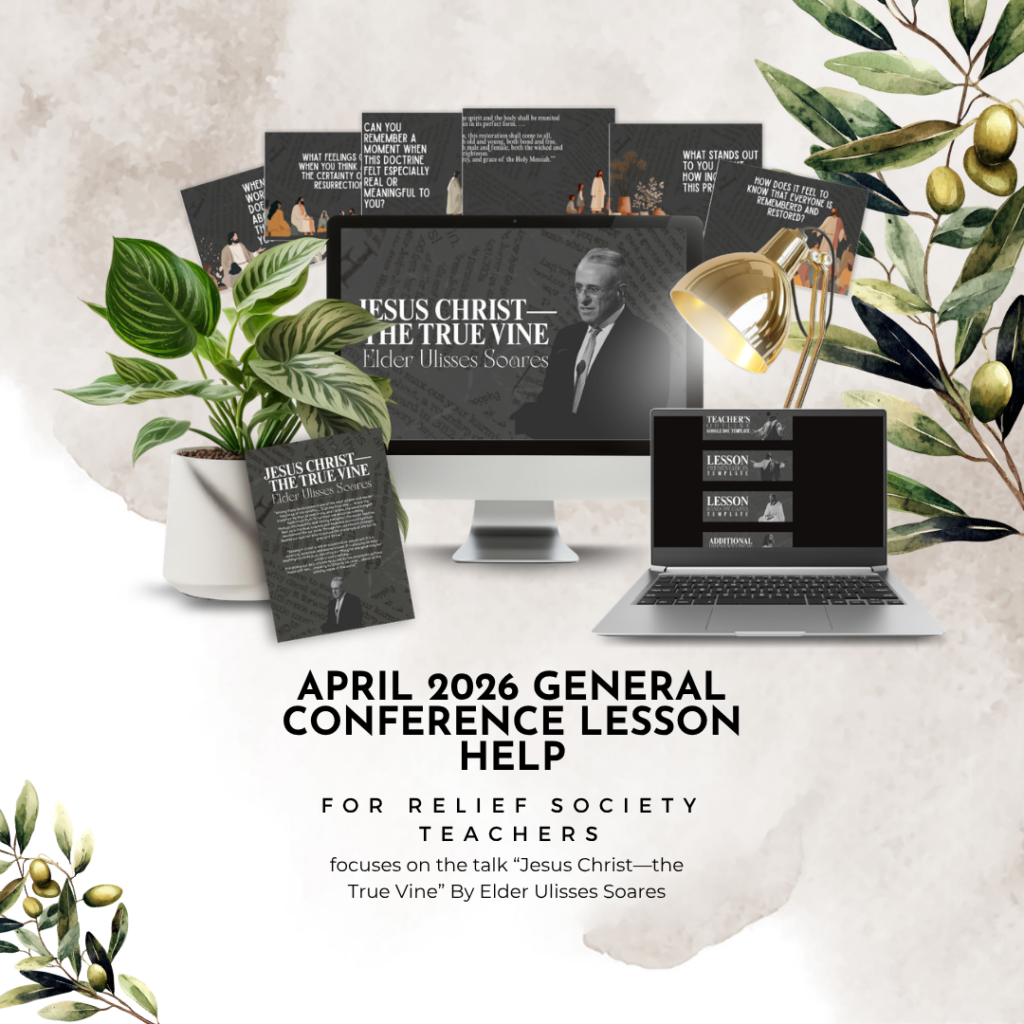
Interested in a done-for-you lesson plan with a teacher’s outline Google Doc, Canva Presentation Template, Lesson Handout Template, and themed presentation backgrounds? Click here: https://www.etsy.com/listing/4498245780/april-2026-general-conference-lesson?ref=listings_manager_grid
Section 1: Jesus Christ Is the True Vine
Teach
Elder Soares opens in a deeply reverent Easter setting and centers the talk on one of the Savior’s “I am” declarations: “I am the true vine.” This first section establishes the doctrine that Jesus Christ is not one helpful source among many. He is the essential source of spiritual nourishment and life.
Direct Quotes from the Talk
“In this sacred Easter season, our hearts turn with deep gratitude and reverent devotion to our Savior, Jesus Christ, and remember His merciful mortal ministry, His perfect love, and His marvelous gift of the Atonement. Throughout His ministry, the Savior spoke on several occasions the sacred words ‘I am,’ using sublime metaphors to bear witness of who He eternally is—the great Jehovah of the Old Testament, the Son of God, the promised Messiah.”
“Among these declarations is one of the most solemn and tender teachings of His ministry, spoken on the night preceding His suffering and death: ‘I am the true vine. … Ye are the branches: He that abideth in me, and I in him, the same bringeth forth much fruit: for without me ye can do nothing.’”
“Through this beautiful and moving metaphor, the Savior teaches that He is the true, trusted, and essential source of spiritual nourishment for our souls. Through Him, we receive strength beyond our own not only to survive the challenges of life but to grow and thrive.”
Discussion Questions
- What stands out to you about the Savior calling Himself the “True Vine”?
- Why do you think this teaching was given on the night before His suffering and death?
- What does the image of branches and a vine teach that a more abstract explanation would not?
- Why is it important that Elder Soares says Christ is the essential source of nourishment?
- How is spiritual nourishment different from temporary motivation?
- What does it mean to you personally that “without me ye can do nothing”?
- Why do we sometimes try to produce spiritual fruit apart from Christ?
- How has the Savior strengthened you beyond your own natural capacity?
- What do you think it means to thrive spiritually rather than merely survive?
- How does this opening section shape the rest of the talk?
Object Lessons
- Bring a live branch cut from a plant and compare it to a branch still connected to the stem.
- Show grapes or a vine image and discuss where fruit actually comes from.
- Use an unplugged lamp versus a plugged-in lamp to show dependence on a source.
- Bring a watering can and dried plant to illustrate nourishment versus withering.
- Draw a vine with branches on a board and label what flows from Christ into us.
Personal Sharing Prompts
- Share a time you felt spiritually strengthened beyond your own ability.
- Describe what “spiritual nourishment” feels like in your life.
- Share how your relationship with Jesus Christ has become more essential over time.
- Talk about a season when you realized you could not do it alone.
- Share an experience where Christ helped you do more than just survive.
- Describe how the Savior has helped you grow.
- Share what this metaphor teaches you personally about your dependence on Him.
- Talk about a time you felt disconnected and what helped you return.
- Share why the title “True Vine” matters to you.
- Describe what fruit has grown in your life because of Christ.
Section 2: Remaining Connected to Christ Is Essential to Our Spiritual Survival
Teach
Elder Soares immediately applies the metaphor. Just as branches cannot bear fruit alone, neither can we reach our spiritual measure unless we abide in Christ and His gospel. This section is a strong place to discuss dependence on the Savior without shame—simply as reality.
Direct Quotes from the Talk
“Through Him, life becomes more hopeful and more joyful and the fruits of the Spirit are manifested in us. Therefore, just as the branches cannot bear fruit of themselves unless they remain connected to the vine, neither can we reach our full spiritual measure unless we abide in Him and His gospel.”
“In a world of many voices, remaining connected to the True Vine is not merely desirable; it is essential to our spiritual survival.”
Discussion Questions
- What does “spiritual survival” mean to you?
- Why is connection to Christ not merely desirable but essential?
- What are some signs that a person is trying to bear fruit apart from the vine?
- How does hope increase when we stay connected to Christ?
- Which fruits of the Spirit have you seen grow most when you are close to Him?
- Why do people sometimes treat closeness to Christ as optional?
- What does “full spiritual measure” mean?
- How does this section challenge self-sufficiency?
- What helps you stay spiritually alive in demanding seasons?
- How does the world encourage disconnection without always naming it that way?
Object Lessons
- Compare a fresh branch in water with a dried, disconnected one.
- Show fruit from a tree or vine and ask where it originated.
- Use a phone charger to illustrate “essential,” not optional, connection.
- Bring a plant that needs sunlight and water and discuss survival conditions.
- Make two columns: “connected” and “disconnected,” and brainstorm results of each.
Personal Sharing Prompts
- Share a time staying close to Christ preserved you spiritually.
- Describe what helps you feel connected to Him.
- Share a season when you felt spiritually dry and what changed it.
- Talk about a fruit of the Spirit you have seen grow in your life.
- Share how the Savior has brought more hope into your life.
- Describe a time connection to Christ felt like survival.
- Share what spiritual thriving looks like for you.
- Talk about what pulls you away and what brings you back.
- Share how your view of dependence on Christ has deepened.
- Describe why this doctrine matters in daily life.
Section 3: Abiding in Christ Is a Constant, Conscious, Sacred Choice
Teach
This section is especially rich for Relief Society because Elder Soares defines abiding in Christ in very concrete ways. It is not casual. It is not occasional. It is not vague. It involves thoughts, words, digital behavior, daily choices, covenants, and listening to the voice of the Lord over the voices of the world.
Direct Quotes from the Talk
“Abiding in Christ is not an occasional or casual act; it is a constant, conscious, and sacred choice. It is allowing His holy teachings to abide in us, elevating our thoughts and governing our words in every setting—including the digital spaces where we so often interact—and purifying and consecrating our actions unto Him.”
“It is letting our daily choices be guided by the covenants we have made with Him and allowing our lives to be directed by His loving and constant influence through the Holy Ghost. It is choosing to listen to His voice and the voice of His servants and following what they teach, above all the enticing voices of the world.”
Discussion Questions
- What word in this definition stands out most to you: constant, conscious, or sacred?
- Why is abiding in Christ more than a feeling?
- How do His teachings elevate our thoughts?
- What does it look like to let Christ govern our words?
- Why do you think Elder Soares specifically mentions digital spaces?
- How do covenants guide daily choices in ordinary life?
- What does it mean to let the Holy Ghost direct our lives?
- Which “enticing voices of the world” are especially loud right now?
- How can we tell when we are listening more to the world than to the Lord?
- What small choices best reflect abiding in Christ?
Object Lessons
- Use a daily planner or calendar to discuss how sacred choices are made in real life.
- Hold up a phone and ask how digital spaces either strengthen or weaken connection to Christ.
- Use a filter demonstration to show how Christ’s teachings shape what enters and exits our hearts.
- Show a steering wheel to illustrate who is directing our lives.
- Bring a covenant path visual and place daily decisions along it.
Personal Sharing Prompts
- Share one daily practice that helps you abide in Christ.
- Describe how your covenants influence your choices.
- Share an experience where the Holy Ghost redirected you.
- Talk about how you try to honor Christ in digital spaces.
- Share a time you chose His voice over a louder worldly voice.
- Describe how your speech changes when you feel close to the Savior.
- Share how abiding in Him has become more intentional over time.
- Talk about one sacred choice you are trying to make more consistently.
- Share what “conscious discipleship” means in your life.
- Describe a recent moment when you felt your actions being consecrated to Him.
Section 4: Abiding in Christ Does Not Remove Burdens, but It Changes How We Carry Them
Teach
Elder Soares is realistic and compassionate here. He does not promise a burden-free life. He promises Christ’s grace, lighter burdens, stronger hearts, comfort, and peace. This is a very meaningful section for sisters carrying grief, exhaustion, chronic stress, illness, or long-term sorrow.
Direct Quotes from the Talk
“Abiding in Christ does not remove the burdens of life, but through His grace they are made lighter, and our hearts are strengthened by the comfort and peace He promises. As we place ourselves in His loving care and take upon us His yoke, we receive the spiritual power to endure and overcome the trials, weaknesses, and sorrows of mortality—burdens often too heavy to bear without His redeeming help and healing influence.”
“In his first epistle to the Saints, the Apostle John taught that he who ‘abideth in him ought himself also so to walk, even as he walked.’ The Apostle Paul likewise testified, ‘If any man be in Christ, he is a new creature.’”
Discussion Questions
- Why is it important that Elder Soares does not say Christ removes every burden?
- What is the difference between a burden being removed and a burden being made lighter?
- How has the Savior strengthened your heart even when the situation did not change immediately?
- What do you think it means to take upon us His yoke?
- Why are some mortal burdens too heavy to bear without Him?
- How does abiding in Christ help us endure weakness and sorrow?
- What does it look like to walk even as He walked during hard times?
- How does this section connect relief with becoming a “new creature”?
- What have you learned about Christ’s healing influence in long seasons, not just quick miracles?
- How can we help each other carry burdens in Christlike ways?
Object Lessons
- Carry two buckets alone and then with help to illustrate shared burden-bearing.
- Use a yoke image or picture to discuss being joined with Christ.
- Place rocks in a bag, then remove some while keeping the bag to show lighter, not gone.
- Show a before-and-after heart image to discuss strengthened hearts.
- Use a soft blanket or shawl to symbolize comfort and peace in pain.
Personal Sharing Prompts
- Share a time Christ made a burden lighter even though it remained.
- Describe how the Savior has strengthened your heart.
- Share what His peace has looked like in a difficult season.
- Talk about a weakness that has become a place of growth.
- Share an experience of being carried by grace.
- Describe a time His healing influence mattered more than immediate resolution.
- Share how abiding in Christ has changed the way you suffer.
- Talk about what it means to be a “new creature” to you.
- Share how Christ has helped you endure something heavy.
- Describe a burden you could not have borne without Him.
Section 5: There Are Other Vines That Only Pretend to Be True
Teach
This section is one of the strongest in the talk. Elder Soares warns that the word true implies the existence of false or counterfeit vines. Some voices look good, sound good, and even appear connected to Christ, but they slowly lead hearts elsewhere. This section is especially timely and useful for deep discussion.
Direct Quotes from the Talk
“Returning to John’s account, we read that the Savior declared: ‘Abide in me, and I in you. As the branch cannot bear fruit of itself, except it abide in the vine; no more can ye, except ye abide in me.’
“It is within this context—of abiding in Him and allowing Him to abide in us—that the Savior’s declaration that He Himself is the True Vine takes on even deeper meaning. The word true suggests that there are, in the world, other vines that present themselves as legitimate, even appearing to represent the loving voice and word of the Savior, the True Vine, and His gospel, while subtly and deviously leading minds and hearts elsewhere.”
Discussion Questions
- Why is the word true so important in this passage?
- What are some examples of “other vines” in today’s world?
- Why do counterfeit voices often appear legitimate at first?
- What makes deception subtle and effective spiritually?
- How can we distinguish between what sounds spiritual and what truly leads to Christ?
- Why do you think false voices sometimes borrow Christlike language?
- What happens when our hearts are slowly led elsewhere?
- How can we stay humble enough to recognize when we are being subtly influenced?
- What safeguards does the Lord give us against spiritual counterfeits?
- Why is this warning especially important now?
Object Lessons
- Show a real plant and an artificial one to compare appearance versus life.
- Use counterfeit and real currency images to discuss subtle deception.
- Bring two labels, one “true” and one “almost true,” and sort examples under them.
- Show two similar cords, one actually connected and one not, to illustrate false connection.
- Use a food label comparison between something nutritious and something only marketed as healthy.
Personal Sharing Prompts
- Share a time you recognized a voice or influence that was not leading you to Christ.
- Describe how the Spirit has helped you discern truth from imitation.
- Share what helps you stay rooted in the gospel when many voices compete.
- Talk about a philosophy or idea that sounded appealing but lacked spiritual life.
- Share an experience where prophetic counsel protected you from confusion.
- Describe a time you felt gently corrected by the Lord.
- Share what helps you recognize the Savior’s voice.
- Talk about how discernment has become more important in your life.
- Share how you have seen counterfeit ideas weaken spiritual connection.
- Describe how truth feels different from something merely attractive.
Section 6: The Many Voices of the World Can Entangle Us
Teach
Elder Soares expands the warning. Some voices are eloquent and well-intentioned. Some are attractive but shallow. Some are openly misleading. Over time, they become tangled vines spread through media and popular philosophies. This section is especially strong for discussing discernment without fear-based teaching.
Direct Quotes from the Talk
“We live in a world filled with many voices—voices that relentlessly seek our attention and offer persuasive messages and invitations. Some speak with eloquence and influence and are well intentioned in their desire to promote goodness. Others are attractive in appearance but lack substance. Still others are misleading and may even appear to be connected to Christ and His gospel.”
“Over time, many of these voices grow into tangled vines, rooted in popular philosophies and spread through various forms of media. They promise security, happiness, or authenticity, yet they cannot satisfy the soul. Often, they quietly introduce doubt and division—first in the mind and then in the heart—leading to spiritual loss and sorrow. Although becoming entangled in such voices may feel exciting at first, it ultimately draws us toward fleeting worldly pursuits and weakens our connection to the True and Living Vine, Jesus Christ.”
Discussion Questions
- Which phrase stands out most to you in this warning about many voices?
- Why do persuasive voices so often gain our attention?
- What does it mean for something to look good but “lack substance”?
- How do doubt and division often begin in the mind before reaching the heart?
- Why can entangling voices feel exciting at first?
- What kinds of messages promise happiness but cannot satisfy the soul?
- How does media shape our spiritual environment?
- What helps you recognize the difference between what is loud and what is true?
- How can we protect our homes and hearts without becoming fearful or disconnected from the world?
- What spiritual habits make entanglement less likely?
Object Lessons
- Use tangled string or vine to show how gradual entanglement happens.
- Present attractive packaged snacks versus nourishing food to discuss substance.
- Hold up several noisy objects and then contrast them with a quiet, steady sound.
- Use weeds growing around a healthy plant to illustrate competition for nourishment.
- Show a phone screen full of notifications to discuss relentless voices.
Personal Sharing Prompts
- Share a time you realized a certain influence was not satisfying your soul.
- Describe how you have learned to guard your mind and heart.
- Share a moment when the Spirit warned you about something that seemed harmless.
- Talk about how you manage media with spiritual discernment.
- Share what voices most strengthen your faith.
- Describe how Christ has helped untangle something in your life.
- Share an experience where worldly excitement proved spiritually empty.
- Talk about how your standards have become clearer over time.
- Share what helps you stay rooted when the world feels noisy.
- Describe a time you chose nourishment over distraction.
Section 7: Spiritual Discernment Is Essential in a Technological World
Teach
Elder Soares gives a balanced and wise teaching here. Technology itself is not condemned. Instead, he teaches that true wisdom is using modern tools with discernment through the Holy Ghost without letting them replace the rightful voice of the True Vine. This section is practical and especially relevant for modern Relief Society discussion.
Direct Quotes from the Talk
“My beloved brothers and sisters, true wisdom in our technological day is found in using modern tools with spiritual discernment—through the Holy Ghost—without allowing them to replace the rightful voice of the True Vine. Only our Redeemer can truly redeem us. He is the way, the truth, and the life of the world. ‘His way is the path that leads to happiness in this life and eternal life in the world to come.’”
“In his first message to the world as our prophet, President Dallin H. Oaks declared with clarity and conviction: ‘Jesus Christ is the way. … “There shall be no other name given, nor any other way nor means, whereby salvation can come unto the children of men, only in and through the name of Christ, the Lord Omnipotent.”’”
Discussion Questions
- What does “spiritual discernment” look like in a technological world?
- Why is it important that Elder Soares does not simply tell us to reject modern tools?
- How can helpful tools become replacements for the Savior’s voice?
- What role does the Holy Ghost play in media and technology use?
- What does this section teach about wisdom?
- Why does Elder Soares reconnect discernment back to the truth that Jesus Christ is the way?
- How can we use technology without letting it disciple us?
- What practical boundaries or habits help keep Christ’s voice primary?
- How can women teach younger generations this principle with balance and hope?
- What does this section invite you to evaluate in your own life?
Object Lessons
- Show a useful tool like a calculator or phone and discuss proper use versus dependence.
- Place a phone beside scriptures and discuss which voice leads first.
- Use headphones to illustrate what happens when one voice dominates.
- Show a remote control to discuss who is actually in control.
- Use a flashlight app and a real flashlight to discuss tools versus source.
Personal Sharing Prompts
- Share how you try to use technology with spiritual discernment.
- Describe a time the Holy Ghost helped you recognize something was off.
- Share a change you have made in media habits to keep Christ’s voice first.
- Talk about what helps you avoid digital overload.
- Share how the Savior’s voice has become clearer in your life.
- Describe a technology habit that has actually helped your discipleship.
- Share how you teach discernment in your home or family.
- Talk about what happens when worldly noise gets too loud.
- Share how prophetic counsel has helped you navigate modern life.
- Describe one adjustment you feel prompted to make.
Section 8: We Must Receive Nourishment Directly from the True Vine
Teach
Elder Soares now brings the message back to hope and invitation. Christ offers far more than visibility, status, or acclaim. He offers never-ending happiness. If we want to bring forth good fruit, we must receive nourishment directly from Him, through His words and the words of those He has called.
Direct Quotes from the Talk
“The True Vine offers something far greater and eternal than visibility or acclaim—the promise to ‘dwell with God in a state of never-ending happiness.’ With patience and perfect love, He continues to invite us to come unto Him through His words and the words of those whom He has called and ordained to represent Him, to speak in His name, and to testify of Him.”
“If we desire to bring forth good fruit, as the Savior taught, we need to receive our spiritual nourishment directly from the True Vine, for He is the source of all light and truth. Only then do the precious fruits of the gospel grow in our souls, and only then do we find the true light, life, and hope that flow from Him.”
Discussion Questions
- What is the difference between visibility or acclaim and the life Christ offers?
- Why must nourishment come directly from the True Vine?
- What are some signs that a person is trying to live on secondhand nourishment?
- How do His words and the words of His servants feed us?
- What gospel fruits have you seen grow when you receive nourishment directly from Christ?
- Why is patience part of His invitation?
- What does “never-ending happiness” mean in the context of a mortal life that still contains pain?
- How does this section reframe what success really is?
- What practices help you receive light and truth more directly from the Savior?
- Which fruit of the gospel do you most desire to grow in your soul right now?
Object Lessons
- Bring fresh fruit and trace it back to its source.
- Compare processed, artificial food with something nourishing and natural.
- Use a watering system feeding directly into roots.
- Show a vine diagram and label “light,” “truth,” “hope,” and “life” flowing into branches.
- Bring a devotional book and scriptures to compare secondary helps with direct nourishment from Christ’s word.
Personal Sharing Prompts
- Share how you personally receive nourishment from the Savior.
- Describe a time the words of Christ fed your soul.
- Share a gospel fruit that has grown in your life.
- Talk about what Christ offers that the world cannot.
- Share how prophetic teachings have nourished you.
- Describe a time you found light and hope directly through Him.
- Share how your priorities have changed as you have stayed rooted in Christ.
- Talk about the difference between being impressed and being nourished.
- Share what kind of fruit you most want the Lord to grow in you.
- Describe what “life and hope that flow from Him” means in your experience.
Section 9: “Abide with Us” – Desire and Invitation Open Our Eyes
Teach
Elder Soares uses the road to Emmaus to show that desire matters. The disciples invited the resurrected Savior to stay. Without that desire and invitation, their hearts would not have been transformed, their eyes would not have been opened, and they would not have become witnesses. This is a beautiful section for discussing agency and seeking the Savior.
Direct Quotes from the Talk
“After His Resurrection, Jesus walked with two disciples on the road to Emmaus. Luke records that when they reached their destination, ‘[the Savior] made as though he would have gone further. But [the two disciples] constrained him, saying, Abide with us.’ Those disciples invited the resurrected Savior to abide with them. Without first the desire and then the invitation, their hearts would not have been transformed, their eyes would not have been opened to recognize Him, and they would not have returned to Jerusalem to bear witness of the living Christ—the True Vine.”
Discussion Questions
- Why do you think Elder Soares includes the Emmaus story here?
- What does “Abide with us” mean to you personally?
- Why are desire and invitation necessary in a relationship with the Savior?
- How do we invite Christ to abide with us in daily life?
- What happens in us when we genuinely want Him near?
- Why do transformed hearts often become witnessing hearts?
- What does this story teach about agency in discipleship?
- How have your eyes been opened over time to recognize the Savior more clearly?
- What are some ways we unintentionally live as if we do not need Him to stay?
- How does this section deepen the meaning of abiding in Christ?
Object Lessons
- Use an open door image to symbolize inviting the Savior in.
- Place an empty chair in the room and label it “Abide with us.”
- Use a dinner table setting to represent making room for Christ.
- Hold a heart-shaped object and a key to illustrate opened hearts.
- Use a candle being invited into a dark room as a symbol of welcomed light.
Personal Sharing Prompts
- Share a time you consciously invited the Savior into a situation.
- Describe how your heart has been transformed as you stayed near Him.
- Share a moment when your spiritual eyes were opened.
- Talk about what “Abide with us” feels like in your own life.
- Share how desire for Christ has grown in you.
- Describe a time you recognized His presence after first missing it.
- Share how your witness of Him has become more personal.
- Talk about an experience that made you want to bear testimony.
- Share how the Savior has stayed with you in a sacred way.
- Describe what kind of invitation you feel prompted to offer Him now.
Section 10: Remaining Connected to the True Vine Is Essential
Teach
Elder Soares closes by returning to his main message with increased urgency and witness. Remaining connected to Christ is essential to spiritual survival. His voice comes through His servants. Abiding in Him brings fruit. He lives. He invites all to continue in His love. This section works beautifully as a concluding teaching moment in Relief Society.
Direct Quotes from the Talk
“My beloved brothers and sisters, in a world of many voices, remaining connected to the True Vine is not merely desirable; it is essential to our spiritual survival. Those who abide in Jesus Christ come to recognize and trust His voice, especially as it is spoken through those He has called to represent Him.”
“In that sacred moment, I felt the Savior ministering in love to me through the voice of one of His anointed servants. I felt the peace and comforting assurance flowing from the True Vine. Elder Holland’s life and mighty ministry testify that as we hear the Savior’s voice through His servants and abide in Him—the True Vine—we bring forth much fruit, ‘for without [Him we] can do nothing.’”
“In this sacred Easter season, I solemnly testify that Jesus Christ is the True Vine. He lives. He rose from the dead, and His redeeming power is real. I bear witness that His voice is the voice of truth and life. With perfect love, He invites all to abide in Him and to continue in His love that we may recognize His power in our lives, that God’s love may be perfected in us, and that we may know that we are in Him.”
Discussion Questions
- Why does Elder Soares return to the phrase “essential to our spiritual survival”?
- How have you come to recognize the Savior’s voice more clearly?
- Why is it important that His voice is often heard through His servants?
- What do you learn from Elder Soares’s personal witness about hearing the Savior through another leader?
- How does Easter deepen the meaning of Christ as the True Vine?
- What does it mean that His redeeming power is real?
- How does abiding in Christ perfect God’s love in us?
- What evidence of His power have you seen in your life?
- Which final phrase from Elder Soares’s testimony feels most meaningful to you?
- What do you want to do differently because of this talk?
Object Lessons
- End with a full vine-and-branches visual from the start of the lesson.
- Use a microphone or speaker image to talk about recognizing the Savior’s voice through servants.
- Light a candle labeled “truth and life” as a final witness symbol.
- Display fruit grown on a vine as a conclusion to the lesson.
- Use a resurrection image alongside a vine to connect Easter and abiding in Christ.
Personal Sharing Prompts
- Share how you have learned to trust the Savior’s voice.
- Describe a time you felt Christ minister to you through one of His servants.
- Share evidence that His redeeming power is real in your life.
- Talk about how Easter strengthens your witness of Him.
- Share a fruit you have seen grow because you stayed connected to Christ.
- Describe a time you felt peace flow from the True Vine.
- Share how God’s love has been perfected in you over time.
- Talk about a recent moment when you recognized His power in your life.
- Share your testimony that Jesus Christ lives.
- Describe what abiding in Him means to you now after studying this talk.
Conclusion
One of the greatest blessings of using a structured lesson help is that it gives you room to prepare spiritually instead of just administratively. When the talk is already broken into meaningful discussion points, when the key quotes are already identified, and when the questions and prompts are ready, you can focus more on what matters most: listening to the Spirit, thinking about the women in your class, and preparing to teach in a way that truly blesses them.