Introduction
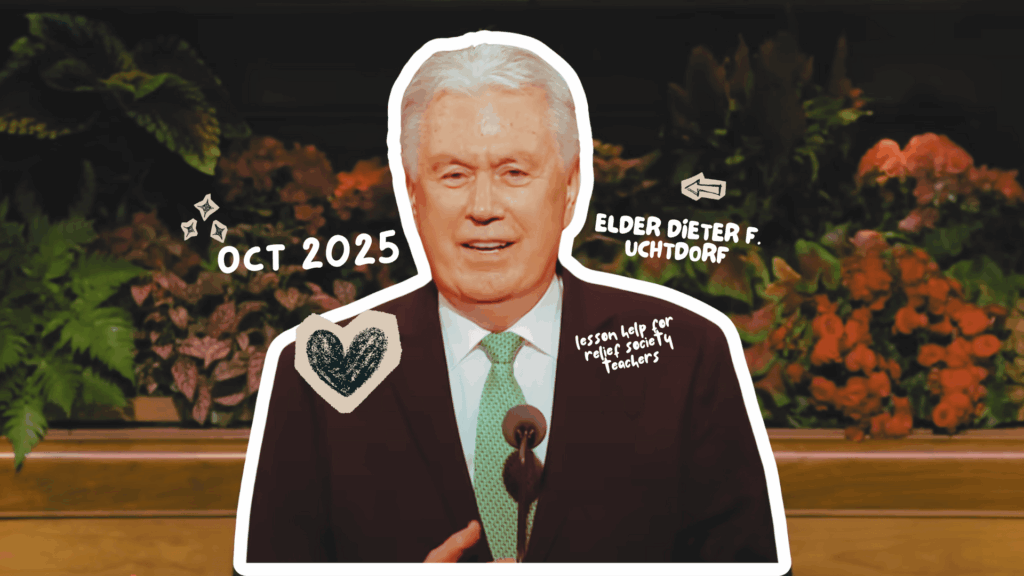
As Relief Society teachers, one of the greatest gifts we can give our sisters is helping them see how beautifully simple — yet deeply intentional — discipleship can be. Elder Dieter F. Uchtdorf’s talk invites us to see faith not as something that happens to us, but something we practice daily.
This lesson help is designed to help you guide your class through reflection, connection, and action. You’ll find each section broken down by Elder Uchtdorf’s main discussion points — along with questions that spark heartfelt conversation, object lessons that visually bring his teachings to life, and sharing prompts that invite sisters to connect gospel principles to real life.
Let’s dive in.

Grab our free bundle of 50+ Presentation Backgrounds by clicking here: https://otherthanamom.myflodesk.com/freebackgrounds

Interested in a done-for-you lesson plan with a teacher’s outline Google Doc, Canva Presentation Template, Lesson Handout Template, and themed presentation backgrounds? Click here: https://www.etsy.com/listing/4389498629/october-2025-general-conference-lesson?ref=listings_manager_grid
Section 1: The Flight Simulator – Practice Keeps Us Capable
“Getting good at anything, whether it be flying, rowing, sewing, or knowing, takes consistent self-discipline and practice. … If you think that means you can stop practicing and studying, you gradually lose the knowledge and abilities you once acquired at great cost.”
Elder Uchtdorf begins with a relatable story from his time as a pilot — a vivid reminder that even when we’ve mastered something, stopping the practice means we start losing the power. Discipleship, like flying, is not a one-time certification; it’s lifelong training.
Discussion Questions
- What parallels do you see between Elder Uchtdorf’s flight simulator story and our personal spiritual routines?
- How can we recognize when we’re becoming “spiritually rusty”?
- What daily or weekly “spiritual simulator” experiences help you keep your testimony sharp?
- Why is it sometimes easier to maintain worldly skills than spiritual ones?
- What emotions arise when you realize your spiritual habits need refreshing — and how do you respond?
- How can we support one another when faith feels like “hard work”?
- What’s one small, daily discipline that’s helped you stay close to Christ lately?
- How does humility play a role in continual learning as a disciple?
- Why do you think the Lord allows us to “forget” spiritual truths if we stop nurturing them?
- How can this analogy help someone who feels unworthy to start again?
Object Lesson Ideas
- Rusty Key: Show a shiny key and a rusted one — discuss how regular use keeps things functional.
- Deflating Balloon: Blow up a balloon and let it slowly lose air — remind sisters that testimony deflates without continual “refilling.”
- Dusty Bible: Hold up a clean and a dusty set of scriptures — talk about what daily spiritual use looks like.
- Tuning an Instrument: Pretend to “tune” a ukulele or guitar; explain how constant tuning keeps harmony.
- Exercise Bands: Stretch a resistance band — note how strength and flexibility increase only through repeated effort.
Personal Sharing Prompts
- Share about a time when consistent scripture study changed your perspective.
- Tell about a “spiritual skill” you had to re-learn after neglecting it.
- Have you ever realized you were coasting spiritually? What helped you re-engage?
- Describe someone who models quiet, consistent discipleship for you.
- What’s a personal “training routine” that keeps your faith strong?
- Share how you balance grace and effort in your discipleship.
- How has repentance felt like “getting back in the simulator”?
- What do you do when you feel spiritually burned out?
- Share a time you saw steady, small habits bring big spiritual growth.
- How do you remind yourself that spiritual progress is never “one and done”?
Section 2: Discipleship Requires Daily Effort
“Faith in Jesus Christ is a gift, but receiving it is a conscious choice that requires a commitment of all our might, mind, and strength. It is a practice of every day, every hour.”
Here Elder Uchtdorf draws a distinction between having faith and living in faith. Discipleship isn’t a spiritual title; it’s a daily lifestyle of loyalty and devotion.
Discussion Questions
- Why do you think Elder Uchtdorf called faith both a “gift” and a “choice”?
- What does “all your might, mind, and strength” look like for you personally?
- How can we create a lifestyle that makes faith our first reflex, not our last resort?
- What are some “every hour” ways we can show loyalty to the Savior?
- How do trials test and strengthen our faith?
- What happens when we treat discipleship as something casual or convenient?
- How do you differentiate between faith and positive thinking?
- How do you help your children (or others) see discipleship as joyful, not burdensome?
- What has helped you stay steady in seasons of spiritual drought?
- How do you personally “nourish” your faith each day?
Object Lesson Ideas
- Charging Phone: Hold a phone with low battery — illustrate how constant “charging” through prayer and scripture keeps spiritual energy alive.
- Lamp & Plug: Unplug a lamp — the light fades when disconnected from its power source.
- Seeds in Soil: Plant two seeds, one watered and one not — show how faith grows through daily care.
- Daily Calendar Pages: Tear off pages — each day is an opportunity to recommit to Christ.
- Rocks in a Jar: Fill a jar with big rocks labeled “faith habits” and smaller pebbles for distractions — what fills your jar first?
Personal Sharing Prompts
- Describe what “everyday discipleship” looks like in your home.
- How do you turn ordinary routines (like driving or cooking) into spiritual moments?
- Share a time daily prayer made a clear difference in your day.
- What has helped you rebuild your faith after feeling disconnected?
- What “mini moments” bring you closer to the Savior?
- Share about a season when faith felt like a daily climb.
- How do you remind yourself to rely on Christ in busy or stressful times?
- What spiritual habit are you working to strengthen right now?
- How do you show loyalty to the Savior when no one’s watching?
- Share how you’ve seen faith grow stronger “against opposition.”
Section 3: Using and Magnifying Our Gifts
“God gives us gifts of knowledge, of ability, of opportunity, and He wants us to use and amplify them … Our gifts magnify and multiply only when we put them to use.”
In this section, Elder Uchtdorf shifts from self-discipline to self-recognition — helping us see that our divine gifts are not meant to be admired but activated. The Lord doesn’t compare; He calls us to contribute.
Discussion Questions
- Why do you think it’s easier to notice others’ gifts than our own?
- How can we help sisters recognize quiet or unseen spiritual gifts?
- What does it look like to “amplify” a spiritual gift instead of hiding it?
- How do fear or comparison keep us from using our talents?
- What are some non-traditional gifts that bless the ward family?
- Why might Heavenly Father give us gifts that don’t look “flashy”?
- How can we discern which gifts the Lord wants us to develop right now?
- What happens when we use our gifts to lift others instead of ourselves?
- How do you handle moments when you feel “ordinary” or “less gifted”?
- How can we teach our children or youth to value spiritual gifts over worldly ones?
Object Lesson Ideas
- Unopened Gift Box: Display a wrapped gift labeled “Your Spiritual Gift” — it blesses no one until opened.
- Flashlight with Dead Batteries: A gift unused loses its light — recharge through service.
- Measuring Cups: Show that even “small measures” can make a recipe complete.
- Plant with Pruned Branches: Growth happens when gifts are cared for and trimmed, not neglected.
- Mirror: Each sister looks briefly — remind them they reflect divine potential, even when they don’t see it.
Personal Sharing Prompts
- Share a time you discovered a hidden gift while serving.
- Talk about someone whose quiet gift has deeply blessed your life.
- How has using a spiritual gift brought you closer to Christ?
- When have you felt Heavenly Father nudging you to use your talents?
- Share about a time you hesitated to share your gift — what happened?
- How do you discern when to use or step back with your gifts?
- What spiritual gift do you hope to develop more fully?
- How do you encourage others to recognize their gifts without pride?
- Share an experience where the Lord turned a weakness into a strength.
- What “small and simple” gift have you seen create great things?
Section 4: You Are Gifted—Divine Origin, Divine Destiny
“You are a blessed being of light, the spirit child of an infinite God, and you bear within you a potential beyond your own capacity to imagine. … You are anything but ordinary. You are gifted.”
This section is one of the most tender parts of Elder Uchtdorf’s message. He shifts from “practice” and “discipline” to pure identity—reminding us that discipleship is not about earning God’s love but remembering where it began.
When sisters internalize this truth, comparison softens, self-doubt quiets, and spiritual confidence begins to grow.
Discussion Questions
- Why do you think so many of us forget that our origin story is divine?
- How does seeing yourself as a “blessed being of light” change the way you live each day?
- What are some quiet ways heaven has reminded you of your worth?
- How does knowing “heaven has never left you” help you in moments of loneliness?
- What happens when we treat ourselves—or others—as “ordinary”?
- How can recognizing divine gifts change the way we serve?
- How might this truth heal feelings of inadequacy or burnout?
- Why do you think God gives different gifts to each of His children?
- How can Relief Society become a place where sisters truly see one another’s divinity?
- How does this section connect with Elder Uchtdorf’s earlier metaphor of nurturing faith?
Object Lesson Ideas
- Mirror Covered in Dust: Wipe it clean to show how divine reflection becomes clearer when we remove self-doubt.
- Candle and Flame: Light one candle, then light several others from it—God’s light multiplies when shared.
- Crown or Tiara: A simple reminder of divine heritage.
- Puzzle Pieces: Each piece represents a sister’s unique gifts that complete the picture of Zion.
- Cloud in a Jar (cotton + light): “You came trailing clouds of glory”—a visual for divine origin.
Personal Sharing Prompts
- Share a time you felt God remind you of your divine worth.
- How has someone in Relief Society helped you see your light?
- Tell about a season when you doubted your value and how you found it again.
- How does motherhood (or ministering) reveal divine traits in you?
- Who do you think of when you picture “a being of light”?
- What gift has God given you that you once overlooked?
- How has knowing your divine nature helped you make better choices?
- Describe a time you saw God’s image in someone unexpected.
- How do you remind your children—or yourself—of divine potential?
- Share a personal mantra or scripture that strengthens your sense of divine identity.
Section 5: Growth Happens Gradually and Through Christ
“God knows who we truly are, who we are designed to become, and so His expectations for us are high. … Growth happens gradually and patiently, but also consistently and unrelentingly. Remember, it is Jesus Christ who already did the superhuman part.”
Here Elder Uchtdorf beautifully grounds our divine potential in grace. He reminds us that Christ’s Atonement carries the weight of transformation—we simply walk the path step by step.
Discussion Questions
- Why do you think Elder Uchtdorf emphasized “gradual” growth?
- How does remembering that Jesus already did the “superhuman part” bring peace?
- What does consistent spiritual progress look like in real life?
- How do you keep from feeling discouraged by your imperfections?
- Why does God’s patience matter in our discipleship journey?
- How can we apply this gradual-growth mindset to ministering or parenting?
- What helps you stay committed when progress feels invisible?
- What’s one area where you’ve seen small, steady growth over time?
- How can you remind others that perfection is a process?
- How do humility and grace work together in spiritual growth?
Object Lesson Ideas
- Growing Plant or Seedling: Growth is slow but sure; small roots make strong trees.
- Sand Timer: Progress takes time—each grain matters.
- Stair Steps: Place paper steps labeled “faith,” “repentance,” “hope,” etc.—each leads upward.
- Before/After Photos (e.g., art or garden): Show transformation over time.
- Piece-by-Piece Puzzle Build: Demonstrate how small, daily acts complete a bigger picture.
Personal Sharing Prompts
- Share a time you recognized spiritual growth only after looking back.
- How has Jesus helped you through a slow-changing trial?
- Describe a “one-step-at-a-time” experience that shaped your faith.
- When have you felt refined by repetition rather than big leaps?
- How do you stay patient with yourself?
- Who has modeled gradual, faithful discipleship for you?
- Share how small spiritual habits have changed your heart over time.
- How do you remind yourself that Christ’s grace fills the gap?
- What helps you start again when you feel you’ve failed?
- Tell about a time the Savior turned your effort into growth you didn’t expect.
Section 6: Enduring Faith—Step by Step Toward Zion
“Our Father asks that we approach this challenge of faith and discipleship not as casual tourists but as wholehearted believers … Because of our beloved Savior, there is no such thing as a no-win scenario.”
Elder Uchtdorf concludes by inviting us to see discipleship as a journey of loyalty, not perfection. We’re not tourists snapping photos of faith; we’re travelers walking home to God.
Discussion Questions
- What does it mean to be a “wholehearted believer” rather than a “casual tourist”?
- How can we cultivate endurance in our faith journey?
- Why do you think Elder Uchtdorf says “there is no no-win scenario”?
- How does this truth affect your view of trials?
- What does daily perseverance look like for you right now?
- How can we help one another keep walking when the road feels long?
- What role does hope play in enduring discipleship?
- How can we balance gratitude for past progress with motivation for future growth?
- What helps you keep your “eyes on Zion” amid distractions?
- How do you renew your commitment to Christ each day?
Object Lesson Ideas
- Trail Map: Show a map—each checkpoint represents steps of faith and endurance.
- Running Shoes: Discipleship is a marathon, not a sprint.
- Compass: Symbolize keeping direction toward Christ even when paths twist.
- Anchor: Our hope in Christ keeps us steady in storms.
- Lantern in Dim Light: The Savior’s light guides one step at a time.
Personal Sharing Prompts
- Share about a season when you had to “keep walking by faith.”
- What helps you hold on to hope when life feels uncertain?
- Who has modeled quiet, enduring discipleship for you?
- Describe a time you saw God turn a seeming “no-win” into a miracle.
- What motivates you to keep going spiritually?
- How has ministering strengthened your endurance?
- Tell about a moment when the Savior felt near in your perseverance.
- How do you find joy even while still “on the journey”?
- What do you do when you feel spiritually exhausted?
- How does focusing on Zion—rather than Babylon—change your priorities?
Conclusion: Practicing Discipleship Daily
Elder Uchtdorf’s message reminds us that discipleship is both disciplined and deeply personal. It’s choosing, every day, to look toward Christ—to practice faith like a pilot rehearsing every scenario until it becomes instinct.
In Relief Society, we have the privilege of walking that flight path together. We lift one another when our wings feel weak, and we remind each other that no matter how far we still have to go, the Savior has already conquered the impossible parts.
So as you teach this lesson, invite your sisters to see themselves as divine learners in God’s great simulator—courageous, gifted, and guided by a perfect Instructor who never gives up on them.
May each of us keep practicing discipleship until it becomes the rhythm of our hearts and the language of our lives. 💛



Your questions are AMAZING!!! Thank you so so much for all your effort!
Awww thank you for this sweet message, I’m so happy you like them!