
Introduction
Elder Aaron T. Hall’s talk “I Glory in My Jesus” is a beautiful Relief Society lesson because it invites sisters to do more than talk about Jesus Christ. It invites them to rejoice in Him personally. This message is centered on the deeply personal relationship Nephi and Ammon had with the Savior, and it gives us language to reflect on the many ways Jesus Christ blesses, redeems, heals, gathers, advocates for, guides, and delivers us.
This lesson help is designed to make preparation easier while also helping you create a deeper, more personal discussion. The talk is divided into chronological sections, with direct quotes, discussion questions, object lesson ideas, and personal sharing prompts. That way, instead of trying to organize everything from scratch, you can focus on prayerfully choosing what your Relief Society sisters most need.

Grab our free bundle of 50+ Presentation Backgrounds by clicking here: https://otherthanamom.myflodesk.com/freebackgrounds
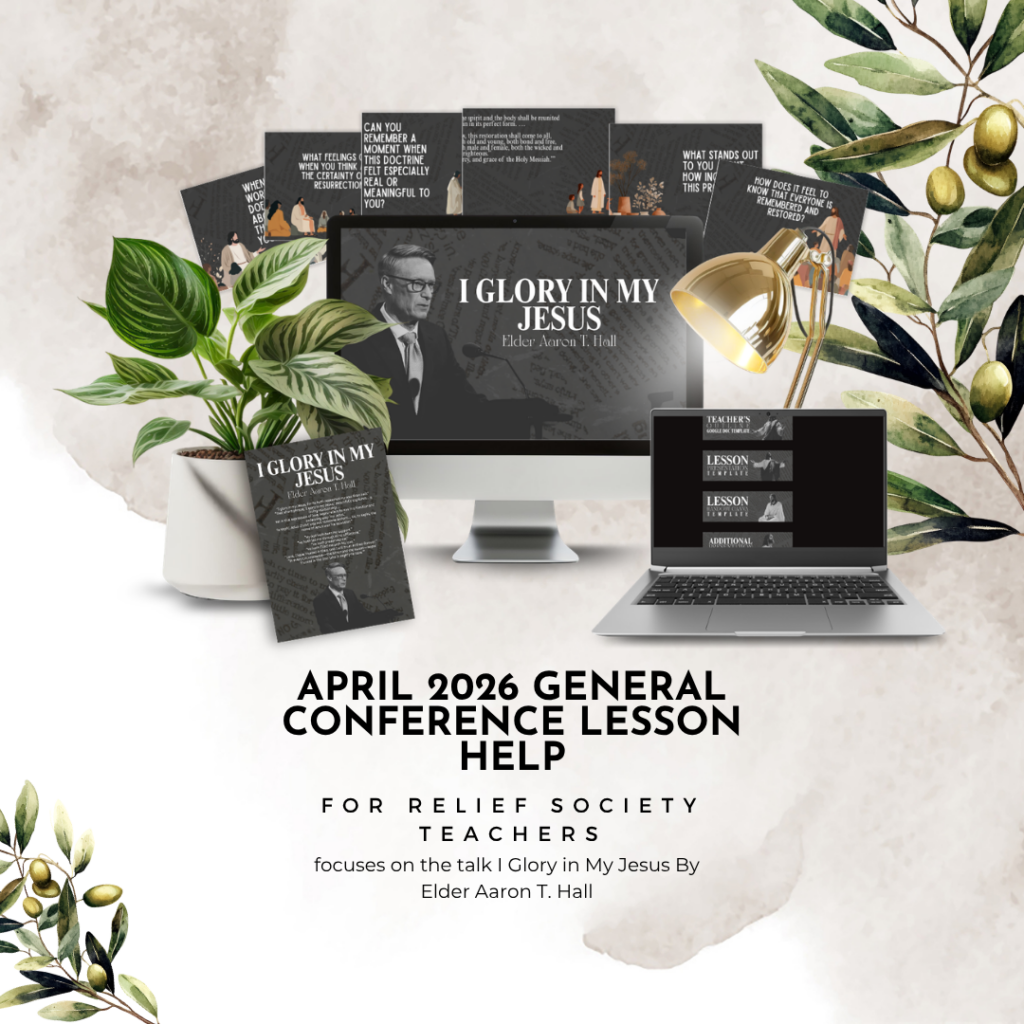
Interested in a done-for-you lesson plan with a teacher’s outline Google Doc, Canva Presentation Template, Lesson Handout Template, and themed presentation backgrounds? Click here: https://i-glory-in-my-jesus-by-elder-aaron-t-hall.teachery.co/payment?preview=true
Section 1: “I Glory in My Jesus”
Teach
Elder Hall begins with Nephi’s tender phrase: “my Jesus.” This is not distant, formal language. It shows a deeply personal relationship with the Savior.
Direct Quotes from the Talk
“As the Book of Mormon prophet Nephi concludes his teaching, he bears this powerful witness: ‘I glory in plainness; I glory in truth; I glory in my Jesus, for he hath redeemed my soul from hell.’
“That short phrase, ‘I glory in my Jesus,’ beautifully captures Nephi’s loving relationship with the Son of God, the Messiah, the Redeemer. In the books of 1 and 2 Nephi, there are over 60 different names for Jesus Christ. Each name reveals something of His majesty, His character, and His mission as the Savior of the world. Yet in this expression of love, Nephi refers to Him in a familiar and endearing way: ‘my Jesus.’”
“To Nephi, Jesus Christ was not someone distant or merely known by name. No, to Nephi, the name of Jesus was his salvation.”
Discussion Questions
- What stands out to you about Nephi saying “my Jesus”?
- Why does personal language matter when we talk about the Savior?
- How is knowing Jesus by name different from knowing Him personally?
- What does it mean to glory in Jesus Christ?
- Why do you think Elder Hall emphasizes Nephi’s relationship with Christ?
- How has Jesus Christ become more personal to you over time?
- What name or title of Jesus Christ feels especially meaningful to you?
- Why is it important that Nephi connected glorying in Christ with redemption?
- How can we help others see Jesus as personal and near?
- What would change if we felt more comfortable saying “my Jesus”?
Object Lessons
- Write several names of Christ on cards and invite sisters to choose one that feels personal.
- Use a name tag that says “My Jesus” to discuss personal relationship.
- Show a family photo to illustrate the difference between knowing about someone and truly knowing them.
- Use a heart with the Savior’s name written inside it.
- Display a list of Christ’s titles and discuss how each reveals part of His character.
Personal Sharing Prompts
- Share a name of Christ that has become personal to you.
- Describe a time when Jesus Christ felt near rather than distant.
- Share how your relationship with Him has changed.
- Talk about what “my Jesus” means to your heart.
- Share how the Savior has redeemed you.
- Describe when His name brought you peace.
- Share a moment when you felt His love personally.
- Talk about how you came to know Him better.
- Share why you glory in Him.
- Describe what you want your relationship with Jesus Christ to become.
Section 2: Trusting Jesus in the Bitter and the Sweet
Teach
Elder Hall explains that Nephi’s relationship with Christ deepened through both trials and deliverance. Nephi gloried in Jesus because he had experienced the Savior’s support, preservation, love, and saving power.
Direct Quotes from the Talk
“As Nephi experienced trials and the joy of deliverance, the name of Jesus Christ became even more personal to him.
“Nephi came to know that ‘there is none other way nor name given under heaven whereby man can be saved in the kingdom of God.’ The name of Jesus Christ was Nephi’s redemption, and he gloried in it.”
“Reflecting on his afflictions, temptations, and weakness, Nephi shares why he glories in Jesus Christ. He writes:
‘My God hath been my support.’
‘He hath led me through mine afflictions.’
‘He hath preserved me.’
‘He hath filled me with his love.’
We then read Nephi’s firm declaration: ‘Lord, I have trusted in thee, and I will trust in thee forever.’
In every circumstance—the bitter and the sweet—Nephi trusted in the One ‘who is mighty to save.’”
Discussion Questions
- Why do trials often make the Savior’s name more personal to us?
- Which of Nephi’s phrases speaks most to your life right now?
- What does it mean that God is our support?
- How has the Lord led you through affliction rather than simply around it?
- What does it mean to be preserved by Christ?
- How does being filled with His love help us keep going?
- Why is trust in Christ important in both bitter and sweet seasons?
- How can we develop the kind of trust Nephi expressed?
- What experiences have taught you that Christ is mighty to save?
- How can we glory in Christ even before deliverance fully comes?
Object Lessons
- Use a walking stick to symbolize support through affliction.
- Show a map with a path through mountains to represent being led through trials.
- Use a life preserver to represent Christ preserving us.
- Pour water into a cup until full to symbolize being filled with His love.
- Place two bowls labeled “bitter” and “sweet” beside a picture of Christ.
Personal Sharing Prompts
- Share a time God was your support.
- Describe how He led you through affliction.
- Share a moment when you felt preserved by Christ.
- Talk about a time His love filled you.
- Share how your trust in Jesus has grown.
- Describe a bitter experience where Christ became more personal.
- Share a sweet experience where you felt grateful for Him.
- Talk about how Jesus saved you in a way only He could.
- Share a phrase from Nephi that feels like your testimony.
- Describe how you can trust Him forever.
Section 3: “Who Can Glory Too Much in the Lord?”
Teach
Elder Hall then turns to Ammon, whose life shows the redemptive power of Jesus Christ. Ammon once walked a path of rebellion, but through Christ, he became filled with joy and praise.
Direct Quotes from the Talk
“Nephi was not alone in his desire to glory in the Lord. The mighty Book of Mormon missionary Ammon, who had once walked a path of rebellion and sin, also experienced the joy of the redemptive power of Jesus Christ.”
“Reflecting on the Lord’s mercy, he joyfully declared: ‘Therefore, let us glory, yea, we will glory in the Lord; yea, we will rejoice, for our joy is full; yea, we will praise our God forever. Behold, who can glory too much in the Lord? Yea, who can say too much of his great power, and of his mercy, and of his long-suffering towards the children of men? Behold, I say unto you, I cannot say the smallest part which I feel.’”
“I too can scarcely express the smallest part of that which I feel for my Jesus: our Savior, our King of kings, and our Prince of Peace.”
Discussion Questions
- Why is Ammon’s testimony so powerful considering his past?
- What does his joy teach us about repentance and redemption?
- Why do you think he asks, “Who can glory too much in the Lord?”
- How does mercy lead to praise?
- What does it mean to have joy that is full?
- Why is it sometimes hard to express what we feel about Jesus Christ?
- How does long-suffering reveal the Savior’s character?
- What does Ammon teach us about spiritual enthusiasm?
- How can we speak more openly and naturally of Christ?
- What makes you want to glory in the Lord?
Object Lessons
- Use an empty cup being filled to overflowing to symbolize full joy.
- Show a before-and-after path to represent redemption.
- Use a microphone or testimony card to represent praising God.
- Bring a small crown to symbolize Christ as King of kings.
- Use a peace sign or calm water image to discuss Christ as Prince of Peace.
Personal Sharing Prompts
- Share a time mercy filled you with joy.
- Describe how repentance changed your relationship with Christ.
- Share why you glory in the Lord.
- Talk about a time you could not fully express what you felt spiritually.
- Share how Christ’s patience has blessed you.
- Describe what full joy in Christ feels like.
- Share how the Savior redeemed a part of your life.
- Talk about a moment you felt deep gratitude for Him.
- Share a title of Christ that makes you want to praise Him.
- Describe what you would say if asked, “Who can glory too much in the Lord?”
Section 4: Glorying in Our Redeemer and Good Shepherd
Teach
Elder Hall begins listing specific ways he glories in Jesus Christ. First, he glories in Christ as Redeemer and Good Shepherd. These titles teach that Christ receives the repentant, forgives, gathers, rescues, and brings us home.
Direct Quotes from the Talk
“Today I glory in our Redeemer. His arms of mercy are extended toward us. He sends an invitation to all, saying, ‘Repent, and I will receive you.’ We are engraved upon the palms of His hands. I rejoice in the gift of repentance and the promise of forgiveness.
“I glory in our Good Shepherd. He calls to us, gathers us, rescues us, and fills us with His love. I rejoice that we are His sheep and that He relentlessly works to bring us safely home.”
Discussion Questions
- What does Redeemer mean to you personally?
- How does it feel to picture the Savior’s arms of mercy extended toward you?
- Why is repentance a gift rather than a punishment?
- What does it mean to be engraved upon the palms of His hands?
- How does the Good Shepherd gather and rescue us?
- Why is it comforting that He “relentlessly” works to bring us home?
- What helps you hear the Shepherd’s voice?
- How has forgiveness changed your life?
- What does being one of His sheep teach you about belonging?
- Which title speaks more to you right now: Redeemer or Good Shepherd?
Object Lessons
- Use a shepherd’s staff or image of sheep to discuss gathering.
- Trace hands on paper and write names in the palms.
- Show open arms to symbolize mercy.
- Use a “lost and found” box to represent rescue.
- Bring a small gift box labeled “repentance.”
Personal Sharing Prompts
- Share how Christ has redeemed you.
- Describe a time repentance felt like a gift.
- Share how the Savior gathered you when you felt lost.
- Talk about how forgiveness changed your heart.
- Share what it means to be engraved on His palms.
- Describe how you hear the Good Shepherd’s voice.
- Share a time you felt rescued.
- Talk about how He has filled you with love.
- Share why you trust Him to bring you home.
- Describe how these titles deepen your love for Him.
Section 5: Glorying in Our Healer and Advocate
Teach
Elder Hall next glories in Christ as Healer and Advocate. These names show both tenderness and power. Jesus understands every pain and pleads our cause before the Father.
Direct Quotes from the Talk
“I glory in our Healer. He can heal all who feel the sting of death, loneliness, physical and emotional pain, the burden of sin, and every broken heart. He has perfect empathy. He weeps with us, and He invites us to be still. I rejoice that the Son of God heals us one by one and encircles us in the arms of His love.”
“I glory in our Advocate. He lovingly pleads our cause before the Father, saying, ‘Father, spare these my brethren that believe on my name, that they may come unto me and have everlasting life.’ I rejoice that Jesus Christ’s atoning sacrifice satisfied the demands of justice and that He has claimed the rights of mercy for us all.”
Discussion Questions
- Which kind of healing listed by Elder Hall feels most meaningful to you?
- What does perfect empathy mean?
- How does it change your view of Christ to know He weeps with us?
- Why is “be still” sometimes hard to receive?
- What does one-by-one healing teach about the Savior?
- What does it mean that Christ pleads our cause?
- How does the Advocate title help us understand mercy and justice?
- Why is it powerful that Christ has claimed the rights of mercy?
- How have you felt encircled in His love?
- Which title feels most comforting right now: Healer or Advocate?
Object Lessons
- Use a bandage or first-aid kit to symbolize healing.
- Wrap a blanket around someone’s shoulders to represent being encircled in love.
- Use a courtroom image to discuss Christ as Advocate.
- Show a balance scale labeled justice and mercy.
- Use a quiet “be still” sign or calm water image.
Personal Sharing Prompts
- Share a time Christ healed your heart.
- Describe how He has helped you with loneliness or grief.
- Share a moment when you felt He understood perfectly.
- Talk about a time stillness helped you feel Him.
- Share how the Savior has healed you one by one.
- Describe what it means that He pleads for you.
- Share how mercy has blessed your life.
- Talk about a time you felt encircled in His love.
- Share how Christ helped you with emotional or spiritual pain.
- Describe why you glory in Him as Healer or Advocate.
Section 6: Glorying in Our Lawgiver and Deliverer
Teach
Elder Hall continues by glorying in Christ as Lawgiver and Deliverer. These titles remind us that commandments and covenants are not burdensome restrictions; they are divine gifts that guide, protect, transform, save, exalt, and deliver.
Direct Quotes from the Talk
“I glory in our Lawgiver. His commandments guide and protect us. His covenants bind us to Him—so He can ‘transform, save, and exalt’ all who choose Him. I rejoice that He stands at the head of His restored, true, and living Church and that His laws help us experience heaven on earth.
“I glory in our Deliverer. He has overcome the monsters of physical and spiritual death. No challenge in mortality lies beyond His matchless power. I rejoice that He can deliver us from pains, afflictions, and temptations of every kind.”
Discussion Questions
- Why is it meaningful to glory in Christ as Lawgiver?
- How do commandments guide and protect us?
- What does it mean that covenants bind us to Him?
- How have laws helped you experience heaven on earth?
- What does Christ deliver us from?
- Why does Elder Hall call physical and spiritual death “monsters”?
- How does Christ’s matchless power give hope in impossible challenges?
- How can we teach commandments as protection rather than restriction?
- What challenge in mortality do you need to remember is not beyond Him?
- Which title strengthens you most right now: Lawgiver or Deliverer?
Object Lessons
- Use a guardrail or road sign to symbolize commandments.
- Tie a ribbon around a wrist to represent covenants binding us to Christ.
- Show a key unlocking chains to represent deliverance.
- Use a shield to symbolize protection.
- Draw two “monsters” labeled physical death and spiritual death, then place Christ above them.
Personal Sharing Prompts
- Share how a commandment protected you.
- Describe a covenant that has bound you closer to Christ.
- Share how His laws have brought peace to your home.
- Talk about a time Christ delivered you.
- Share a challenge where you needed His matchless power.
- Describe how your view of commandments has changed.
- Share how covenants have transformed you.
- Talk about what deliverance means in your life.
- Share how Christ has helped you resist temptation.
- Describe why you glory in Him as Lawgiver or Deliverer.
Section 7: Divine Names Can Restore Peace to Our Souls
Teach
Elder Hall then invites us to reflect on the names of Jesus Christ, especially when life feels unfair or hard. The names of Christ are not just beautiful titles; they reveal His power and help us draw near to Him.
Direct Quotes from the Talk
“Brothers and sisters, what names of Jesus Christ help you glory in Him? Perhaps Master, Counselor, or Friend?
“When life feels infuriatingly unfair and finding the strength to glory in the Lord seems difficult, reflect on the meaning of His divine names and let Him restore peace to your soul.”
“With perfect understanding of our mortal experience, Jesus Christ lovingly extends this promise: ‘Draw near unto me and I will draw near unto you; seek me diligently and ye shall find me.’ To help us draw near to Him, He invites us to learn of Him, listen to His words, and walk with Him.”
Discussion Questions
- What name of Jesus Christ helps you glory in Him?
- Why can reflecting on His names restore peace?
- What title of Christ has helped you during unfairness?
- What does it mean to draw near unto Him?
- How does learning of Him help us find Him?
- What does it look like to listen to His words?
- How do we walk with Him in ordinary life?
- Why is it sometimes hard to glory in the Lord during unfair seasons?
- How does His perfect understanding bring comfort?
- What name of Christ do you want to study more deeply?
Object Lessons
- Create a “names of Christ” board and invite sisters to add titles.
- Place different names of Christ in a jar and draw one for discussion.
- Use a peace-filled image with a Savior title written over it.
- Show a dictionary or scripture guide entry for names of Christ.
- Use footprints to represent walking with Him.
Personal Sharing Prompts
- Share a name of Christ that restored peace to you.
- Describe a time life felt unfair and the Savior helped.
- Share how learning of Christ has changed your relationship with Him.
- Talk about how you listen to His words.
- Share what walking with Him means to you.
- Describe a time you drew near and felt Him draw near.
- Share a title of Christ you want to understand better.
- Talk about how divine names can deepen testimony.
- Share how Christ brought peace to your soul.
- Describe which name of Jesus feels personal right now.
Section 8: Covenant Relationship Gives Us Access to His Power
Teach
Elder Hall teaches that the Savior invites us into a covenant relationship where we can receive direct access to His power and an extra measure of His love and mercy. This connects glorying in Christ with covenant discipleship.
Direct Quotes from the Talk
“To help us find Him, He invites us into a covenant relationship where we can receive direct access to His power and ‘an extra measure of [His] love and mercy.’
“In moments of joy and in our trials, let us be faithful, obey His commandments, honor our covenants, and patiently wait on the Lord.”
Discussion Questions
- What does it mean to have direct access to Christ’s power?
- How do covenants help us find Him?
- What does “an extra measure of His love and mercy” mean to you?
- Why are both joy and trials mentioned here?
- What does it mean to patiently wait on the Lord?
- How do faithfulness, obedience, and covenant keeping help us glory in Christ?
- When have covenants strengthened you in a trial?
- Why is waiting often part of covenant discipleship?
- How can we honor covenants in quiet, daily ways?
- What covenant blessing makes you glory in Jesus Christ?
Object Lessons
- Use a power cord plugged into an outlet to represent access to power.
- Show a covenant path with stepping stones.
- Use a measuring cup filled extra-full to symbolize an extra measure.
- Tie two objects together to represent covenant relationship.
- Use a waiting room sign to discuss patiently waiting on the Lord.
Personal Sharing Prompts
- Share how covenants have given you access to Christ’s power.
- Describe a time you felt an extra measure of mercy.
- Share how waiting on the Lord strengthened you.
- Talk about a covenant that helps you feel close to Him.
- Share how obedience has deepened your joy.
- Describe how you honor covenants in daily life.
- Share a trial where covenant power carried you.
- Talk about how Christ’s love felt greater during difficulty.
- Share what faithfulness means in your current season.
- Describe how covenant relationship helps you glory in Him.
Section 9: Jesus Christ Did All of This Because He Loves Us
Teach
Elder Hall closes with prophetic testimony and his own joyful witness. The Savior overcame death, made repentance possible, and experienced all mortal pains and infirmities because He loves all of God’s children.
Direct Quotes from the Talk
“Our beloved prophet, President Dallin H. Oaks, beautifully testified why we can all glory in Jesus Christ. He taught: ‘As part of the Father’s plan, the Resurrection of Jesus Christ overcame death to assure each of us immortality. Jesus Christ’s atoning sacrifice gives each of us the opportunity to repent of our sins and return clean to our heavenly home. … And our Savior willingly experienced all mortal pains and infirmities that He would know how to strengthen us in our afflictions. Jesus Christ did all of this because He loves all of the children of God.’”
“Brothers and sisters, ‘Who can glory too much in the Lord?’! I joyfully testify that God is our loving Heavenly Father and that Jesus is the resurrected and living Christ. On this Easter Sunday and always, I invite us to glory in Jesus Christ. He is my Jesus and yours.”
Discussion Questions
- Why can we all glory in Jesus Christ?
- How does the Resurrection help you glory in Him?
- How does repentance help you glory in Him?
- How does knowing He experienced all mortal pains strengthen your trust?
- What does it mean that He did all of this because He loves God’s children?
- Why is it powerful that Elder Hall ends with “my Jesus and yours”?
- How can we glory in Christ on Easter Sunday and always?
- What part of the Savior’s mission fills you with the most gratitude?
- How does prophetic testimony strengthen your own?
- What is one way you want to glory in Jesus Christ more openly?
Object Lessons
- Use three cards labeled Resurrection, Repentance, Strength in Affliction.
- Show an empty tomb image to represent the living Christ.
- Place a heart over the words “He did all of this.”
- Use a home image to discuss returning clean to our heavenly home.
- End with a testimony card that says “He is my Jesus and yours.”
Personal Sharing Prompts
- Share your testimony of the resurrected Christ.
- Describe how repentance has helped you feel clean.
- Share how Jesus has strengthened you in affliction.
- Talk about how you know He loves you.
- Share what makes you want to glory in Him.
- Describe a time prophetic testimony strengthened your faith.
- Share how Easter changes your view of Jesus Christ.
- Talk about what “my Jesus and yours” means to you.
- Share a blessing you have received because He lives.
- Describe how you want to rejoice in Christ moving forward.
Conclusion
Elder Hall’s talk is a beautiful reminder that discipleship is not only about believing in Jesus Christ, but rejoicing in Him. Nephi gloried in “my Jesus” because Christ had redeemed, supported, led, preserved, and filled him with love. Ammon gloried in the Lord because he had tasted the joy of mercy. Elder Hall invites us to do the same by reflecting on the names and roles of Jesus Christ that have become personal to us.
A lesson help like this gives teachers a strong framework so they can focus on guiding a Spirit-led discussion. With the sections, quotes, questions, object lessons, and sharing prompts prepared, you can choose the parts of the talk that best fit your Relief Society and invite sisters to share their own witnesses of the Savior.
This talk can help sisters remember that Jesus Christ is not distant. He is Redeemer, Shepherd, Healer, Advocate, Lawgiver, Deliverer, Friend, and more. He is “my Jesus and yours.” As sisters reflect on His names and what He has done for them, they can leave class not only knowing more about Him, but feeling a deeper desire to glory in Him.