Introduction
Elder Chi Hong (Sam) Wong’s talk “Remember, Remember” is a beautifully structured message centered on one repeated invitation: to remember the Savior. Through five powerful “remember, remember” passages in the Book of Mormon, he teaches that remembering is not passive—it is active, covenantal, and transformative.
This lesson help is designed to help you teach this talk with depth and clarity. The message is broken into chronological discussion sections that follow the speaker’s natural progression. Each section includes longer, direct quotes from the talk, discussion questions, object lessons, and personal sharing prompts to encourage meaningful Relief Society conversation.
One of the greatest blessings of a lesson help like this is that it allows you to focus less on organizing content and more on ministering to the sisters in your class. With structure already in place, you can prayerfully select what will best invite the Spirit and help sisters reflect, share, and draw closer to Jesus Christ.

Grab our free bundle of 50+ Presentation Backgrounds by clicking here: https://otherthanamom.myflodesk.com/freebackgrounds
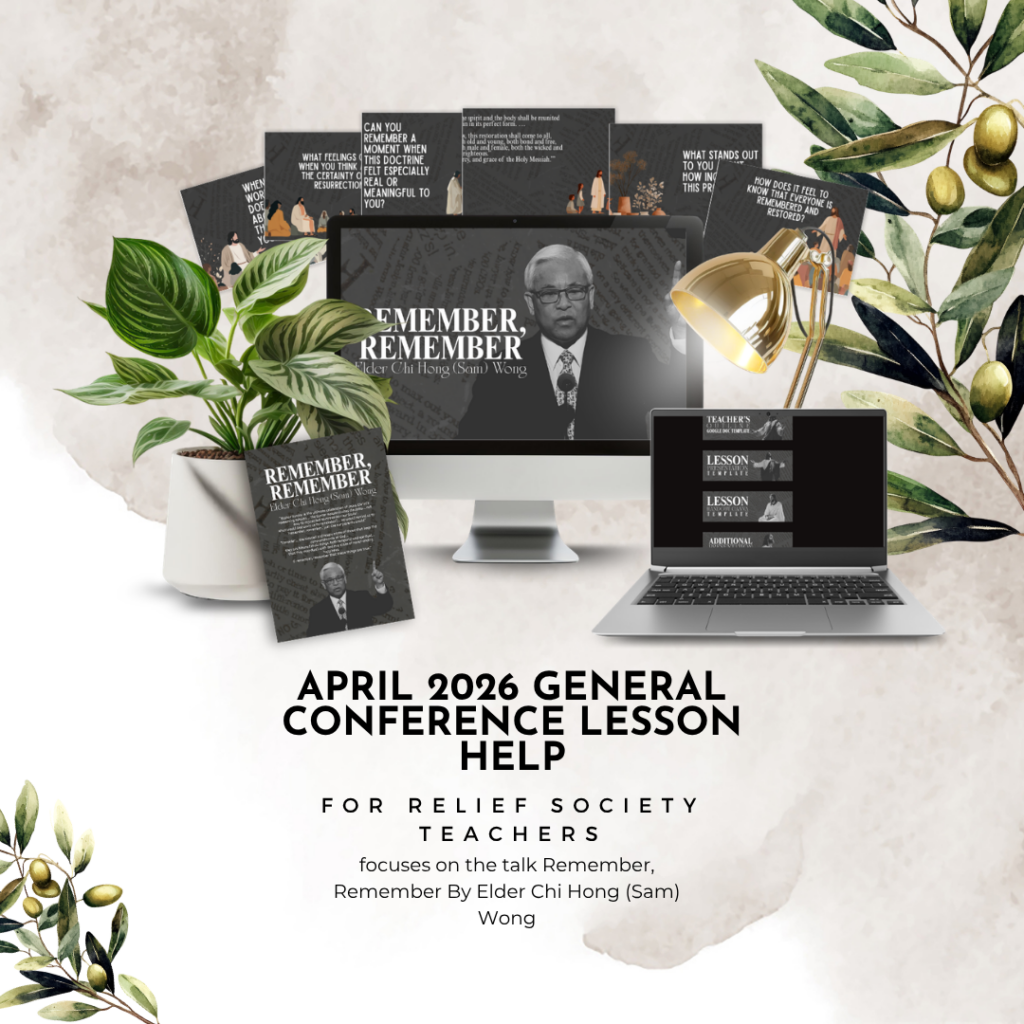
Interested in a done-for-you lesson plan with a teacher’s outline Google Doc, Canva Presentation Template, Lesson Handout Template, and themed presentation backgrounds? Click here: https://www.etsy.com/listing/4498257143/april-2026-general-conference-lesson?ref=listings_manager_grid
Section 1: The Invitation to Remember the Savior
Teach
Elder Wong begins by centering Easter not only as a time to rejoice, but as a time to remember. He invites us to consider how God teaches us to remember and where those reminders are found.
Direct Quotes from the Talk
“Easter Sunday is the ultimate celebration of Jesus Christ’s redeeming mission, especially His Resurrection. The Easter season invites disciples of Jesus Christ not only to rejoice but to remember our Savior.
“What would God want us to remember? How would He let us know? Where would we find His reminders? About 10 years ago, as I pondered these questions, a clear thought came to my mind: He would put His reminders in the Book of Mormon. He would remind us to ‘remember, remember,’ just like our parents would.”
Discussion Questions
- Why is remembering such a central part of discipleship?
- What is the difference between rejoicing in Christ and remembering Him?
- Why do you think God uses repetition like “remember, remember”?
- How has the Book of Mormon helped you remember the Savior?
- What are some things the Lord wants us to remember daily?
- Why do we sometimes forget spiritual truths we already know?
- How does remembering change the way we live?
- What does this section teach about God’s teaching style?
- How can we become more intentional about remembering Christ?
- What does Easter invite you to remember personally?
Object Lessons
- Use a sticky note labeled “remember” placed in visible spots.
- Show a phone reminder alert to symbolize spiritual prompting.
- Use a family photo to discuss remembering relationships.
- Write “remember, remember” on the board and repeat it aloud.
- Use a journal to represent recording and remembering spiritual experiences.
Personal Sharing Prompts
- Share a time the Lord reminded you of something important.
- Describe how you remember the Savior in daily life.
- Share a scripture that helps you remember Christ.
- Talk about a time you forgot something spiritual and had to relearn it.
- Share how Easter helps you remember Him more deeply.
- Describe a personal reminder system that strengthens your faith.
- Share how the Book of Mormon has helped you remember truth.
- Talk about what you most need to remember right now.
- Share a moment when remembering changed your choices.
- Describe how remembering Christ brings peace.
Section 2: Remember That Obedience Brings Eternal Happiness
Teach
The first “remember, remember” passage focuses on the blessings of obedience. Keeping God’s commandments leads to both temporal and spiritual blessings, and ultimately to eternal happiness with Him.
Direct Quotes from the Talk
“And moreover, I would desire that ye should consider on the blessed and happy state of those that keep the commandments of God. For behold, they are blessed in all things, both temporal and spiritual; and if they hold out faithful to the end they are received into heaven, that thereby they may dwell with God in a state of never-ending happiness. O remember, remember that these things are true; for the Lord God hath spoken it.”
“Keeping God’s commandments is a blessing, both temporal and spiritual. If we can endure to the end, we will dwell with Him in a state of never-ending happiness.”
Discussion Questions
- What does “never-ending happiness” mean to you?
- Why are commandments described as blessings rather than burdens?
- How have you seen both temporal and spiritual blessings from obedience?
- What does it mean to “hold out faithful to the end”?
- Why is it important to remember that these promises are true?
- How does this doctrine change the way we view sacrifice?
- What blessings of obedience have surprised you?
- Why is eternal happiness connected to daily choices?
- How can we help others see commandments as gifts?
- What does this section teach about God’s intentions for us?
Object Lessons
- Use a path leading to a destination labeled “eternal happiness.”
- Show two containers: one labeled “temporary” and one “eternal.”
- Use a chain of paper links representing consistent obedience.
- Display a gift box labeled “commandments.”
- Use a compass pointing toward “home” (Heavenly Father).
Personal Sharing Prompts
- Share a blessing you’ve received from obedience.
- Describe how commandments have brought you peace.
- Share a time obedience felt hard but became a blessing.
- Talk about what eternal happiness means to you.
- Share how you’ve seen God’s promises fulfilled.
- Describe how your perspective on commandments has changed.
- Share how you stay faithful over time.
- Talk about a small act of obedience that mattered.
- Share how obedience has strengthened your testimony.
- Describe a time you felt guided by keeping commandments.
Section 3: Remember That Commandments Are Firm and Protective
Teach
The second reminder teaches that God’s commandments are strict, not to restrict us, but to guide and protect us. Elder Wong uses President Oaks’s kite analogy to illustrate how commandments anchor us.
Direct Quotes from the Talk
“O remember, remember, my son Helaman, how strict are the commandments of God. And he said: If ye will keep my commandments ye shall prosper in the land—but if ye keep not his commandments ye shall be cut off from his presence.”
“God reminds us that His commandments are firm and that obedience to them brings promised blessings.”
“If we lose our hold on the string, the kite will not rise higher. It will be carried about by these winds and inevitably crash to the earth.”
Discussion Questions
- Why are God’s commandments described as strict?
- How do commandments protect rather than limit us?
- What does the kite analogy teach about freedom?
- What happens spiritually when we “cut the string”?
- Why is it important to stay anchored in truth?
- How do commandments steady us in life’s winds?
- What does it mean to prosper spiritually?
- Why do people sometimes resist commandments?
- How can we better trust God’s guidance?
- What experiences have shown you commandments are protective?
Object Lessons
- Use a kite and string to demonstrate stability.
- Hold a balloon on a string vs. letting it go.
- Show a guardrail protecting from a cliff.
- Use a seatbelt as a symbol of protective boundaries.
- Demonstrate wind pushing an unanchored object.
Personal Sharing Prompts
- Share a time a commandment protected you.
- Describe how obedience brought stability in your life.
- Share what helped you trust God’s standards.
- Talk about a time you saw consequences of letting go.
- Share how commandments guide your decisions.
- Describe a moment you felt spiritually anchored.
- Share how you explain commandments to others.
- Talk about a time you felt God’s protection.
- Share how obedience has brought clarity.
- Describe how you stay grounded in truth.
Section 4: Remember That Jesus Christ Is the Only Way
Teach
The third reminder centers everything on Jesus Christ. He is the only source of redemption, resurrection, and eternal life.
Direct Quotes from the Talk
“O remember, remember… that there is no other way nor means whereby man can be saved, only through the atoning blood of Jesus Christ.”
“Jesus Christ stands at the very heart of God’s plan of salvation and exaltation. Every promise of redemption, every hope of resurrection, and every assurance of eternal life flows through Him. Without Jesus Christ, there is no salvation, no victory over sin and death, and no path back to our Heavenly Father.”
Discussion Questions
- Why is it important to remember that Christ is the only way?
- What does it mean that every promise flows through Him?
- How does this doctrine strengthen your faith?
- Why is the Atonement central to everything?
- How can we keep Christ at the center of our lives?
- What does “no other way” teach about humility?
- How does this truth affect repentance?
- Why do we sometimes try to rely on ourselves instead of Christ?
- How does remembering Christ change our daily priorities?
- What does this section teach about the plan of salvation?
Object Lessons
- Use a single path leading to a destination.
- Show a bridge over a gap labeled “Christ.”
- Use a hub-and-spokes diagram with Christ in the center.
- Display a cross and empty tomb image.
- Use a doorway labeled “Jesus Christ.”
Personal Sharing Prompts
- Share how the Savior has redeemed you.
- Describe a time Christ became central in your life.
- Share how the Atonement has changed you.
- Talk about your testimony of Jesus Christ.
- Share how Christ brings hope.
- Describe how you rely on Him daily.
- Share a time you felt His power.
- Talk about what it means to come unto Christ.
- Share how Christ has guided your path.
- Describe your relationship with the Savior.
Section 5: Remember to Build on the Rock of Christ
Teach
The fourth reminder teaches that Christ is our foundation. When we build on Him, we cannot fall—even in storms.
Direct Quotes from the Talk
“And now… remember, remember that it is upon the rock of our Redeemer… that ye must build your foundation… that when all his hail and his mighty storm shall beat upon you, it shall have no power over you… because of the rock upon which ye are built.”
“Every time we faithfully receive, review, remember, and renew sacred covenants, our spiritual anchors are secured ever more firmly… to the ‘rock’ of Jesus Christ.”
Discussion Questions
- What does it mean to build on Christ?
- What storms have tested your foundation?
- How do covenants anchor us to Christ?
- Why is a strong foundation essential?
- What weak foundations do people sometimes build on?
- How does remembering strengthen our foundation?
- Why do storms reveal what we are built on?
- What does it mean that we “cannot fall”?
- How do we strengthen our foundation daily?
- What helps you stay rooted in Christ?
Object Lessons
- Build two small structures—one on sand, one on rock.
- Use a large rock labeled “Christ.”
- Show anchor imagery.
- Use a storm sound to simulate pressure.
- Demonstrate stability with a weighted base.
Personal Sharing Prompts
- Share a time your foundation was tested.
- Describe how Christ has steadied you.
- Share how covenants anchor you.
- Talk about a storm that strengthened your faith.
- Share what helps you stay grounded.
- Describe a moment you felt unshaken.
- Share how scripture study strengthens your foundation.
- Talk about how you rebuild after weakness.
- Share how Christ supports you.
- Describe what it means to “not fall.”
Section 6: Remember That You Have Agency
Teach
The fifth reminder focuses on agency. We are free to choose, and our choices matter.
Direct Quotes from the Talk
“And now remember, remember… that whosoever perisheth, perisheth unto himself… for behold, ye are free; ye are permitted to act for yourselves.”
“As we understand its teachings, they begin to shape our hearts… we will be guided to discern right from wrong and empowered to use our God-given agency wisely.”
Discussion Questions
- Why is agency such a sacred gift?
- What does it mean that we are free to act?
- How do our choices shape our lives?
- Why is accountability important?
- How does the Book of Mormon guide our choices?
- What helps us choose wisely?
- How does Christ strengthen our agency?
- Why do choices have eternal consequences?
- How can we teach agency to others?
- What does wise agency look like?
Object Lessons
- Use a fork in the road.
- Show two labeled choices.
- Use a scale to weigh decisions.
- Display a decision tree.
- Use a steering wheel analogy.
Personal Sharing Prompts
- Share a choice that changed your life.
- Describe how you learned to choose wisely.
- Share how agency has blessed you.
- Talk about a difficult decision.
- Share how the Spirit guided a choice.
- Describe a time you saw consequences clearly.
- Share how Christ helped you choose better.
- Talk about teaching agency to your children.
- Share how you discern right from wrong.
- Describe what agency means to you.
Section 7: Remember the Savior and Come Unto Him
Teach
Elder Wong concludes by inviting us to remember the Savior and act—to come unto Him, keep commandments, and prepare for His return.
Direct Quotes from the Talk
“Let us remember, remember our Savior, especially in this Easter season. He is resurrected. He wants us to come unto Him. Let us pray unitedly that we will keep His commandments, use our moral agency wisely every day, and prepare for His glorious return.”
Discussion Questions
- What does it mean to actively remember the Savior?
- Why is remembering connected to action?
- How does remembering lead us to come unto Christ?
- What daily practices help you remember Him?
- How can we prepare for His return?
- Why is the Resurrection central to this message?
- How does remembering strengthen obedience?
- What invitations do you feel from this talk?
- How can we help others remember Christ?
- What does this final invitation mean to you?
Object Lessons
- Use sacrament imagery.
- Write “remember Him” on the board.
- Show a calendar marking daily remembrance.
- Use a pathway leading to Christ.
- Display a picture of the resurrected Savior.
Personal Sharing Prompts
- Share how you remember Christ daily.
- Describe what coming unto Him looks like in your life.
- Share how Easter strengthens your testimony.
- Talk about a moment you felt close to the Savior.
- Share how remembering changes your behavior.
- Describe your relationship with Jesus Christ.
- Share what helps you stay spiritually focused.
- Talk about preparing for His return.
- Share how Christ has changed your heart.
- Describe what you will remember moving forward.
Conclusion
Elder Wong’s talk reminds us that remembering is not passive—it is powerful. When we remember the Savior, we remember His commandments, His Atonement, His role as our foundation, and our ability to choose. Remembering shapes our hearts, strengthens our faith, and guides our daily decisions.
Using a lesson help like this allows you to focus more on the sisters you teach and less on organizing the material. With clear sections, strong quotes, and meaningful prompts, you can create a lesson environment where women feel invited to reflect, share, and draw closer to Jesus Christ.
Ultimately, this talk teaches that remembering leads to becoming. As we “remember, remember” our Savior, we come unto Him more fully—and through Him, we receive every promise of redemption, resurrection, and eternal life.