Introduction
There is something powerful that happens when a General Conference lesson moves beyond surface-level discussion and into real, Spirit-led connection. President Dallin H. Oaks’s talk “Alive in Christ” gives us rich doctrine and practical application—but without intentional preparation, it can be easy to miss the depth.
This lesson help is designed to walk you through the talk in seven clear discussion sections, helping you guide meaningful conversation, invite personal reflection, and create space for the Spirit to teach.
Each section follows a simple rhythm: teach, quote, ask, and apply—so you can focus less on what to say and more on what the sisters need to feel.

Grab our free bundle of 50+ Presentation Backgrounds by clicking here: https://otherthanamom.myflodesk.com/freebackgrounds
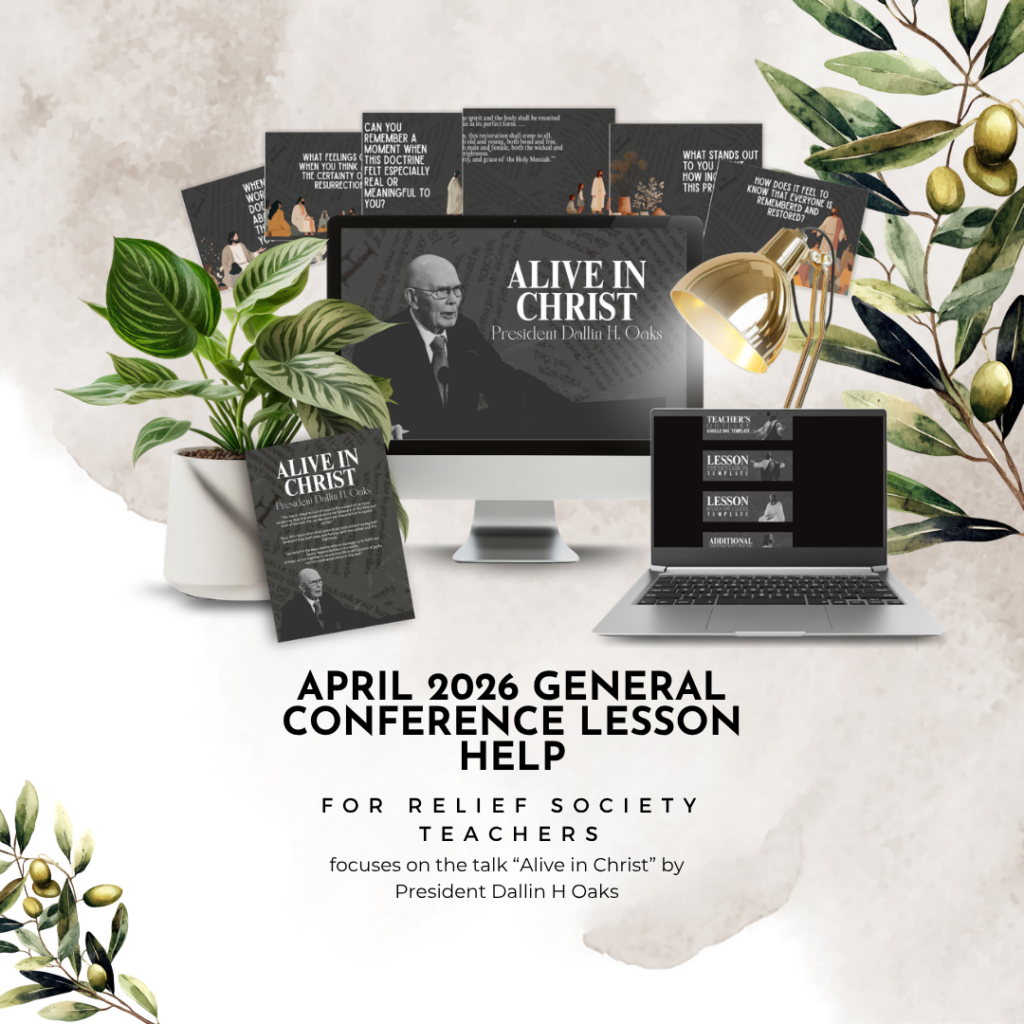
Interested in a done-for-you lesson plan with a teacher’s outline Google Doc, Canva Presentation Template, Lesson Handout Template, and themed presentation backgrounds? Click here: https://www.etsy.com/listing/4492022429/april-2026-general-conference-lesson?ref=listings_manager_grid
Section 1: The Resurrection Is a Pillar of Our Faith
Teach
President Oaks begins by grounding us in the doctrine of the Resurrection as a foundational truth that everything else builds upon.
Quote
“On this glorious Easter Sunday, I have chosen to speak first about the Resurrection, which is a pillar of our faith.
The literal Resurrection of Jesus is the subject of so many scriptures that it is settled doctrine for believers of the Bible and Book of Mormon. For us, the universal Resurrection is equally certain.”
Ask
- Why do you think President Oaks calls the Resurrection a “pillar” of our faith?
- How would your faith feel different if this doctrine were uncertain?
- What does it mean to you that the Resurrection is “settled doctrine”?
- How does this truth shape your understanding of Jesus Christ?
- Why do you think this is where he chose to begin his talk?
- How can we strengthen our personal conviction of the Resurrection?
- What role does testimony play in this doctrine?
- How do we teach this principle to others with confidence?
- What scriptures have strengthened your belief in the Resurrection?
- How has your testimony of this grown over time?
Apply
Invite sisters to reflect on how firmly rooted their belief in the Resurrection feels and what they can do to strengthen it.
Section 2: The Promise of a Universal Resurrection
Teach
The Resurrection is not just real—it is universal, inclusive, and restoring.
Quote
“The spirit and the body shall be reunited again in its perfect form. …
Now, this restoration shall come to all, both old and young, both bond and free, both male and female, both the wicked and the righteous.”
Ask
- What stands out to you about the inclusiveness of the Resurrection?
- How does it change your perspective to know that everyone will be resurrected?
- What does “perfect form” mean to you?
- How does this doctrine reflect God’s love?
- Why is it important that this applies to both the righteous and the wicked?
- How does this truth affect how we see others?
- What hope does this bring for physical or emotional struggles?
- How does this doctrine influence how we treat our bodies?
- What questions have you had about the Resurrection?
- How does this strengthen your trust in God’s plan?
Apply
Encourage sisters to consider how this doctrine brings hope in their current circumstances.
Section 3: The Resurrection Changes Our Perspective on Life
Teach
Belief in the Resurrection reshapes how we see mortality, trials, and even death.
Quote
“I wonder if we fully appreciate the enormous significance of this belief in a literal, universal resurrection. The conviction that death is not the conclusion of our identity changes the whole perspective of our mortal life.
It affects how we look on the physical challenges of mortality. It gives us the strength and perspective to endure the mortal challenges faced by each of us and by those we love. It signifies that mortal deficiencies are only temporary! It also gives us the courage to face our own death or that of loved ones—even deaths we might call premature.”
Ask
- What does it mean that death is not the end of our identity?
- How has this belief changed your perspective on trials?
- What does it look like to live with an eternal perspective?
- How can this doctrine bring peace during hardship?
- Why do you think President Oaks emphasizes “temporary”?
- How does this affect the way we handle fear?
- What experiences have strengthened your eternal perspective?
- How can we help others see their trials differently?
- How does this influence your daily priorities?
- What does this teach you about God’s plan?
Apply
Invite sisters to identify one challenge they could view differently through the lens of eternity.
Section 4: The Resurrection Strengthens Family Relationships
Teach
This doctrine doesn’t just change how we see life—it changes how we live with each other.
Quote
“Our belief in the Resurrection also encourages us to fulfill our family responsibilities in mortality. It helps us live together in love in this life in anticipation of joyful reunions and associations in the next.”
Ask
- How does the Resurrection influence family relationships?
- What does it mean to live in anticipation of joyful reunions?
- How can this perspective change the way we treat loved ones?
- How does this doctrine bring healing to family struggles?
- What does it teach about the importance of relationships?
- How can we strengthen love within our families?
- What role does forgiveness play in eternal relationships?
- How does this affect parenting?
- How does this doctrine bring comfort in loss?
- What can we do today to build eternal relationships?
Apply
Invite sisters to think of one way they can strengthen a relationship this week.
Section 5: Christ’s Commandment to Love All
Teach
President Oaks transitions into Christ’s teachings on love—expanding our understanding of who we are called to love.
Quote
“Love your enemies, bless them that curse you, do good to them that hate you, and pray for them which despitefully use you, and persecute you.
What a revolutionary teaching for personal relationships!”
“All mortals are beloved children of God.”
Ask
- Why is this commandment so challenging?
- What does loving your enemies look like in real life?
- How does this differ from natural reactions?
- What helps us love more like Christ?
- How does seeing others as children of God change things?
- What experiences have helped you grow in this?
- How can we pray for those we struggle with?
- What does Christ teach us through His example?
- How does this apply in families or communities?
- What is one step you could take toward this kind of love?
Apply
Invite sisters to think of one person they could show more Christlike love toward.
Section 6: Seeing Others Through God’s Eyes
Teach
The story shared by President Oaks illustrates a powerful transformation in how we see others.
Quote
“She described [him] as ‘the most repulsive man’ she had ever met… She despised him.
… In that moment, a profound change came over her. She felt an almost electric current of love from our Heavenly Father to this man. She saw him as a child of God.
… She testified that being brought to see a despised enemy like this as a child of God was one of the great spiritual experiences of her life.”
Ask
- What stands out most to you in this experience?
- What changed in the nurse’s perspective?
- How can we invite that kind of change in our own hearts?
- Why is it powerful to see others as children of God?
- What prevents us from seeing people this way?
- How does this story apply to everyday relationships?
- What role does the Spirit play in changing our hearts?
- How can we act on those impressions?
- What would change in your life if you saw others this way?
- How can we teach this to our families?
Apply
Invite sisters to pray for help seeing someone through God’s eyes this week.
Section 7: Becoming Peacemakers
Teach
President Oaks concludes with a call to action—to actively become peacemakers in a contentious world.
Quote
“Blessed are the peacemakers: for they shall be called the children of God.
Peacemakers! How it would change the world if followers of Christ would forgo harsh and hurtful words in all their communications.”
“My brothers and sisters, as followers of Christ, let us follow Him by forgoing contention and by using the language and methods of peacemakers.”
Ask
- What does it mean to be a peacemaker?
- Why are words so powerful in creating peace or contention?
- How can we eliminate harsh communication in our lives?
- What habits help us become peacemakers?
- How does Christ model this?
- What situations test this the most?
- How can we respond differently moving forward?
- What role does humility play?
- How does being a peacemaker connect to being a child of God?
- What is one change you feel inspired to make?
Apply
Invite sisters to choose one specific way they will bring more peace into their interactions this week.
Conclusion
When Relief Society lessons are thoughtfully prepared, they become more than discussions—they become experiences that invite the Spirit, strengthen testimonies, and build unity.
This lesson help gives you a clear, structured way to teach President Oaks’s message with confidence. Instead of wondering what to ask or how to guide conversation, you can focus on listening, connecting, and allowing the Spirit to lead.
As you teach from this talk, you are not just covering doctrine—you are helping sisters feel the power of the Resurrection, the depth of Christlike love, and the calling to become peacemakers in their homes and communities.
And that is where real transformation happens.